Its stock eviscerated, Keep faces difficult road back to fiscal fitness
The fitness company’s online paid revenue plummeted in the first half of this year, as it increasingly relies on growing sales of branded fitness products
Key Takeaways:
- Keep Inc.’s revenue grew slightly in the first half of the year, as its loss narrowed by two-thirds
- The fitness company’s fledgling AI concepts have yet to make a significant contribution to its business
By Cheng Shui Tong
It’s renowned among Chinese fitness buffs. But the latest financial report from fitness platform Keep Inc. (3650.HK) hardly portrayed a company at the peak of health.
Keep reported revenue of 825 million yuan ($124 million) for the first half of 2026, essentially flatlining from the year-ago period with just a 0.4% rise. Its bottom line was slightly more inspired, as its net loss of 12.19 million yuan represented a big improvement from its loss of 35.43 million yuan a year earlier.
Despite the bottom-line improvement, the reality is that Keep has been losing money for years. It posted a 223 million yuan loss in 2023, the year of its Hong Kong listing, and the figure more than doubled to 469 million yuan in 2024, before receding to 72 million yuan last year. Things look better after excluding non-cash expenses like share-based compensation and changes in the fair value of investments. On that basis, Keep recorded an adjusted profit of 25.22 million yuan last year, and 5.88 million yuan in the first half of 2026.
Weight-loss godfather
Its slowly improving metrics have done little to draw investors to Keep’s stock. The shares currently trade near a historic low around HK$1.70, marking a massive discount of nearly 94% compared to headier times when the company sold IPO shares for HK$28.92 in 2023. The company was riding high at that time, boosted by a post-pandemic fitness boom. Its millennial founder, Wang Ning, is also local legend for his own weight-loss story.
Born in 1990, Wang attended the Beijing Information Science and Technology University. In 2014, when he was about to graduate, he noticed his weight had crept up to 90 kilograms. Seeking to slim down, he searched for weight-loss information online and managed to shed 30 kilograms within half a year.
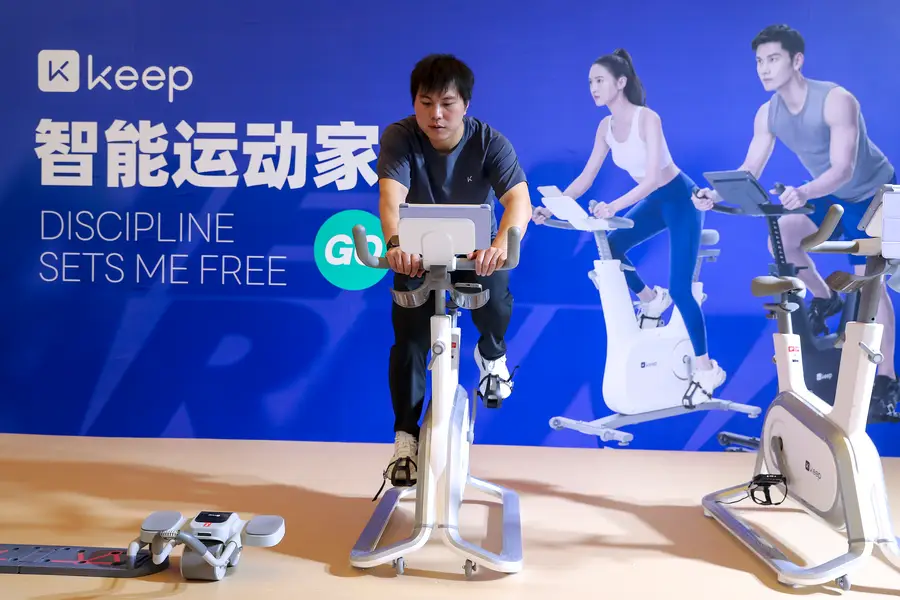
His frustration at searching across different websites, some better than others, gave him the idea of gathering a more complete set of fitness content onto a single platform. That September, he registered and established Beijing Calorie Technology, setting out to code a fitness application. He ultimately launched his Keep App the following year. With a mantra of “Self-discipline gives me freedom,” the app rapidly built brand awareness, attracting 1 million monthly active users within a year, and 10 million two years later.
Wang Ning was also quite proactive when it came to fundraising. The company completed nine financing rounds between 2014 and 2021, with participation from numerous big-name investors, including GGV Capital, SoftBank, Hillhouse and Tencent. The company submitted its first Hong Kong listing application in 2022, and finally succeeded on its third attempt with its July 2023 IPO.
Keep’s ongoing losses since its listing stem from its failure to find a business model with enduring profit potential. Its early revenue relied heavily on paid subscriptions, which helped it thrive during the pandemic when people used its materials to exercise while confined at home. Its monthly active users peaked of 36.4 million in 2022, only to later ebb with the pandemic’s end.
By the end of June this year, its average monthly active users had plummeted by half from that peak to 18.58 million, also representing a 17% drop year-on-year. But the company has been squeezing more money from each of those remaining fans, with average monthly revenue per user rising 21% to 7.4 yuan. Still, revenue from online memberships and paid content fell 26.9% year-on-year to 247 million yuan in the first half of the year.
Prioritizing quality users over quantity
The decline in Keep’s user base owes at least partly to its recent policy of prioritizing quality over quantity. Less motivated customers on the platform tend to leave, causing the average exercise time of each monthly active user to grow by 15.3% year-over-year in the latest half-year period.
While its subscriber business continues to look for steadier footing, revenue from Keep’s self-branded fitness products increased by 21.7% year-on-year in the latest period to 483 million yuan. As that happened, the segment’s proportion of the company’s total revenue rose above the 50% mark to reached 58% by the middle of this year, compared with 48% a year earlier. The gross margin for the segment also rose by 5.3 percentage points to 40.1%.
Within the fitness products category, revenue from fitness gear rose 49% during the period, accounting for more than 60% of self-branded fitness product revenue. Muscle-training products sold exceptionally well, with gross sales value (GSV) surging by 63%; GSV for yoga products grew by 33%; and GSV for body-shaping products climbed by 49%.
While Keep bills itself as an online fitness platform, its growing reliance on product sales is making it look increasingly like a fitness goods stock – an area where the company doesn’t necessarily enjoy a competitive advantage. Many others already sell into that space, such as leading sportswear stock Anta (2020.HK), whose gross margin of 62% last year, and Li Ning (2331.HK), with a gross margin of 49% during the same period, both clearly far outperform Keep.
Future growth hinges on AI
Keep’s ability to jumpstart its profit growth and boost its stock could well hinge on its development of AI-related products. In that direction, the company is emphasizing a long-term strategy geared toward an AI-driven fitness and health ecosystem. First, it rolled out Keeppace.ai, a self-developed vertical large model for fitness and health.
It also recently released the App’s 9.1 version to recruit independently paid super AI members. The latest version includes features such as AI voice running companionship and multi-dimensional data analysis. In the first half of the year, the company introduced over 8,000 AI courses. Daily average token volume use more than doubled from 8.4 billion in March 2026 to 18.5 billion in July.
In summary, investors have punished Keep’s stock since its IPO, sending it down more than 90% from its offer price, dragging down its market value from HK$16 billion to just HK$800 million now. Its improving finances seem to have set a floor under the shares for now. But AI developments that could bring some excitement back to the stock remain in preliminary stages and have yet to generate any significant revenue or profits. Accordingly, the stock could enjoy some upside as the company’s prospects improve, but is unlikely to return to its peak valuation anytime soon.
To subscribe to Bamboo Works weekly free newsletter, click here
Related Articles

RELATED ARTICLES
-
Yusheng IPO tests bumpy road for China’s used car market

- Losses, losses and more losses. How far down the road is WeRide’s profitability?
-
Creality’s 3D-printing dream faces first post-IPO test
3388.HK
-
Iluvatar earns paper profit, as its core GPU business stays stuck in the red
9903.HK
-
What robot boost? Zhaowei Machinery faces challenge as growth stumbles
2692.HK003021.SHE