Aoyuan’s asset fire sales may leave creditors holding the bag
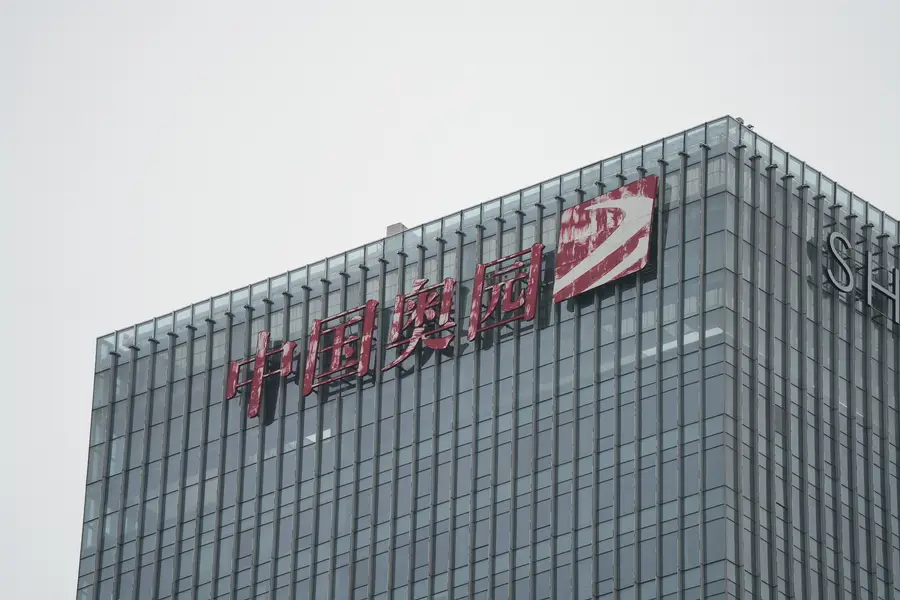
After restructuring its offshore debt in 2024, the property developer defaulted a second time this year for failing to pay interest on some of its bonds
Key Takeaways:
- Aoyuan defaulted on one of its bonds in March, as its revenue continued to decline in the first half of this year
- The property developer reorganized its offshore debt in 2024, but now its capital gearing ratio has soared again to 404%
By Cheng Shui Tong
Debt restructuring has become the new mantra for China’s property developers, most weighed down with obligations they can never repay in their current state. But as the market continues to worsen, even that may not be enough to keep the lights on for some of the hardest hit companies still struggling to survive.
One of those is China Aoyuan Group Ltd. (3883.HK), which once made its name as builder of a series of Olympic Garden developments that were some of the earliest modern-style housing in China. But the only thing Olympiad about the company these days is its marathon of defaults. One of its Hong Kong commercial properties was recently seized by creditors and sold for a rock-bottom price more than 80% below its original purchase price.
Aoyuan announced earlier this month that the property, located on Kwok Shui Road in Hong Kong’s Kwai Chung district, was purchased for HK$950 million ($122 million) in 2018. However, after it failed to make mortgage payments, lender Hang Seng Bank foreclosed on the property this July. It was ultimately sold for HK$150 million to Ocean One Holding Ltd., a seafood importer.
Proceeds from that and other fire sales are merely a drop in the bucket compared to Aoyuan’s massive debt of over 100 billion yuan ($14.9 billion), underscoring the huge financial pressure the company faces. In March, it defaulted again on some of its publicly held debt after failing to pay interest on three U.S. dollar notes maturing in 2029, 2030, and 2031.
Property plus sports
Like most of its peers, Aoyuan’s predicament stems from rapid expansion using borrowed money on an assumption that China’s property market would boom indefinitely. After entering China’s then-fledgling property market in 1996, founder Guo Ziwen seized on a nationwide sports craze and began integrating development with sports three years later in partnership with the state-owned China Sport Industry Group.
Their first joint project was the Guangzhou Olympic Garden, which received a personal congratulatory inscription from then-International Olympic Committee President Juan Antonio Samaranch. That ringing endorsement helped the project’s launch in 2000 become a citywide sensation, with buyers lining up to purchase homes. Aoyuan went on to replicate the model in other cities, and Guo was named one of the 10 most influential figures in China’s real estate industry in 2001.
Aoyuan went public in Hong Kong in 2007, and quickly adopted an aggressive expansion strategy characterized by high leverage and rapid asset turnover. It joined the ranks of real estate developers with over 100 billion yuan in annual sales in 2019, and a year later its sales peaked at 133 billion yuan, as its market capitalization topped HK$30 billion.
But all that began to change after China rolled out policies in August 2020 to rein in debt-fueled development, kicking off a downturn that sent prices steadily downward and sharply slowed new development.
As the downturn lingered, Aoyuan and many of its peers began to default on their financial obligations. Aoyuan successfully restructured its offshore bonds in early 2024 through a mixture of extending some old debt, converting some into new notes, and issuing up to 1.4 billion ordinary shares to settle a portion of its obligations. In September that year, Guo also sold 16.5% of Aoyuan to Multi Gold, a UAE-based investment entity.
But life post-restructuring has hardly been easy, as Aoyuan’s operations continue to struggle in sync with the ailing property market. Despite booking a 26.16 billion yuan gain from debt restructuring in 2024, the company recorded a mere 35.03 million yuan in full-year profit that year. Without that paper gain, the company’s core business continued to backslide, with revenue plunging 65% during the year to 9.68 billion yuan.
Revenue contracted by another 4.3% last year to 9.26 billion yuan, and the company swung back to the red with an annual net loss of 17.76 billion yuan. Its revenue fell another 17% in the first half of this year to 3.7 billion yuan from a year earlier, while its net loss narrowed by 28.9% to 6.27 billion yuan.
Surging debt ratio
The bottom line is that Aoyuan’s finances remain under severe pressure. The company reported total assets of approximately 118.13 billion yuan at the end of June against total liabilities of about 170.27 billion yuan, pushing it into insolvency. Its cash and bank deposits totaled a paltry 208 million yuan, while restricted bank deposits added another 1.14 billion yuan. But its debt maturing within 12 months approached a staggering 70 billion yuan. And its capital gearing ratio surged from about 288% at the end of 2025 to 404% by midway through this year.
Beijing has been trying to revive the market, most recently offering direct interest rate subsidies for first time home and commercial property buyers earlier this month. But none of those efforts have provided much relief. And even as market sentiment shows some small signs of improving, buyers tend to favor the largest developers, leaving smaller ones like Aoyuan less likely to benefit until a broader recovery takes hold.
Weak cash generation
Adding to its woes, Aoyuan’s tight finances leave it with no capital to replenish its land bank for future projects, leaving limited room for growth when the market finally bottoms. With over 90% of its revenue from property sales and lacking stable rental income, its chances of staging a turnaround look increasingly slim.
Debt restructuring for Chinese property developers invariably involves significant reductions in principal amounts owed, debt extensions, swapping old debt for new, and debt-for-equity swaps. But such measures just buy time while everyone hopes for a rebound. If that fails to happen, debt restructuring just kicks the can down the road, setting the stage for new defaults when big interest payments come due.
In such an environment, debt-for-equity swaps that have become popular among developers are losing any remaining appeal they once held, since many companies’ shares have become penny stocks. That means that creditors who previously accepted debt-for-equity swaps have essentially lost everything, with creditors unlikely to accept such compensation in future debt restructures.
To subscribe to Bamboo Works weekly free newsletter, click here
Related Articles
RELATED ARTICLES
-
Struggling Shimao looks on as creditors move in on its trophy Hong Kong hotel
 0813.HK
 - With looming debt pressures, Agile faces tough road to restructuring
-
Citic Bank breezes into China’s insular tobacco sector with new investment
601998.SHG
- Gaw Capital builds new foundation on private real estate debt
-
Developer lifeline: Seazen seeks financial relief through REIT spinoff
1030.HK
-
New World looks to REIT in bid to rescue its shaky foundation
0017.HK
-
Bleeding cash and mired in debt, Haichang teeters on the brink of collapse
2255.HK