Struggling Shimao looks on as creditors move in on its trophy Hong Kong hotel
Its onshore and offshore bonds now restructured, the developer must still navigate its massive bank debt, likely requiring more asset liquidations
Key Takeaways:
- Several creditor banks may be moving to seize a key Hong Kong property owned by Shimao, whose short-term debt approached 120 billion yuan at the end of last year
- The property developer’s stock has plummeted to an all-time low, dragging down its market cap by 99% from its peak
By Cheng Shui Tong
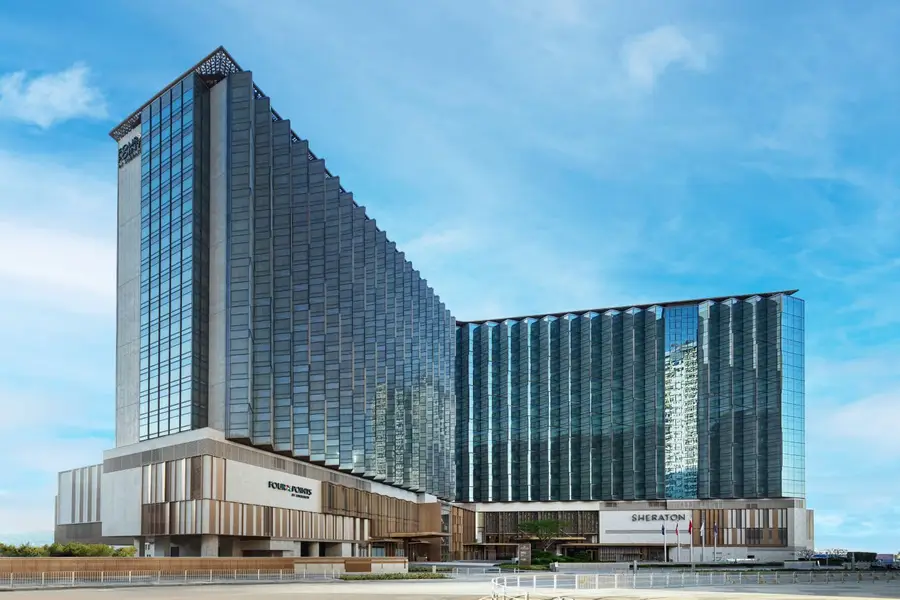
The Sheraton Hong Kong Tung Chung Hotel and Four Points by Sheraton was a crowning jewel for Shimao Group Holdings Ltd. (0813.HK) at its opening in 2020, showcasing the developer’s move beyond the Mainland China property market. Boasting over 1,200 rooms, the property overnight became the second-largest hotel in Hong Kong by room count.
Fast forward six years, when new reports say that Shimao, caught up in China’s prolonged property slump, has defaulted on a HK$4.5 billion ($5.77 million) bank loan. And a consortium of lenders behind that loan — including HSBC, BOCHK and Bank of East Asia — has reportedly entered discussions to seize the trophy Hong Kong property.
Incredible shrinking company
Things were far different when the Tung Chung hotel complex opened in 2020. Shimao’s Hong Kong-listed stock was trading at record levels, propelling its market capitalization past HK$150 billion. But as the company’s debt crisis began in 2021, its stock went into a devastating tailspin. Now relegated to penny status, the company’s market cap sits at a paltry HK$800 million, down more than 99% from its peak.
This precipitous collapse stems from the company’s mounting debt crisis and lackluster property sales, mirroring the fate of many developers being hammered by a prolonged downturn in China’s property market. Like its peers, Shimao’s difficulties have left it with insufficient financial resources to service its massive liabilities.
While the company’s 2025 financial report boasted a return to the black with a 14.47 billion yuan net profit, the feat was mostly an accounting mirage made possible by a 69.5 billion yuan gain from its offshore debt restructuring.
Its underlying operations remained dismal, as its revenue for the year tumbled 53% to just 28.4 billion yuan. Contracted sales clocked in at 24 billion yuan, down 30% year-over-year. The new year hasn’t been any better, with sales deteriorating further to 5.73 billion yuan in the first four months of 2026, off 36.8% from the same period last year.
By the end of 2025, Shimao’s total liabilities stood at 182.3 billion yuan. While that was a 69.8 billion yuan improvement from the previous year, a closer look reveals a looming threat in the form of 118.6 billion yuan in short-term debt coming due in the next 12 months. The company had accumulated 92.5 billion yuan in missed loan payments through the end of last year. And, with just 12.1 billion yuan in its coffers, it looks severely ill equipped to cover its massive upcoming near-term obligations.
Its auditor issued a disclaimer of opinion regarding Shimao’s ability to continue as a going concern. It also warned that a myriad of pending lawsuits and arbitration cases against the company casts a shadow of uncertainty over its broader viability.
Striking gold in Hong Kong equities
Shimao founder Hui Wing Mau was born in South China’s Fujian province in 1950. After moving to Hong Kong in the 1980s, he claims to have made his first fortune in the local stock market. He later funneled that bounty back to his hometown to invest in textile factories and real estate. By the 1990s, Hui had pivoted to luxury residential and commercial property development. In the 2000s, he built landmark luxury projects like Shimao Riviera Garden in Shanghai, famously enlisting Hong Kong movie star Tony Leung for a promotional campaign — a marketing coup that became the talk of the town.
Shimao subsequently went national, with contracted sales topping the 300 billion yuan mark at its peak in 2020. That same year, the company splashed out to acquire Fujian Fullsun Group, a financially distressed developer also from Fujian. That purchase ultimately proved toxic, as Shimao found itself dragged down by Fullsun’s massive hidden debts — quietly laying the groundwork for its own demise.
When China rolled out a series of draconian financing constraints aimed at reining in debt-happy property developers in 2021, Shimao’s highly leveraged business took a severe beating, leading to rumors of an imminent default that year. In March 2022, its auditor at the time, PricewaterhouseCoopers, abruptly resigned, delaying the release of its financial results. That kicked off a punishing 16-month trading suspension of its Hong Kong shares, as the company officially spiraled into default.
As it struggled with its debt load, Shimao embarked on a protracted restructuring to sort out its billions of dollars in offshore and onshore financial obligations. In early 2024, it finalized a restructuring plan backed by 79% of its offshore creditors. The landmark agreement formally relieved it of $11.5 billion in offshore debt along with $1 billion in accrued interest, which was cleanly converted into $8 billion in new notes with maturities of 6 to 8.5 years, combined with $4.5 billion in one-year mandatory convertible bonds.
Back at home, Shimao successfully negotiated with creditors in late 2025 to secure substantial maturity extensions for its 23.8 billion yuan in onshore obligations, rolling some deadlines back as far as 2035.
Dodging immediate liquidation
All told, Shimao may have temporarily dodged the bullet of immediate liquidation through its sweeping debt overhauls. Still, the overarching pressure it faces has far from dissipated. Adding to its headaches, China’s property market remains mired in its slump, weighing on Shimao’s sales. Lacking capital, the company has little or no cash to replenish its land bank for future projects, effectively mortgaging its future as it tries simply to survive in the present.
In its scramble to avert collapse, the company has had no choice but to start liquidating its investment properties. This year, it offloaded six floors at The Center, a prime office building in Hong Kong’s Central financial district, to DBS Bank, pocketing HK$2.62 billion. It also shed a single floor at the Lippo Centre in Hong Kong’s Admiralty district for HK$253 million — taking a nearly 50% haircut on both sales compared with what it originally paid.
What’s more, the Shenzhen Longgang land parcel that Shimao secured in 2017 — originally envisioned as the site for China’s tallest skyscraper — stalled entirely due to lack of funds. The plot was ultimately sold to state-owned China Resources Land (1109.HK) earlier this year.
The potential seizure of the Tung Chung hotel is also just the latest chapter for that property. Shimao commissioned agents to quietly shop the asset as early as 2023. But even after the asking price was slashed from HK$6 billion to HK$4.5 billion, the massive asset has yet to attract a buyer, leaving it vulnerable to the reported seizure.
To subscribe to Bamboo Works weekly free newsletter, click here
Related Articles