Developer lifeline: Seazen seeks financial relief through REIT spinoff
The property developer received regulatory approval this month to issue a commercial real estate investment trust, or REIT
Key Takeaways:
- Seazen plans to raise funds through a real estate investment trust whose main assets will comprise two of its shopping malls
- The plan, which has been approved by the Chinese securities regulator, is expected to raise 1.5 billion yuan in much-needed funds
By Lau Chi Hang
Call it a timely lifeline from the same government that sent China’s property developers into crisis when it abruptly cut off their access to easy credit with its “Three Red Lines” policy in 2020.
In a strategic effort to stabilize the market, Beijing has been aggressively advocating development of real estate investment trusts (REITs) to help debt-stricken developers raise much-need cash. The program allows developers to monetize their existing properties by securitizing them as REITs, then using the cash raised to alleviate their heavy debt obligations. REITs also offer another option for investors still wishing to bet on the property sector, paying out their profits as regular dividends.
Since the milestone launch of the program in 2021, some 80 new REITs have helped companies raise a massive 220 billion yuan ($32.8 billion) in combined funds. One of the latest is Seazen Group Ltd. (1030.HK), which this month announced plans for a new REIT anchored by two of its large shopping malls.
$230 million fundraising
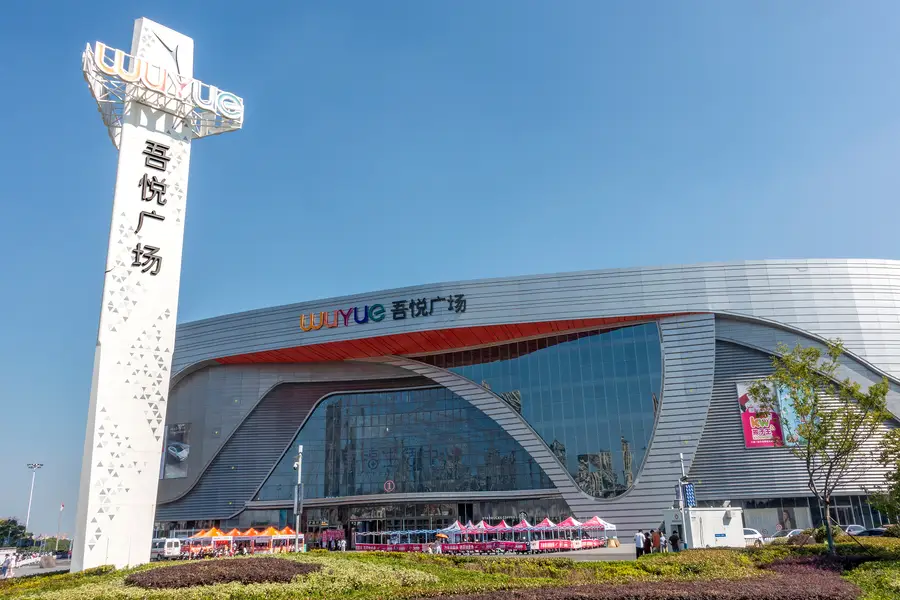
The two malls are Seazen’s Qidong Wuyue Plaza and Tianning Wuyue Plaza, both located in East China’s Jiangsu province, according to its announcement. The pair of properties have gross floor areas of 80,353 square meters and 123,394 square meters, respectively. The company expects to issue 500 million fund units, with a target of raising about 1.54 billion yuan ($230 million).
The appointed REIT manager has obtained a formal “no-objection” letter for the listing from the Shanghai Stock Exchange, as well as an official registration approval from China’s securities regulator. Seazen said fundraising activities will commence within the next six months, with the company holding 34% of the overall offering.
When compared to other heavily indebted developers, Seazen’s situation is far better. Most importantly, its debt burden is considerably lower than its peer.
Seazen’s latest financial results show its net debt-to-equity ratio stood at a manageable 57.1% at the end of June this year. With short-term liabilities amounting to 10.8 billion yuan and 7.85 billion yuan in cash, the company’s immediate funding gap is less than 3 billion yuan. That means the fresh 1 billion yuan it expects to raise from the REIT should be useful in helping to meet its short-term financial needs.
Misappropriated funds
Seazen’s on-balance sheet debt doesn’t look bad on the surface, but some investors may remain concerned about potential undisclosed problems. That wariness owes in no small part to past related-party transactions between the company and its property management subsidiary, S-Enjoy Service Group (1755.HK).
The event that raised eyebrows traces back to March last year, when S-Enjoy abruptly delayed the publication of its financial results and saw its shares suddenly suspended from trading. Alarming discrepancies were subsequently revealed across five of its corporate bank accounts, involving massive intercompany lending totaling about 7 billion yuan improperly provided to Seazen.
In response, S-Enjoy executive director Yang Bo resigned from all his positions at the company. Later, three other non-executive directors resigned as well.
Investors suspect that Seazen had run into severe cash flow constraints, which led it to hit up its own property management arm in a desperate bid to ease its mounting financial pressure. While Seazen subsequently returned the funds, the broader market’s confidence in management was significantly undermined, raising doubts about the company’s true financial health and accuracy of its past financial statements.
Falling property sales
Like its peers, Seazen’s situation continues to deteriorate in lockstep with China’s sputtering property market. The company’s revenue sank 20.2% year-over-year to 17.69 billion yuan in the first half of 2026, while its profit fell 12.1% to 608 million yuan.
Seazen has tried slashing operating costs to stabilize its ship. Its corporate sales and marketing expenses fell by nearly 32% year-on-year to 670 million yuan in the first half of this year, and its administrative costs fell 12.7% to 1.18 billion yuan. Without such cuts, the company’s falling profitability would have been even worse.
Seazen’s core residential property business continues to decline. In the first seven months of this year, its total contracted sales plunged 40% to 7.22 billion yuan from 11.98 billion yuan a year earlier. Over that period, the gross floor area of its sales also dropped 25% to 1.17 million square meters from 1.55 million square meters the previous year.
The company emphasizes that revenue from its commercial property operation is growing, reaching 7.11 billion yuan in the first half of this year, up 2.4% year-over-year. That part of its business now accounts for more than half of its revenue, a sharp reversal as the commercial property market fares comparatively better than the residential market that used to be Seazen’s biggest breadwinner.
In the first half of this year, its shopping mall portfolio expanded to 181 properties, up by seven from the 174 properties it had a year earlier. But revenue from those commercial properties rose by less than 3% year-over-year, suggesting actual average revenue per mall definitively declined this year.
While the company’s REIT spinoff, combined with its nearly 8 billion yuan in cash, is roughly enough to service its short-term debt obligations, the fact remains that Seazen still holds a massive 44.63 billion yuan in outstanding long-term borrowings. On the one hand, the company currently operates nearly 200 completed shopping malls that could potentially be used as assets for new fundraising. But it’s impractical to think it will be able to keep spinning off more of those as REITs over the short term.
What’s more, the value of its real estate assets continues to shrink, forcing it to record a valuation loss of 203 million yuan in the first half of this year. Such write-downs are likely to continue in the current market where prices continue to fall due to oversupply, even as the central and local governments take new steps to support prices. If that continues, which seems inevitable, the company’s net debt-to-equity ratio – currently its pride and joy among its peers – is bound to creep upward.
To subscribe to Bamboo Works weekly free newsletter, click here
Related Articles

RELATED ARTICLES
-
Cash-strapped Sirnaomics seeks lifeline in cosmetic treatments

- With looming debt pressures, Agile faces tough road to restructuring
-
Struggling Shimao looks on as creditors move in on its trophy Hong Kong hotel
0813.HK
-
China Travel Int’l spinoff spotlights its natural scenery and cultural tourism aspirations
0308.HK
-
Shoucheng Holdings invests in two REITs
0697.HK
- Vipshop looks to outlets in bid to jumpstart growth