The robotaxi leader’s latest financial report shows its losses remained stubbornly high in the first half of this year, despite a substantial revenue increase
Key Takeaways:
- WeRide reported its revenue surged by 73% to 346 million yuan in the first half of 2026, while it lost 790 million yuan
- The company’s fleet of autonomous robotaxis reached 1,800 vehicles by the end of June
By Lau Chi Hang
Investors frequently ask when autonomous driving will finally succeed, to which some reply that day will come when the driving profession disappears.
The statement may be somewhat exaggerated, but it does reflect the long road autonomous driving faces before it can become truly commercialized. For the enterprises waiting for that day, profits are largely a fleeting dream, and containing losses and simply keeping the lights on is often more realistic. Several notable names, like Tsingtech Microvision, once valued as high as 10 billion yuan; Zongmu Technology, backed by Lenovo and Xiaomi; and former autonomous truck highflyer TuSimple, have all reached the end of their roads or are close.
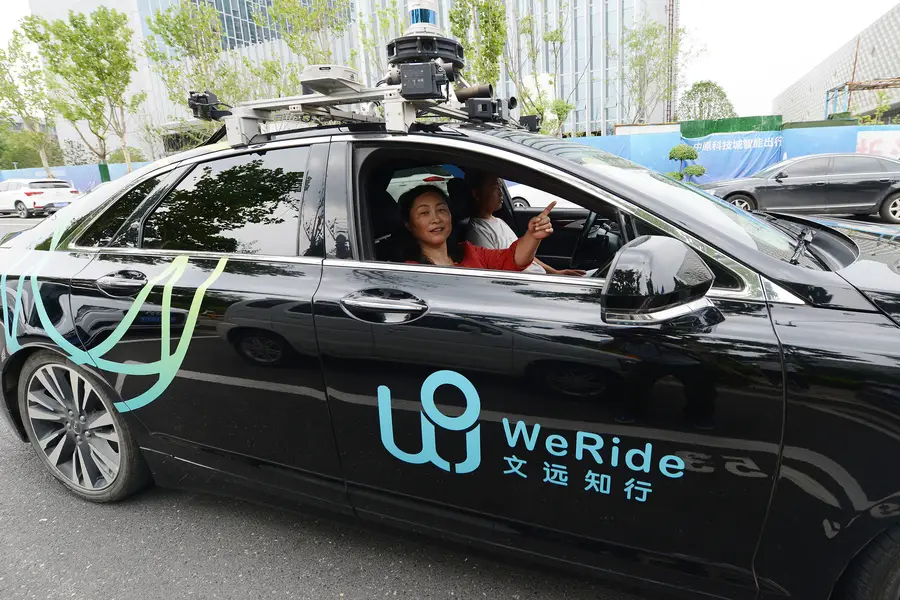
Even a powerhouse like robotaxi operator WeRide Inc. (0800.HK; WRD.US) faces an uphill road to profitability, which is reflected in its latest earnings report delivered last week. Its revenue rose by a healthy 73.3% to 346 million yuan ($51.31 million) in the first half of the year, including a stellar second-quarter reading of 232 million yuan, up 82.2% year-on-year and doubling from the previous quarter.
Continuing losses
The company has been steadily building up a robotaxi fleet that it hopes will one day become its core business. At the end of July, its global fleet exceeded 1,800 vehicles, up nearly 40% from the 1,300 vehicles it had at the end of April. Average daily rides per vehicle during the second quarter exceeded 21, up 24% quarter-over-quarter, while its registered user base grew by 35% sequentially.
WeRide’s overseas autonomous driving business is now in 13 countries, including a partnership with ride-hailing giant Uber (UBER.US) for European autonomous robotaxi services in Madrid and Zurich.
While all those milestones look encouraging, investors shouldn’t rejoice too early. Despite the surging revenue, WeRide has continued to burn through money, including a loss of 790 million yuan during the first half of the year, similar to the same period last year. The company lost 400 million yuan in the second quarter alone, narrowing by 1.4% year-on-year, while its quarter-over-quarter loss expanded by 3%.
WeRide has lost big sums in each of the last four years, including 1.3 billion yuan in 2022; 2 billion yuan in 2023; 2.5 billion yuan in 2024; and 1.65 billion yuan last year. Its latest loss translates to another 1.6 billion yuan down the drain on an annualized basis, showing its red ink remains stubbornly high despite its revenue gains.
In that context, it’s not surprising the company’s Hong Kong-listed stock fell by over 6% the day after its latest earnings announcement, showing investors remain skittish about its longer-term prospects.
Fierce competition
While WeRide’s revenue growth looks strong, the nearly 350 million yuan in first-half revenue the company reported is hardly anything to write home about. The figure remains low on an absolute basis, as the big majority of its business comes from programs still in pilot phases. That will make it difficult for the company to achieve economies of scale needed to drive down costs through mass production.
And even though the company’s first-half revenue rose by 73%, its expenses have been growing at a similar clip. Its marketing and advertising expenses, in particular, reached 51.9 million yuan in the first half of the year, up 87%, or even more than its revenue growth. That means the company is achieving its revenue growth in large part on massive advertising and marketing spending. R&D spending is also constantly required as the technologies evolve, though that figure grew by a more modest 24% in the first half to 798 million yuan.
Then there’s the competition, as WeRide attempts to outrace global rivals like Waymo to mainstream consumer acceptance. That race was nicely captured by WeRide Chairman Han Xu, also known as Tony, when he said during a recent interview that: “In every generation, new talents emerge, with each leading the field for merely three to five months.”
That illustrates just how brutal competition is in the autonomous driving industry, where today’s market leader could quickly become yesterday’s news. That means spending is essential to stay in the race, leaving profits somewhere in the distance for everyone.
Elusive L5 goal
Unmanned driving is divided into six levels, with Level 5 (L5) as the highest, defined as truly autonomous. But how long will it take to reach that goal? Han spoke candidly on that topic in his interview, saying, “It is entirely possible that L5 won’t be realized in the next 10 to 20 years.” While a mere flick of a finger in human history, such a timeframe can feel quite distant and uncomfortable for investors.
Of course, WeRide may not need to wait for L5 driving to turn a profit. But realistically speaking, how long will it take to reach that milestone?
Han previously said his goal is to have 1 million autonomous vehicles in operation, quoting an ancient proverb: “Without taking small steps, one cannot complete a journey of a thousand miles.” He explained that 1,000 vehicles is just the current starting point, whereas 1 million is a longer-term objective that must be achieved for success.
That looks quite ambitious, given WeRide’s current fleet only consists of 1,800 vehicles. And while the company operates under an asset-light model, its constant need for new investment makes it look like profitability won’t be on the horizon in the next two or three years.
WeRide CFO and head of international Jennifer Li said the company is moving steadily toward self-sustainability, aiming to assure investors the company is beginning to see improvements in its cash flow. Despite that, Li wasn’t any more specific on how much further WeRide must travel before it breaks even, let alone becomes profitable.
To subscribe to Bamboo Works weekly free newsletter, click here
Related Articles
RELATED ARTICLES
-
China’s robotaxi race hits a safety pause
- Trunk Technology drives ahead in search of profits
-
NEWS WRAP: UISEE makes Hong Kong debut, powered by autonomous driving demand
1511.HK
- Lingxing drives into congested Hong Kong ride-hailing IPO lane
-
CiDi drives beyond China with new British partnership
3881.HK