Trunk Technology drives ahead in search of profits
The autonomous commercial vehicle technology maker plans to top up with a Hong Kong IPO under a rule allowing ‘specialist technology companies’ to list even if they are losing money
Key Takeaways:
- Trunk Technology has filed for a Hong Kong IPO, counting Bosch and Nio among its early backers
- The maker of technology for autonomous commercial vehicles’ revenue rose 35.6% last year, but it has remained in the red for the last three years
By Bai Xin Rui
Losing money used to be a major roadblock for companies looking to list in Hong Kong. But all that has changed in recent years as the stock exchange rolls out a growing list of exceptions to welcome early-stage enterprises with promising new technologies.
One of the latest exceptions, called Chapter 18C, has attracted a growing platoon of such “specialist technology companies” since its rollout in 2023. The latest in that procession is Trunk Technology (Beijing) Co. Ltd., a leading developer of Level 4 (L4) autonomous truck technology and related smart logistics solutions, which submitted its listing application under the Chapter 18C channel earlier this month.
Trunk Technology was established in March 2017, and is now China’s fourth-largest provider of autonomous driving solutions for commercial vehicles. Founder Zhang Tianlei possesses extensive experience in autonomous driving and AI, with a resume that includes earlier stints at Microsoft and Baidu between 2012 to 2015.
The company’s focus is L4 autonomous driving solutions for trucks, with L4 considered the first fully autonomous level on a six-tier autonomous driving scale ranging from L0, which is fully human controlled, to L5. Its backers include big names like German auto parts supplier Bosch, new energy vehicle maker Nio and BAIC Capital, a unit of Beijing Auto. Zhang is currently the largest shareholder with 49.12% of the company’s voting rights.
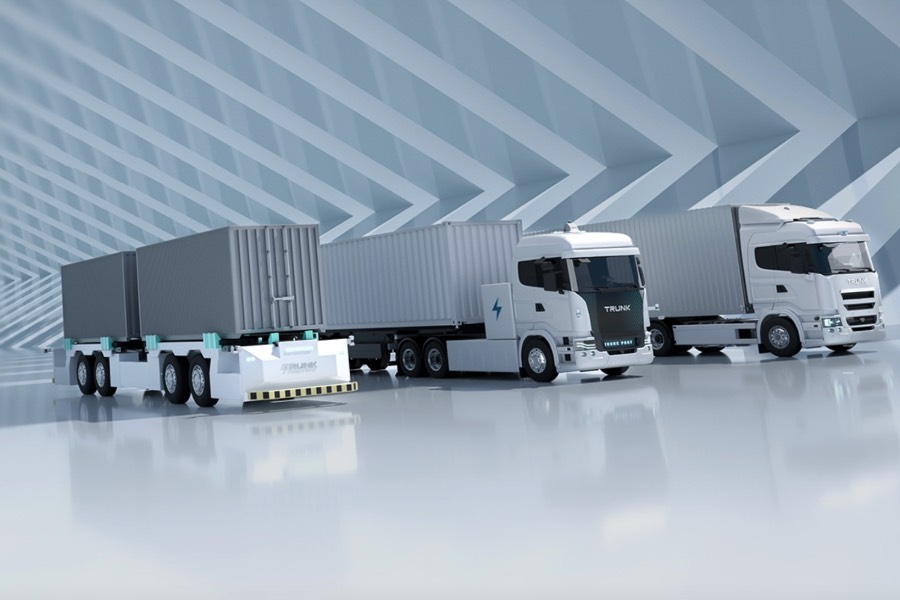
Trunk Technology’s crown jewel is its self-developed, integrated software and hardware system platform for L4 autonomous driving. The platform is targeted at three major commercial scenarios: logistics hubs, which it calls “trunk port”; road freight, called “trunk pilot”; and urban transportation, called “trunk city.” Among those, trunk port has established commercial partnerships with major urban logistics operators including Tianjin Port, Ningbo-Zhoushan Port and the Zhengzhou Inland Port.
Main breadwinner
Trunk Technology’s biggest revenue source is trunk pilot, its road freight division, which brought in 215 million yuan ($32 million) in revenue last year, accounting for 62.5% of its total. That business designs and sells autonomous driving solutions for highway logistics, involving express delivery, less-than-truckload (LTL) freight, bulk cargo and cold chain transport, among others. Trunk pilot has already completed large-scale commercial verification and demonstration operations in areas including the Beijing-Tianjin-Hebei region, the Yangtze River Delta, the Guangdong-Hong Kong-Macao Greater Bay Area and in China’s Southwest, Northeast and Northwest regions.
The company’s trunk port segment offers unmanned transportation solutions for logistics hubs, and it is the first unmanned transportation system deployed for commercial use at ports and other logistics hubs. It uses smart trucks and smart transport robots tailor-made for logistics hub scenarios, allowing it to operate round-the-clock in myriad weather conditions. Trunk port is Trunk Technology’s second-largest segment, generating 127 million yuan last year, accounting for 37% of the company’s total.
The trunk port segment’s revenue declined last year. But that was more than offset by a boom for the trunk pilot segment, whose average selling price surged 251% to 6.72 million yuan. As a result, Trunk Technology’s overall revenue grew 35.6% last year to 345 million yuan.
That said, the company is still an early-stage technological innovator, meaning its R&D expenses are massive, equal to 26.3% of revenue last year. High costs associated with factors like regulatory compliance, system integration and customer customization have kept the company squarely in the red, including a loss of 171 million yuan last year.
Promising prospects
Prospects for China’s logistics industry remain vast, which Trunk Technology hopes to capitalize on over the long haul. Last year the country’s social logistics volume exceeded 360 trillion yuan, and the country has retained its position as the world’s largest logistics market for the last 10 years. Within that figure, road logistics accounts for over 70% of total freight volume. The industry has long faced structural challenges such as driver shortages, high operational costs, frequent road accidents and low transportation efficiency. Autonomous driving addresses many of those, ending labor shortages and reducing accidents caused by factors like driver fatigue.
The market for commercial vehicle autonomous driving solutions in China was worth just 8.5 billion yuan last year, according to third-party market data in the listing document. But the market is expected to grow rapidly as technology improves and becomes more widespread. The entire industry is expected to reach 246.9 billion yuan in 2030, with open-road scenarios accounting for 88% of that figure, according to forecasts in the prospectus.
At the same time, falling costs for the core hardware will also help Trunk Technology to lower its expenses as it drives towards a profitable future. In particular, prices are expected to fall for autonomous driving computing units (ADCU), whose main costs come from high-performance system-on-chips (SoC) and microcontroller units (MCU). Prices for ADCUs rose steadily from 2021 to 2024 due to a broader global semiconductor shortage. But conditions finally began to ease last year, and since then the average selling price for ADCU core chipsets is down 5.1% from the peak. As the technology further matures and production scales, costs are expected to continue falling, which should indirectly benefit Trunk Technology.
Autonomous driving peers such as Pony AI (PONY.US; 2026.HK) and WeRide (0800.HK, WRD.US), currently trade at high price-to-sales (P/S) ratios of 33.6 times and 21 times, respectively, reflecting high investor hopes for the pair despite their relatively low revenue.
A share sale by Trunk Technology at a P/S ratio higher than 30 times could be a stretch, with limited upside for the stock at that level. On the other hand, an IPO share pricing at below 20 times could be more attractive, implying better upside potential. Either way, the company is really just embarking on a long trip that will inevitably be filled with twists and turns, and its longer-term potential will only become clear as the industry matures.
To subscribe to Bamboo Works free weekly newsletter, click here
Related Articles
RELATED ARTICLES
-
NEWS WRAP: UISEE makes Hong Kong debut, powered by autonomous driving demand
 1511.HK
 -
CiDi drives beyond China with new British partnership
3881.HK
- Annto drives out from Midea’s shadow with Hong Kong IPO
- Zhongding Intelligent eyes IPO as onsite logistics heat up
- China’s robotaxi race hits a safety pause