Topstar rolls out shaky robotics IPO, complete with volatile profits, falling revenues
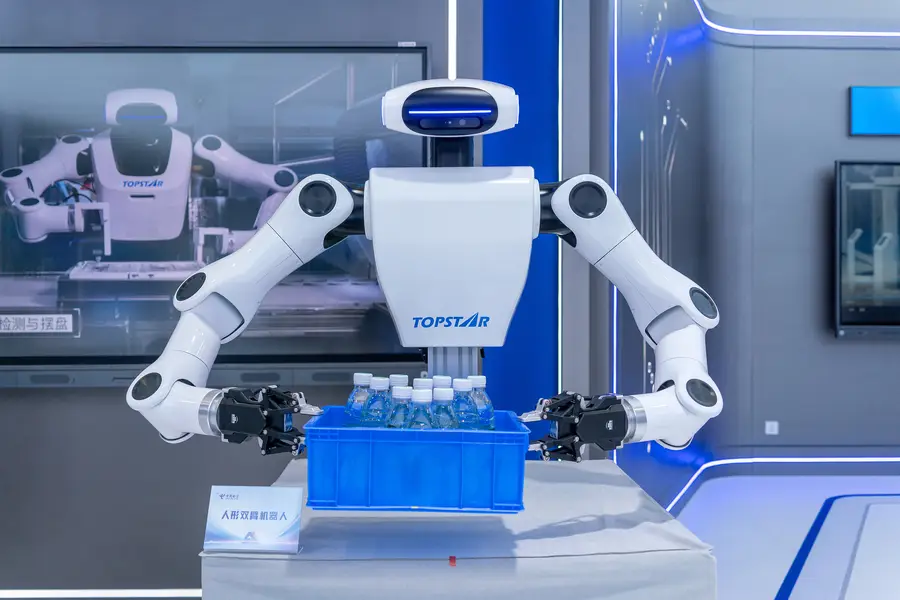
The company’s Hong Kong listing bid faces multiple headwinds, including its own unstable financials and cooling enthusiasm on robotics stocks
Key Takeaways:
- Topstar has filed for a Hong Kong IPO, reporting steadily falling revenues over the past three years
- The company is actively expanding its industrial robotics business in its bid to jumpstart revenue growth
By Lau Chi Hang
Agile robots performing flips and martial arts on China’s “Spring Festival Gala” Lunar New Year program never fail to dazzle, even as this year’s extravaganza is mostly memory by now. Even so, entertainment value isn’t worth a whole lot without practical, real-world applications. From that perspective, industrial models are the primary commercializing force in the robot sector for now, while the performing variety remain mostly a curiosity.
Against that backdrop, Guangdong Topstar Technology Co. Ltd. (300607.SZ), looks like a solid bet, at least conceptually, as a maker of industrial robots for the plastic injection molding sector. The company is banking on its proven products to lure investors to its planned Hong Kong IPO, following its filing of a listing application last week.
Founded in 2007, Topstar started out focusing on plastic injection molding processes before pivoting toward Cartesian and multi-joint robots. Listed on Shenzhen’s Nasdaq-style ChiNext board in 2017, the company has recently introduced its own vertical large model for industrial robots. Last year, it rolled out intelligent single- and dual-arm robots and unveiled China’s first intelligent humanoid robot specifically for use in injection molding scenarios.
Tumbling revenues
Despite its recent move into industrial robotics, nearly half of Topstar’s revenue still comes from its older intelligent energy and environmental products. Combined with injection molding equipment and computer numerical control (CNC) machine tools, industrial robots and automation systems only account for slightly more than 20% of the company’s total revenue, showing it’s still highly dependent on older product lines.
Topstar’s revenues have been falling steadily over the last three years, dropping by more than a third from 4.55 billion yuan ($672 million) in 2023 to 2.87 billion yuan in 2024. They fell further to 2.51 billion yuan last year. That uninterrupted string of declines translates to a contraction of more than 40% over the last three years.
Its bottom line has also been less than stellar. The company logged a profit of 106 million yuan in 2023, but then swung to a 240 million yuan net loss in 2024, before returning to the black last year with a 73.14 million yuan profit. It remained in the black with a 42.85 million yuan profit in the first quarter of 2026, but its overall profitability is clearly volatile.
Topstar attributed the massive top-line slump to a deliberate downsizing of its intelligent energy and environmental businesses. Its listing document shows that segment shrank from contributing 59% of the company’s revenue in 2023 to 36.5% last year, before plummeting to just 5.6% in the first quarter of 2026.
“Addition and subtraction” strategy
Topstar expects to conclude the ongoing scale-back of its intelligent energy and environmental business by the end of this year. While the segment’s revenue will end up a fraction of its former self, overall profitability is set to notably improve. The business has continually lost money in recent years, maintaining a double-digit gross loss margin that has dragged down the company’s overall margins. By slimming down the segment, Topstar is sacrificing revenue but positioning itself for more sustained profits.
While cutting back its loss-making operations, Topstar has been pooling its resources to aggressively scale up its industrial robotics division. That restructuring helped to lift the company’s overall gross margin from 17.6% in 2023 to 32.5% in the first quarter of this year, showing its “addition and subtraction” strategy is bearing fruit.
Still, it’s worth noting that despite its improving margins, revenue from Topstar’s industrial robotics and automation systems business also fell from 969 million yuan in 2023 to 685 million yuan last year. The company said it strategically decided to reject some new orders to focus on serving core clients in the consumer electronics sector, causing its automation system sales to drop from 2,500 units to 1,300 units over that period.
Things started looking up this year. Automation system sales hit 1,000 units in the first quarter of the year, up by a sharp 230% from the year-ago period, while revenue from the segment also surged by a smaller 81% to 320 million yuan. All this shows that the company’s revenue mix is still quite unstable, as it searches for a return to sustainable growth.
Cash burn and mounting inventories
On the financial front, Topstar’s operating cash flow was negative in the first quarter of 2026, as it recorded an outflow of 130 million yuan — up 119% from the same period last year. Its net cash burn across the entire company reached 295 million yuan for the quarter, in stark contrast to its 380 million yuan net inflow a year earlier.
Inventory turnover days have been on an equally troublesome trajectory, lengthening by 72% from 90 days in 2023 to 155 days last year, before further ballooning to 230 days in the first quarter of this year.
A key element to Topstar’s revenue stabilization is the overseas market, whose contribution has been growing steadily. Over the past three years, foreign sales grew from 11% of overall revenue in 2023 to 26.6% in the first quarter of this year.
The overseas expansion owes mostly to Vietnam and Indonesia. But even here, a closer look reveals that underlying revenue generation from overseas sales is less inspiring than the rising ratio of export sales to its overall mix. Instead, that rise is mostly a byproduct of the company’s plunging revenues in its home China market.
Revenues from Vietnam climbed 22% year-over-year to 500 million yuan in 2024, only to sink 27.7% to 365 million yuan last year, before rocketing more than sevenfold year-over-year to 99.7 million yuan in the first quarter of 2026. Indonesia delivered 14.97 million yuan in revenue in the first quarter of 2026, up from zero in the same period last year. Meanwhile, revenues in other foreign regions contracted by nearly 10% to 28.18 million yuan in the first quarter of 2026. As the data plainly shows, the company’s international revenue remains volatile and patchy, and total sums are still quite minor.
Judging from its performance and recent financials, Topstar is in the process of navigating a pivotal transition that’s likely to determine its future. It’s trying to strip out its money-losing businesses, while expanding other areas with better potential, resulting in top-line contraction and an unstable bottom line. Its pivot appears to be mostly on track for now. But the strategy is still in an early stage, and more time is needed to gage the outcome.
To subscribe to Bamboo Works weekly free newsletter, click here
Related Articles

RELATED ARTICLES
-
Specialized embodied robots: A massive next-generation opportunity

- Ubtech charms investors with companion robots – until reality sinks in
- INTERVIEW: Cainiao rolls out ZeeBot in latest step toward ‘Dark Warehouses’
- Dobot taps Shenzhen market to fund its bet on humanoid robots
- The embodied intelligence puzzle: A deep dive into China’s humanoid robot industry