The embodied intelligence puzzle: A deep dive into China’s humanoid robot industry
China’s humanoid robot boom is no longer just about futuristic demos — the real race is now shifting toward scale, cost and industrial deployment
By CLS Marketwatch
Humanoid robots are rapidly emerging as a new focal point in the global technology race. As AI, sophisticated manufacturing, new materials and other technologies increasingly come together, humanoid robots have made the leap from laboratories to diverse real-world scenarios. China, armed with a comprehensive manufacturing system, vibrant application market, and heavy R&D investment, has been laying the groundwork for a robotics industrial chain spanning from core components to assembled systems. Yet despite high market expectations, commercialization still faces big challenges related to efficiency, data infrastructure, and compatibility.
Robots take on diverse roles
China’s robotics industry is currently moving toward diversified development. Manufacturers are exploring different segments based on their respective strengths, ranging from entertainment to specialized industrial uses, with distinct differences in their offerings.
To begin with, low-cost robotic products are flooding the mass consumer market. A typical example is a smart AI-powered robot pet dog priced at 150 yuan ($22), capable of voice interaction, singing, dancing and doing somersaults. At the same time, high-value applications in medical settings have also made progress, reflected by hair transplant surgical robots now used at both private and public hospitals, priced at around 1.2 million yuan.
Meanwhile, industrial and commercial service scenarios are seeing more in-depth applications. In three representative settings of “unmanned factories,” “smart retail” and “smart kitchens,” robots are taking on specialized roles such as retrieving items, providing sales guidance and performing cooking tasks. Diving robots designed for underwater detection, marine scientific research, and water conservancy inspections are expected to achieve mass production in the second half of 2026, priced at around 600,000 yuan for a complete set.
Another noteworthy area is entertainment. A prime example is the humanoid robot developed by Unitree Robotics that can engage in boxing matches, which not only entertains audiences but also demonstrates advances in dynamic balance and real-time interactive control techniques. Interestingly, robot rental services are gaining traction. Take JiShiZu (Shanghai) Technology, the world’s first open robot rental platform, for example. It offers robot rental services to both corporate clients and individual users, with daily rents between 5,299 yuan and 11,900 yuan, effectively lowering the barrier to trying out cutting-edge robotics for the general public.
Scale benefits unlock upstream potential
Within the humanoid robot industrial chain, the upstream sector for core components has benefited most from the current boom. Orders for key components such as precision reducers, dexterous grippers, and servo drives are overflowing, with production capacity expanding at a rapid pace.
Leader Harmonious Drive Systems (688017. SH), a key player in the precision reducer sector, disclosed that it shipped 500,000 units in 2025, with a target of 800,000 for 2026. The company is continually expanding its capacity, and orders are already booked through 2027, reflecting strong demand from complete machine makers for upstream components.
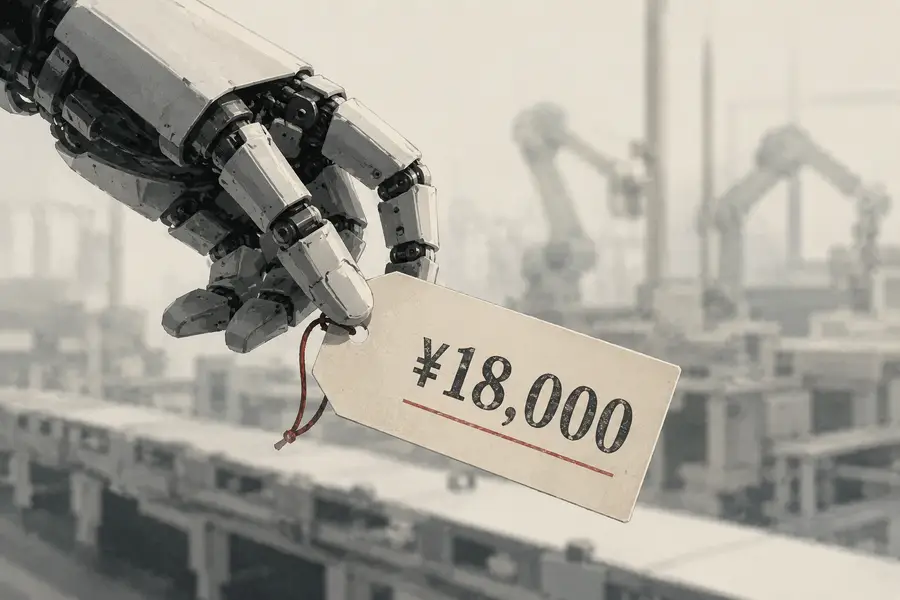
As a critical end-effector for humanoid robots, dexterous hands are also increasing sales at lower prices. An example is Beijing Inspire Robots Technology’s latest anthropomorphic five-finger dexterous hand, featuring an active thumb force of 15N and static passive load capacity of 8 kilograms per finger. Its price of 18,000 yuan is half the price of similar products from the same period last year, primarily attributable to rising shipments.
At the same time, 3D printing technology is also infiltrating the robotic upstream. Given the manufacturing challenges underlying humanoid robots, such as slow R&D iteration, high costs for small-batch production and design constraints, 3D printing offers remarkable cost and efficiency advantages over traditional processes. Despite this, the industry’s overall production schedule remains tight. In particular, core component sectors are seeing surging shipments, soaring orders, favorable pricing and innovations in manufacturing procedures.
Real-world validation remains the ultimate test
IDC forecasts that global shipments of humanoid robots will exceed 510,000 units by 2030, with a compound annual growth rate (CAGR) nearing 95%, indicating a generally optimistic outlook. Still, industry insiders agree that three core challenges remain to robot commercialization: efficiency, data, and adaptability to real-world industrial environments.
Crucially, the gap in robotic operational efficiency remains significant, with overall productivity in real-life tasks still generally lagging far behind humans. At the same time, data, rather than hardware, has emerged as the primary obstacle to the industry’s advancement. Since the whole data ecosystem is still in its infancy, an immediate priority is to keep refining infrastructure through ongoing iteration by data users, alongside data generation and interaction, ultimately fostering a competitive advantage for the industry.
The deployment of embodied intelligence in industrial settings also still faces systemic adaptation challenges. In industrial settings, for example, simply porting laboratory algorithms to the factory floor isn’t enough; instead, architectures must be rebuilt from the ground up based on fundamental logic for each industrial operation. The most prominent challenges include the “impossible triangle” of cost, efficiency, and reliability; and exponential increases in system complexity resulting from the growing variety of tasks, work cycles and performance requirements when dozens or even hundreds of robots run simultaneously within a factory.
Looking ahead, humanoid robots should not be regarded merely as a product, but as a technological mix that will lead future scientific development. Their technological breakthroughs will generate powerful spillover effects, driving rapid progress in a range of advanced domains including AI, new materials, quantum computing, brain-computer interfaces, the internet of things and big data, among others. It is important to note, however, that the industry will need to keep validating robots’ value-creating potential through real-world practices.
CLS Marketwatch provides insights and analysis on China’s industries. You can contact the author at liujingyi@cls.cn
To subscribe to Bamboo Works weekly free newsletter, click here
Related Articles