Leadrive IPO taps into China’s EV export boom
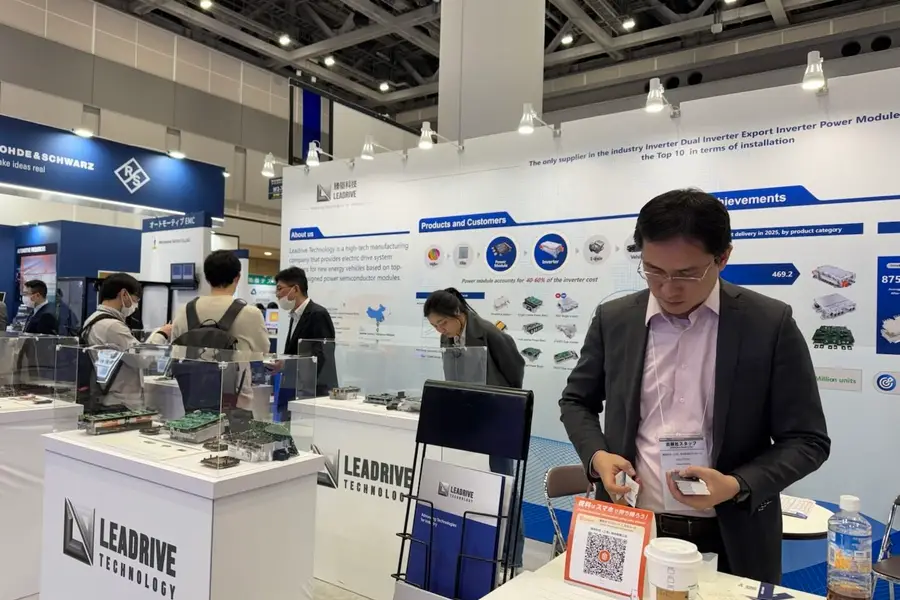
The Shanghai supplier of electric-drive systems kept growing this year even as China’s domestic EV market slowed, but half its revenue depends on a single automaker
Key Takeaways:
- Leadrive’s revenue rose 73.3% in the first five months of 2026, supported by the country’s booming exports, even as China’s domestic EV market contracts
- Half of the electric-drive component maker’s sales come from a single customer, leaving it exposed to customer concentration and price pressure
By Hu Minghe
Leadrive Technology (Shanghai) Co. Ltd. is hoping to land on investor radars alongside China’s higher-profile electric vehicle (EV) and battery producers, positioning itself as a key supplier of the machinery that powers those cars. The company renewed its application for a Hong Kong IPO last week, seeking funds to expand its production of electric-drive systems, the components that control the flow of electricity between an EV’s batteries and its motor.
Less visible than an electric car’s exterior design or battery pack, electric-drive systems play a key role in EVs by controlling how electricity from batteries is converted into motion.
The company’s business has grown rapidly in sync with China’s soaring EV sector. Its revenue jumped more than 10-fold from 159.8 million yuan ($23.6 million) in 2023 to 2 billion yuan in 2025, before increasing another 73.3% year-on-year to 956 million yuan in the first five months of 2026. Its gross margin improved to 9% from negative 8.3% over that time, although the company remained in the red with a net loss of 127.5 million yuan in the latest period.
Founded in 2017, Leadrive is part of an emerging new group of lower-profile Chinese automotive suppliers. China’s first generation of EV champions was dominated by automakers such as BYD (1211.HK; 002594.SZ) and battery giant CATL (3750.HK; 300750.SZ). The next wave consists of less visible companies in the EV supply chain, making everything from power electronics to automotive semiconductors.
Leadrive’s challenge is that this market has some powerful competitors. Many leading automakers, including BYD and Tesla (TSLA.US), develop important electric-drive technologies internally. That means independent suppliers must convince automakers that outsourcing these systems can provide better technology, lower costs, or ideally both.
Exported EV leader
Leadrive has already become a significant player in China, with 3.7% of the country’s motor-controller market in 2025, according to third-party market data in its prospectus. More importantly, Leadrive was first in its class from China based on revenue for motor controllers used in exported vehicles last year, highlighting how the company has benefited from the overseas expansion of Chinese automakers.
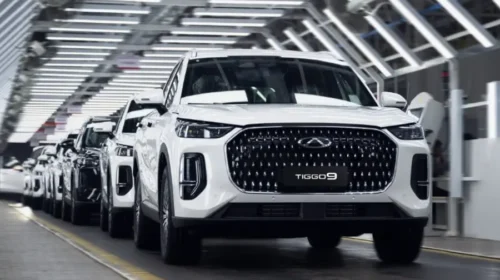
That export-leading status also highlights one of Leadrive’s biggest weaknesses, namely, its heavy dependence on its largest customer. It doesn’t name that customer in the prospectus, but the description matches Chery Auto (9973.HK), China’s largest passenger-vehicle exporter.
The relationship has become the main driver of Leadrive’s growth. Its largest customer has been crowding out other buyers over the last three years, growing from 10.7% of Leadrive’s revenue in 2023 to 57.1% last year, before easing to 50% in the first five months of 2026. The relationship now covers 32 vehicle models, with Leadrive opening a factory in Chery’s home city of Wuhu in late 2024 to support the automaker’s expanding production.
That close relationship has helped Leadrive scale quickly, but also highlights the risks of relying on one customer. Automotive suppliers often benefit from such relationships because switching to rival companies can be costly. However, Chery’s agreement renews annually after an initial three-year term, meaning Leadrive would receive a massive blow if the deal gets scaled back or terminated. Chery’s critical role also gives it huge power to demand lower prices for its bulk buying, which could pressure Leadrive’s margins.
For now, at least, Leadrive’s strength in exported EVs has placed it on the right side of one of the strongest new trends in China’s auto market. China’s domestic EV sales have fallen sharply this year as incentives were reduced, ending several years of explosive growth. Domestic new-energy vehicle (NEV) sales fell 13.4% in the first half of the year, as the broader Chinese car market fell even more. But exports surged over that time, with NEV exports more than doubling to 2.36 million units.
Chery has been one of the biggest beneficiaries of that shift. Its first-half exports jumped 71.5% to 943,817 vehicles, while its overall NEV sales increased 32.3% – even as many NEV makers logged declines.
Shielded from domestic slowdown
That export-driven growth has helped shield Leadrive from China’s domestic slowdown, but it also exposes the company to rising trade barriers against Chinese vehicles. The EU has imposed anti-dumping duties on China-made EVs, while markets including Mexico and Brazil have also increased restrictions on Chinese imports. And the U.S. bans Chinese EV imports outright.
At the same time, Leadrive faces pressure from China’s automotive price war, which has trickled down the food chain as carmakers pressure their suppliers for lower prices to stem their losses.
Leadrive’s average motor-controller selling price tumbled from 4,328 yuan in 2023 to 2,473 yuan in 2025, a decline of about 43%. It more than offset that decline with explosive sales volume growth over the same period, as the number of units sold rose nearly 20-fold to more than 614,000 units.
The company has responded to margin pressures by bringing more production in-house to reduce costs. Power modules were previously outsourced but are now produced internally, helping that segment’s gross margin rise to 26.2% in the first five months of 2026. Overall profitability, however, remains limited, with Leadrive accumulating more than 1 billion yuan in losses since 2023.
Leadrive is trying to broaden its customer base beyond Chery. A customer that matches the description of Changan Auto (000625.SZ) contributed 13.3% of its revenue in the first five months of 2026. Another NEV maker that matches the description of Seres Group (9927.HK 601127.SH) contributed 9.8%. And German supplier Schaeffler (SHA.DE), also a Leadrive investor, has become another major customer and provides a route into Volkswagen supply chains.
Leadrive says one Volkswagen-linked project covering four Chinese models has already entered mass production, while another overseas hybrid project is expected to begin production in 2027.
Leadrive has a strong pedigree in the investment community. Legend Capital is its largest outside shareholder, while a separate fund backed by Lenovo also invested. A Volvo investment unit became a shareholder in 2023, linking Leadrive to the Swedish automaker’s parent, Zhejiang Geely, one of China’s leading private carmakers.
For Leadrive, these relationships offer potential bridges between China’s fast-growing EV market and foreign auto networks as it looks to expand beyond its domestic customer base.
Leadrive’s rise shows how China’s EV industry is serving up a new generation of companies for investors beyond car brands and batteries that have taken most of the spotlight until recently. Its Hong Kong listing comes at a crucial moment as the company tries to outrace a looming correction that many believe is long overdue in China’s heavily oversupplied NEV industry.
To subscribe to Bamboo Works weekly free newsletter, click here
Related Articles
RELATED ARTICLES
-
Chery tiptoes into Japan with EV ‘kei’ microcar joint venture
 9973.HK
 -
The next big EV idea for investors? Bethel bets on the intelligent chassis
603596.SHG
- Avatr parks its NEV listing in Hong Kong, complete with losses and state ownership
- Juhui rides domestic catering boom to Hong Kong IPO
- Dobot taps Shenzhen market to fund its bet on humanoid robots