China’s empty boardroom in Washington, and its crowded auto market at home
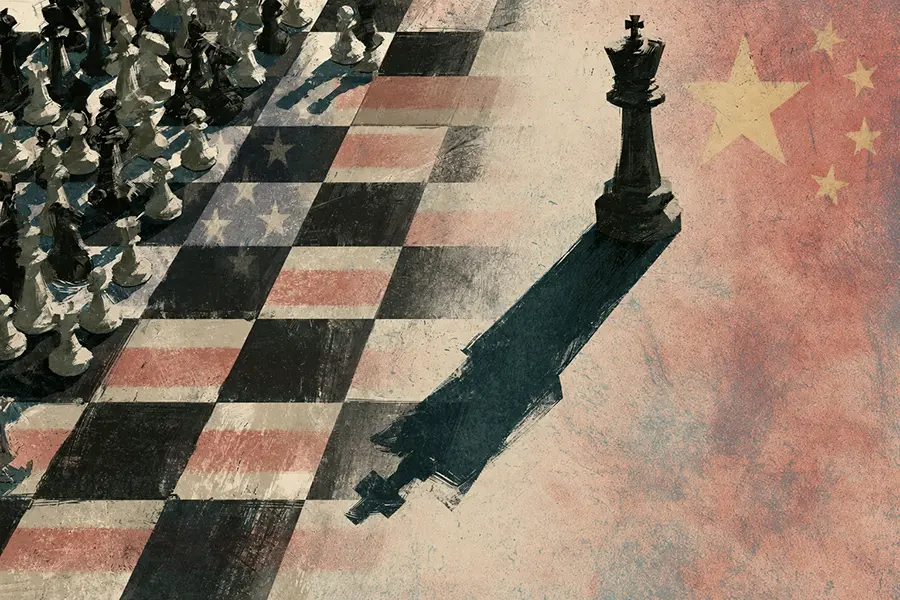
“The Chinese government has always been very slow in forcing substantial changes by way of mergers, acquisitions, or closure of enterprises.” — on the historical hesitance of Chinese authorities to eliminate obsolete industrial capacity

Key Takeaways
- The absence of Chinese business leaders during Xi Jinping’s U.S. visit likely stems from a mix of historical precedent and American national security concerns
- A new cross-shareholding deal between two state-owned legacy automakers signals the start of a slow, government-led consolidation in China’s car market
By Rene Vanguestaine and Doug Young
During Chinese President Xi Jinping’s recent trip to Washington, the world watched closely as the leaders of the world’s two largest economies held their second summit of the year. Yet, beyond the official diplomatic dialogue, there was a striking parallel in how Beijing manages its corporate landscape — both abroad and at home. This overarching state control was glaringly obvious in two separate spheres this past week: the total absence of a Chinese business delegation in the U.S. capital; and a rare, state-backed merger between two of China’s largest state-run automakers back home.
We’ll start with the Washington visit, which was the talk of the town in both capitals. In the week leading up to the summit, rumors swirled that Xi would bring a major delegation of corporate titans, including leaders from smartphone giant Xiaomi (1810.HK) and CATL (300750.SZ), the world’s largest EV battery maker. In the end, neither of those two, nor any other Chinese business leaders, showed up.
Everyone has been guessing what happened. We think there are two highly plausible explanations. First, historically speaking, Chinese businesspeople rarely travel with Xi on official state trips. The pre-summit chatter may have simply been media fantasizing, or corporate fabulating meant to force politicians’ hands for an invitation.
More importantly, it’s highly plausible that the U.S. administration objected to certain companies attending due to national security concerns. The products of companies like CATL have dual-purpose capabilities, which is a diplomatic way of implying they could be utilized by the Chinese military or its surveillance apparatus. Notably, both Xiaomi and CATL have largely been excluded from the U.S. market. You don’t see Xiaomi phones in America, and a planned CATL battery factory recently seems to have gotten scrapped.
This absence provided a sharp contrast to the U.S. side. American business leaders, including Jeff Bezos and Mark Zuckerberg, were prominently involved. We’ve seen this before: when Donald Trump went to China in May, he was accompanied by CEOs like Jensen Huang, Tim Cook, and Elon Musk. The U.S. is a capitalistic environment, making the confluence between the corporate and government sectors inevitable. China operates on a vastly different model. The primacy of the Communist Party over everyone, including successful entrepreneurs, is simply a fact of life.
A sluggish push for auto consolidation
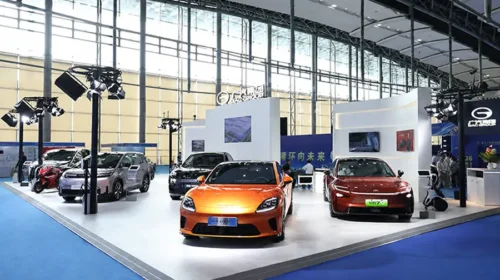
That exact primacy brings us to a second development that underscores Beijing’s tight grip on corporate China. Back at home, we’re witnessing a rare merger of sorts between two of the country’s largest state-owned automakers, FAW and GAC (2238.HK; 601238.SH).
This isn’t an outright acquisition, but rather an entwinement through cross-shareholdings. The deal was notably announced just three days after China’s auto regulator publicly expressed its support for industry consolidation. FAW is one of China’s oldest state automakers owned by the central government, while GAC is a younger, highly successful company owned by the affluent Guangdong provincial government.
It’s a well-known fact that there are way too many car manufacturers in China. Even for a market of 1.4 billion people, having 100 to 120 automakers is unsustainable. Yet, the government has historically been slow to force substantial changes — whether through mergers, acquisitions, or closures — largely to protect local employment.
Why choose these two companies now? Both are deeply tied to struggling legacy formats. GAC is a main joint venture partner with Toyota and Honda, while FAW partners with Toyota and Volkswagen. The sale of internal combustion engine cars in China has plummeted. Volkswagen, BMW, and Mercedes have been slow to transition to EVs and are suffering dramatic sales declines in China. State-owned companies like FAW have also largely failed to successfully navigate the EV transition.
Conversely, private companies are faring much better. Automakers like BYD (1211.HK; 002594.SZ), Xpeng (XPEV.US; 9868.HK), Li Auto (2015.HK, LI.US), and Nio (9866.HK; NIO.US) are dealing with a brutal domestic price war, but they’re positioned almost exclusively in the EV space and are seeing massive growth in overseas sales across Southeast Asia, Latin America, and Europe. Geely (0175.HK) is a similar success story, benefiting from exports and its ownership of EV brands like Volvo and Polestar. Beijing has tried to force private companies to behave and consolidate, but those efforts have largely failed. It makes sense that the government is now starting with the laggards it controls most closely. Whether this cautious, cross-shareholding approach will translate into meaningful capacity reduction remains to be seen. But in both Washington and Guangdong, the message is clear: Beijing is firmly in the driver’s seat.
About China Inc
China Inc by Bamboo Works discusses the latest developments on Chinese companies listed in Hong Kong and the United States to drive informed decision-making for investors and others interested in this dynamic group of companies.
Subscribe to China Inc on your favorite app:


Related Articles

RELATED ARTICLES
-
Two auto giants hitch wagons to combat harsh industry winter
 2238.HK601238.SHG
 - After years on the sidelines, VNET seizes on China’s AI moment with new CATL tie-up
- Avatr parks its NEV listing in Hong Kong, complete with losses and state ownership
-
Autohome skids as China’s car market slams on the brakes
ATHM.US2518.HK
- Leadrive IPO taps into China’s EV export boom
- From microchips to fast food: How Apple and Burger King are adapting to the Chinese market
- Guotai Haitong proves that in China’s brokerage consolidation, bigger really is better