E-paper maker rewrites growth story using its chip stockpile
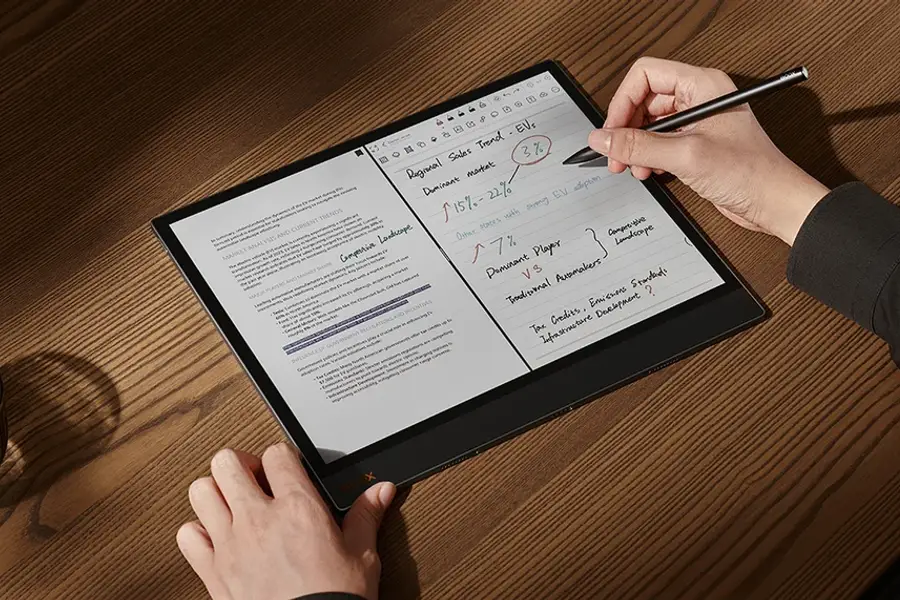
BOOX brand owner Onyx is seeking a Hong Kong listing as it maintains revenue growth by selling stockpiled chips to offset falling sales of its core devices
Key Takeaways:
- Resales of stockpiled chips accounted for all of Onyx’s revenue growth in the first half of 2026, while sales from its two main e-paper lines fell 4.7%
- The Hong Kong IPO applicant’s inventory rose 50% in the first half of 2026, absorbing cash as its bank borrowing more than doubled
By Hu Minghe
For a company best known for its paper-style electronic reading screens, Onyx International Inc. has found its latest source of growth somewhere unexpected: reselling stockpiled computer chips.
The Guangzhou-based maker of BOOX readers and digital notebooks filed for a Hong Kong IPO last week, hoping investors won’t mind a shifting sales profile that’s taking it away from its core business, at least temporarily. Its bigger challenge is to keep consumers interested in its dedicated screens for reading and writing, even as smartphones commandeer a growing slice of that market.
Onyx and its peers are also being challenged right now by rising chip prices that are wreaking havoc on smartphone and PC makers, whose core product sales are falling as they are forced to raise prices.
On the top line, at least Onyx appears to be holding its own. Its revenue rose 7.4% to 574 million yuan ($85 million) in the first half of 2026 from 534 million yuan a year earlier. But a deeper dive shows that resales from its inventory of stockpiled chips contributed 55.7 million yuan of the revenue growth, accounting for the entire increase and more.
Sales from the company’s two main device lines fell 4.7% year-on-year, and their combined gross profit dropped 11.7% as reader sales collapsed. Gains in “other products and services,” attributed mainly to chips, more than offset that gross-profit decline. Still, Onyx’s net profit fell 24% to 53.3 million yuan over the six-month period, as higher expenses and other costs outweighed the modest gross-profit gain.
Rising component costs, especially for memory chips, are testing Onyx and its rivals. Amazon (AMZN.US) raised its basic Kindle price in the U.S. from $109.99 to $149.99 in August, blaming higher memory and storage costs. Chinese e-reader maker Hanvon (002362.SZ) was keeping its prices unchanged despite cost pressure, vice president Wang Jie told Huaxia Times in August, describing the devices as discretionary purchases.
Chip stockpiling
As chip prices began rising in the second half of 2025, Onyx began buying more of the component to hedge against future price increases. That paid off later as it sold some of its stockpile at market prices after retaining enough components to meet its own production needs.
Even so, its inventory rose 50% between December 2025 and June 2026 to 748.8 million yuan, about three-quarters of that raw materials. Its operations used 198.7 million yuan in cash during the first half of the year, and its bank borrowing more than doubled over that time. Management says the raw material inventory is enough to support production and deliveries for this year and next.
Chairwoman Dan Yuting, formerly chief representative in China for electronic-paper specialist iRex Technologies, co-founded Onyx in 2008. The company established its BOOX brand in 2009, when it designed its first reader with handwriting capabilities.
Customers and distributors outside Greater China supplied 54.6% of Onyx’s revenue in the first half of this year, with Europe contributing 20.1% and the U.S. 17.7%.
Back at home, Amazon closed its China Kindle e-bookstore in June 2023 and ended downloads a year later, yielding the market to local rivals like Onyx. BOOX’s Android-based devices can run Tencent’s WeRead, letting Chinese users keep a familiar reading app while moving to a paper-like screen. But the trend towards reading on smartphones continues to undercut e-reader makers, with China’s latest national reading survey finding that 79% of adults read on their phones in 2025.
After all, extra screens like Onyx’s still cost money, and take up extra space for consumers on the go. BOOX’s Chinese website lists its readers from 899 yuan, with some models above 3,000 yuan. In the U.S., its six-inch Go 6 (Gen II) lists at about $200 before tax, compared with $150 for the basic Kindle with lockscreen ads. Buyers must see enough value in reading comfort, app choice and writing tools to justify another device.
E-reader appeal
Jessie Liu, a Hong Kong media professional in her 30s, bought a BOOX Go Color 7 two years ago. She liked its screen, larger than the basic Kindle’s six inches, and says Kindle had no color model when she bought it. But given the choice, she said, she would probably recommend buying a Kindle to her friends.
A Beijing tech founder in his 40s said he had owned four or five Kindles, which were his main way of reading before Amazon’s exit. He later bought a BOOX device on a friend’s recommendation, but was lukewarm on the product. “There’s nothing especially great about it, but nothing really wrong with it either,” he said.
Research firm RUNTO links the appeal of dedicated e-readers to better color displays and software. Pen-enabled notebooks expand the uses beyond books, letting professionals annotate reports and keep handwritten notes.
Onyx says customers are shifting toward handwriting-enabled devices as demand for read-only products ebbs. Revenue from its reading-focused products fell by more than half to 104.3 million yuan in the first half of 2026, while their gross margin fell to 26.2% from 35.8% a year earlier. Management attributed the margin pressure to discounts on older readers, a lower-margin product mix and higher chip costs.
By comparison, Onyx’s revenue from notebooks rose 32% to 383.7 million yuan over the same period. But strong sales for smaller models pulled average selling prices down 22%.
China’s e-reader and notebook market showed notably different trends from Onyx’s. RUNTO recorded a 22.3% rise in reader unit sales in the first half of 2026 from a year earlier and a 30.5% decline in office notebooks. BOOX ranked third in China’s overall online e-paper tablet market over that period, with 17.5% of the market by unit sales.
Traditional e-reader and e-notebook makers like Onyx also face competition from other directions. iFlytek (002230.SZ) makes devices that combine handwriting with meeting transcription, while Amazon’s Kindle Scribe and reMarkable notebooks also handle writing and documents.
Onyx plans to use its listing proceeds for R&D, sales and marketing, acquisitions and investment, production and supply-chain upgrades, and working capital. Its IPO valuation is still a work in progress. A 2024 transaction involving a Lenovo-controlled investor implied the company was worth just over 1 billion yuan at that time, though the transaction involved existing shares and special investor rights.
That means it will be up to Hong Kong investors to determine how much the company is worth now. But with management expecting chip resales that fueled the company’s growth this year to diminish, prospective investors must judge whether Onyx’s core readers and notebooks have a future in the face of the growing challenge from smartphones.
To subscribe to Bamboo Works weekly free newsletter, click here
Related Articles

RELATED ARTICLES
-
ESWIN Computing powers up its RISC-V growth story for Hong Kong investors

-
Volume chipmaker ASR looks to climb up the value chain
688220.SHG
-
Iluvatar earns paper profit, as its core GPU business stays stuck in the red
9903.HK
-
Transsion rebounds, as its ‘Out of Africa’ story stumbles
688036.SHG
- CXMT IPO tests China’s state-driven chip dream
- E-paper display maker DKE launches $66 million IPO
-
Ganfeng rediscovers profitability as volatile lithium prices test its mettle
002460.SHE