Can Longcheer buy its way to the top of the AI rack?
The world’s largest smartphone ODM is using acquisitions to cater to booming demand for AI infrastructure
Key Takeaways:
- Longcheer has revised terms for its acquisition of an AI infrastructure company, reducing the size of its stake and making performance targets stricter
- The world’s largest contract smartphone manufacturer is tapping demand for AI infrastructure with a recent string of acquisitions
By Edith Terry
For years, its calling was making millions of smartphones that have become a fixture of everyday life for most people around the world. But these days, original design manufacturing (ODM) giant Shanghai Longcheer Technology Co. Ltd. (9611.HK, 603341.SH) is making a new bet on AI infrastructure that has become the flavor of the day among tech manufacturers.
But its roadmap, driven by acquisitions, hasn’t been completely smooth. With global demand for AI data centers growing fast, the company looked like it had a good plan last month when it announced it would purchase of 80% of Suzhou A-Rack Information Technology, a maker of data center equipment like server racks and power distribution units (PDUs).
It made the announcement just a few weeks before disclosing midyear results for 2026 that showed its core smartphone manufacturing business wasn’t going anywhere fast. Its revenue fell 6.3% to 18.7 billion yuan ($2.78 billion) in the first half of the year, while its profit fell by an even steeper 30.9% to 245.9 million yuan.
But then last week Longcheer abruptly announced it was reducing the size of the A-Rack stake it was buying to just 60%, in what looked like a hedging of its bet by investing less. It took the step after the Shanghai Stock Exchange, following the initial August announcement, issued a letter warning on integration risks, as well as a large gap between A-Rack’s financials and performance targets set by the two sides.
The lowering of its stake reduced Longcheer’s purchase price from an original 1.12 billion yuan to 840 million yuan, while leaving A-Rack’s valuation unchanged at 1.4 billion yuan. It also modified terms of the agreement by introducing penalties if A-Rack failed to meet performance targets, in a seeming acknowledgement that perhaps Longcheer had been too eager to sign the original agreement without taking all the risks into account.
The revised agreement also requires A-Rack founder Ding Zhiyong to buy at least 50 million yuan worth of Longcheer’s Shanghai-listed shares within 12 months, which would then be subject to a 12-month lockup period.
Investors in both Shanghai and Hong Kong applauded the revised terms that lowered Longcheer’s exposure and made A-Rack more accountable for its post-deal performance. The Shanghai stock rose by 10.8% over the next two trading days, while the Hong Kong stock rose by 5.2% over the same period.
A-Rack is one of three purchases Longcheer has made this year in a bid to buy its way into AI infrastructure manufacturing. In June it paid 540 million yuan for 60% of KC Precision Technology and Dongguan Geeia Metal Products. KC Precision makes high-precision metal etching products for consumer electronics, while Geeia makes thermal management devices for data centers.
According to Grand View Research, the global AI data center market that Longcheer is targeting is expected to grow from $147.3 billion in 2025 to a projected $810.6 billion in 2033, averaging about 25% growth annually over that time. In addition to powerful computing chips, AI data centers also require thermal management systems to dissipate the huge heat given off by those chips, as well as large amounts of electricity to power them.
Post-IPO weakness
In addition to its core smartphones, Longcheer’s current business also includes ODM services for other electronics like tablet PCs, AI of things (AIoT) devices and car electronics. In its prospectus ahead of its Hong Kong IPO in January, it cited third-party market data saying it was the world’s second largest ODM manufacturer of consumer electronics in 2024, based on shipments, and the largest smartphone ODM. Its A-list of smartphone customers includes the likes of Xiaomi, Samsung, Honor, Oppo and Vivo.
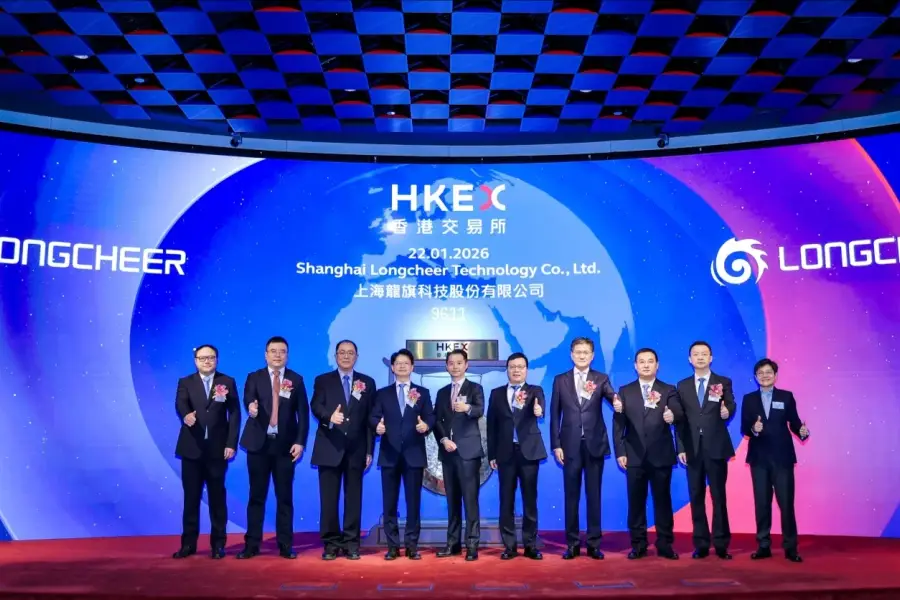
Hong Kong investors initially welcomed Longcheer, which raised around HK$1.52 billion ($194 million) in its January IPO whose retail portion was 15 times oversubscribed, and whose cornerstone investors included Xiaomi and Qualcomm. The stock briefly rose from its IPO price of HK$31 after its trading debut. But it quickly reversed course and has moved steadily downward since then. Its Wednesday close of HK$21.40 is about 30% below its IPO price, as investors flock to sexier stocks with greater growth potential.
While more favorable terms under the revised A-Rack transaction provided a brief respite for the stock, the reality is that Longcheer’s financials are nothing to brag about. Its revenue fell 7% in 2023, before rebounding strongly by 70% in 2024, only to fall again by 9.3% to 42.1 billion yuan last year. The company’s annual profit has also fluctuated, but has generally ranged between 500 million yuan and 600 million yuan every year since 2022.
The company’s main revenue driver in 2025 was a 41% increase in sales of AIoT products, which rose to 7.8 billion yuan to account for 18.5% of revenue, driven by growing demand for AI glasses and other smart eyeware. Smartphones still accounted for about two-thirds of its sales, or 68.6% of revenue at 28.9 billion yuan. But that figure was down by a sharp 20%, from 36.1 billion yuan in 2024, as sales by many major brands slumped after they were forced to raise prices due to soaring memory costs.
So, how does Longcheer compare to its peers? Its closest rival is Huaqin (3296.HK, 603296.SH), which also manufacturers smartphones but is pushing into data center infrastructure and robotics. Huaqin’s Hong Kong-listed shares carry a price to earnings (P/E) ratio of about 17, similar to Longcheer’s multiple of 18.4 for its Hong Kong shares.
But Huaqin’s revenue has been on a steadier upward track, including 55% growth last year to 172.4 billion yuan. Its net profit also increased by more than 50%, from 2.7 billion yuan in 2023 to 4.1 billion yuan in 2025. Like Longcheer, Huaqin’s Hong Kong shares haven’t fared too well since their April IPO, currently trading about 8% below their offer price.
Nonetheless, analysts are still relatively bullish on both companies, with those surveyed by Yahoo Finance giving them “buy” ratings. Perhaps they’re lured by the AI angle, which has fueled explosive gains for many related stocks over the last year.
To subscribe to Bamboo Works weekly free newsletter, click here
Related Articles

RELATED ARTICLES
-
Huaqin stock rises in Hong Kong debut as AI data center business booms
 3296.HK603296.SHG
 - Starved for better profits, Fubei chases IPO to fill its funding bowl
-
Transsion rebounds, as its ‘Out of Africa’ story stumbles
688036.SHG
- Wybotics in sprint to become Hong Kong’s first pool equipment stock
- Unsated by Hong Kong listing, Knowledge Atlas seeks more funds in Shanghai
-
Restructuring hits Want Want’s bottom line, as top line ekes out growth
0151.HK
-
INTERVIEW: Maase pursues AI infrastructure in new business initiative
MAAS.US