INTERVIEW: CiDi toils out of the spotlight to bring autonomous driving to industry
The leader for autonomous trucks used in mining and industrial scenarios is expanding into the related robotics field, and scored a major order for 500 vehicles this year
By Doug Young
While names like Tesla and Waymo hog the global spotlight in electric autonomous driving, CiDi Inc. (3881.HK) is quietly emerging as a leader in the far lower-profile realm of self-driving vehicles used in industrial settings like mining and industrial parks. The company’s autonomous trucking solutions are an increasingly common fixture at Chinese mining and other sites where they can lower both costs and risks, and it scored a major win this year when miner Guangna Group ordered 500 of its vehicles.
Like Tesla and China’s XPeng, CiDi is also taking advantage of its technology to move into robotics, which share many features with autonomous driving like the need for perception and decision-making functions. On that front, it passed another milestone in the first half of this year with its first commercial delivery of 34 robo-excavators.
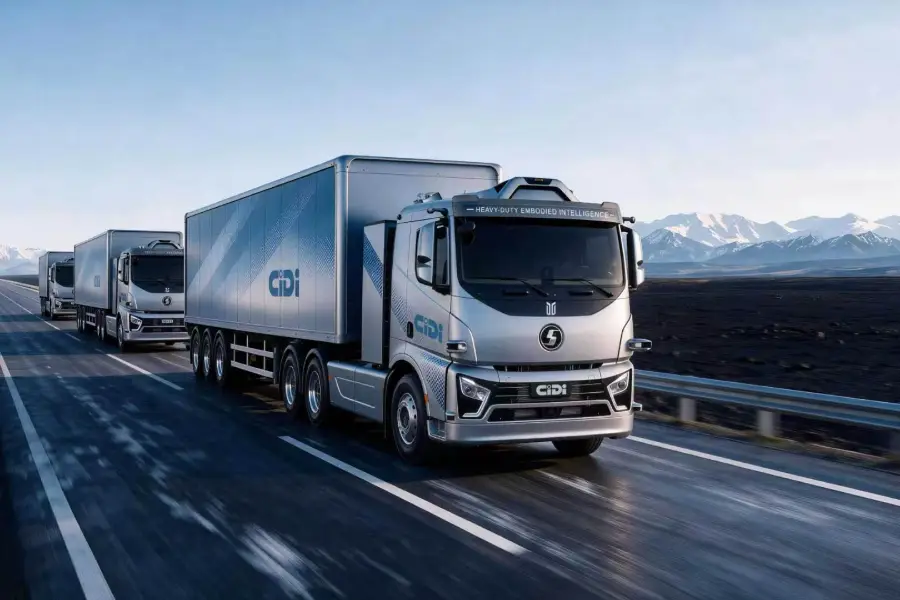
Like many technology firms at a similar stage in its class, CiDi is still losing money. But its losses are rapidly narrowing, including an adjusted loss of just 20 million yuan ($3 million) in the first half of the year as it rapidly closes in on adjusted breakeven. U.S.-educated CEO Albert Hu talked with Bamboo Works in conjunction with the company’s attendance at the bauma China 2026 show this week in Shanghai, where CiDi was displaying some of its newest products, including VEGA, its purpose-built, factory-integrated L4 autonomous heavy-duty truck.
Bamboo Works: Let’s start with a little about your own journey at CiDi. You joined the company in 2018 as a scientist, but you weren’t named CEO until 2023.
Albert Hu: I started at CiDi on the technical and research side, first digging into core engineering for heavy vehicle controls, simulation, coordinated autonomy, and V2X. After that, I took on various roles including head of controls and head of the company’s research arm CiDiLabs.
I’ve been fortunate that my technical and multicultural background has been useful in this field. Robotics is deeply multidisciplinary, and industrial adoption means weighing complex economics alongside difficult engineering problems — so having exposure to both sides has helped me contribute more effectively.
Q: The company shipped a cumulative 1,900 trucks since its inception as of June, including orders for more than 400 trucks in the first half of this year. How has business been since then?
A: Our order book continues to grow, and we expect a substantial increase in cumulative shipments by the end of this year.
We are seeing strong market momentum as the global mining industry continues to accelerate its adoption of autonomous technologies. This trend is being driven not only by the industry’s pursuit of greater operational efficiency and productivity, but also by an increasing focus on workplace safety, with regulators in China and other markets placing greater emphasis on protecting workers in high-risk industrial environments.
Q: For its truck business, CiDi has talked about diversification in two major directions. The first is expansion at mining sites beyond just hauling into other functions. The second is into other logistical areas. How is the company doing in both of those directions?
A: Within mining, our ambition is to move beyond autonomous haulage towards more integrated, mine-wide intelligent operations, covering excavation, drilling, blasting and other high-risk, labor-intensive tasks. We have made encouraging progress in this area. Our teleoperated excavators are already being deployed in real-world mining operations, while we are also advancing specialized robotic solutions for drilling and explosives handling.
Alongside these developments, we introduced the CDK155, our second-generation cabless electric mining truck, purpose-built for autonomous operations with a rated payload of 100 tons. We also launched Yura, our mining AI agent built on the MetaMine platform. Through natural-language instructions, Yura can interpret production requests and coordinate tasks across connected equipment, including autonomous haul trucks, excavators and drilling machines, extending our capabilities into mine-wide production management.
Beyond mining, we have extended our autonomous driving capabilities into industrial park logistics, port transportation, cross-border freight and other heavy-duty logistics applications. We also launched VEGA, CiDi’s new purpose-built, factory-integrated L4 autonomous heavy-duty truck, jointly developed with Zhizi Auto. VEGA is designed to seamlessly connect autonomous freight operations across controlled industrial facilities and public roads, enabling a single vehicle to support end-to-end transportation workflows without vehicle changes or cargo transfers.
Q: The company’s robotics business is clearly emerging as a second growth engine. How do you see that business scaling, and what are the synergies with autonomous trucks?
A: For CiDi, robotics is a natural extension of our existing autonomous driving capabilities rather than an entirely separate business. Our autonomous trucks and task robots share many of the same underlying technologies, including perception, decision-making, heavy-duty equipment control and multi-machine coordination. This allows us to leverage our established technology platform and experience in real-world mining operations to develop robotic solutions for other stages of the mining workflow.
We have already made encouraging progress. In the first half of 2026, our task robotics business generated its first commercial revenue, with 34 robo-excavator units delivered. While the business is still at an early stage, we are optimistic about its long-term growth potential as we expand our product portfolio and commercial applications.
Q: The company still gets the majority of its revenue from China. Which international markets hold the biggest potential?
A: China remains our largest market and provides a strong foundation for our international expansion. Looking overseas, we see significant long-term opportunities in major mining markets, particularly Australia, as well as South America, Indonesia, and other regions where mining operators are increasingly looking to automation to improve safety, productivity and operational efficiency.
As with any technology company entering new international markets, we recognize that building trust takes time. Our experience in China provides a strong foundation for building that confidence. We are also expanding our international network through partnerships with established industry players. Our collaboration with MMD Group is an important example, bringing together CiDi’s autonomous driving capabilities and operational experience with MMD’s expertise in mining equipment and its international industry network.
Q: The company sells its trucks to customers, who then take over full ownership and operation responsibilities. That’s different from other providers that offer these functions as a service providing recurring revenue. Why did CiDi make that decision?
A: Our asset-light business model is a deliberate strategic choice, based on our belief that each participant in the industry should focus on what they do best. CiDi’s core strength lies in developing autonomous driving technologies and integrated solutions for complex, heavy-duty operating environments.
Under this model, our customers own and operate their vehicles, and OEM partners bring expertise in vehicle engineering and manufacturing while CiDi provides the autonomous driving technologies and integrated solutions that enable them to operate more safely and efficiently. We recognize the value of recurring revenue and remain open to developing additional technology-related services that meet our customers’ needs. However, we do not see a need to fundamentally change our asset-light approach.
The Bamboo Works offers a wide-ranging mix of coverage on U.S.- and Hong Kong-listed Chinese companies, including some sponsored content. For additional queries, including questions on individual articles, please contact us by clicking here.
To subscribe to Bamboo Works weekly free newsletter, click here
Related Articles

RELATED ARTICLES
-
Trunk Technology drives ahead in search of profits
-
Its stock slumping, Breton looks for life under mountain of debt
1333.HK
-
As binge-buying big spenders vanish, CDF pivots for survival
601888.SHG
- Its business stabilized, Cango signs first customer for its new AI business
- Autonomous mining truck maker Eacon passes Hong Kong listing hearing
- Canaan gets doubly squeezed in latest crypto downturn
- Specialized embodied robots: A massive next-generation opportunity