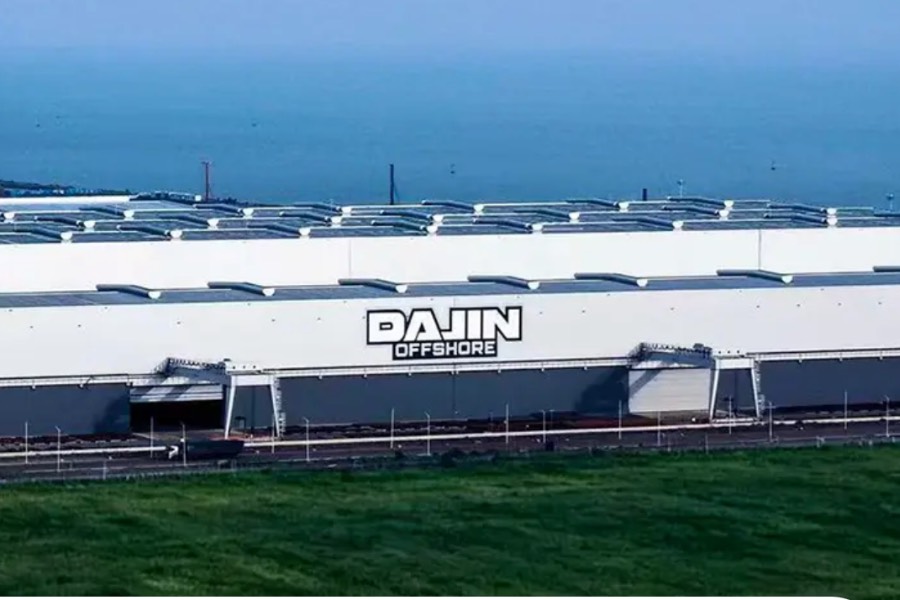
The wind power equipment maker’s shares are down more than 60% since their June listing in Hong Kong, as the company reported its profit deteriorated in the third quarter
Key Takeaways:
- Dajin Heavy Industry said its profit fell 20% in the first three quarters of the year, including a 68% drop in the third quarter
- The wind power equipment maker’s business took a hit from foreign exchange losses, as well as delayed delivery schedules
By Cheng Shui Tong
Hong Kong’s stock market rally that began last year and extended into the first part of 2026 is rapidly running out air. That’s taking the wind from the sails of recently listed companies like Dajin Heavy Industry Co. Ltd. (1081.HK; 002487.SZ), a major offshore wind power equipment maker. The company floated its Hong Kong shares in June, seizing on a rallying market when sentiment was still strong. But with its own profitability now under pressure, the stock has fallen in tandem and now trades about two-thirds below its IPO price.
According to its latest quarterly results released last week, Dajin’s revenue dipped 5.05% to 4.36 billion yuan ($650 million) in the first three quarters of this year, while its net profit fell about 20% to 710 million yuan. But things were far worse in the third quarter, as the company’s top line plunged 37% and its net profit cratered by an even steeper 67.9%, signaling a rapid deterioration in its operations.
Dajin attributed the profit decline to a pullback in delivery volumes and shifts in its order mix. It added that recent appreciation of the yuan also boosted its foreign exchange losses. Excluding that impact, its net profit for first three quarters actually eked out a 6% year-over-year gain. Its gross margin for the first nine months also rose to 35.6% from 31.1% a year earlier.
Extreme volatility
While its Hong Kong listing is relatively new, the company’s older Shenzhen-listed shares have been on a roller coaster ride recently. Propelled by explosive growth in the European market and improving profits as it moved to a fully integrated supply chain, the company’s earnings surged over 130% in 2025. Taking off from the low double-digits, the stock soared to more than 90 yuan by May this year.
Dajin announced its Hong Kong listing plan in late May just as the Shenzhen shares were reaching new heights. Despite lacking an AI angle, its strong fundamentals and stellar performance for its Shenzhen-listed stock created huge demand for its Hong Kong listing, whose local portion for Hong Kong investors was oversubscribed by 134 times and priced at the top end of its range, netting the company over HK$5.7 billion ($856 million).
The stock initially traded near its IPO price of HK$66.40. But by July, rapidly chilling market sentiment sent the stock off a cliff, cratering by half in just two weeks to around HK$30. That led to huge losses for a high-profile roster of cornerstone investors, including Singaporean sovereign wealth fund GIC, as well as Hillhouse Capital and UBS.
While investors licked their wounds, Dajin used its more than HK$5 billion in IPO proceeds to shore up its cash position. During the first three quarters of this year, its net cash flow from financing activities reached 6.17 billion yuan, up by an eye-popping 484% year-over-year.
Beyond his good timing for the IPO, Dajin founder Jin Xin has made several similarly savvy pivots throughout his and the company’s history.
Born in 1967 in the city of Yingkou of Northeastern Liaoning province, Jin started out as a technician at a textile factory after graduating from college, where his standout abilities earned him a leadership position in the Communist Party’s influential Youth League. In the early 1990s, he served as the general manager of a company making security doors in the Liaoning city of Fuxin, earning him his first pot of gold.
Steel structure foray
In 2001, at age 34, Jin took another major step on his entrepreneurial journey by purchasing and running a steel structure production line. In 2003 he founded Liaoning Dajin to manufacture heavy industrial equipment. When China aggressively began promoting new energy, Dajin seized on the moment and entered the wind power equipment sector. In 2010, Dajin Heavy Industry went public on the Shenzhen Stock Exchange, becoming China’s first listed company in the wind turbine tower industry.
Jin’s foresight was at the fore once more when he realized how hyper-competitive the domestic wind power market was and made a key pivot outside China to the European market. The company currently reigns as the king of European wind power, capturing a commanding 29.1% of the region’s monopile market in the first half of 2025.
Wind power components are inherently quite heavy. Since Dajin manufactures mostly at home for overseas delivery, the business has historically faced high transportation costs and logistical uncertainties. To address that, the company has transformed in recent years from a standalone equipment manufacturer into an integrated delivery provider, championing a “manufacturing + transportation + home port + installation” model.
Beyond making equipment, Dajin now operates its own transport vessels, constructs terminals and oversees installation, offering clients a seamless end-to-end service. Such vertical integration not only mitigates project execution risks but also boosts the company’s gross margin by making its operations more efficient.
Underlying risks
Hyper-growth also carries its own underlying risks. In Dajin’s case, a major risk lies in its reliance on a small group of customers. In 2025, its top five clients generated 79.3% of its total sales, with the largest accounting for nearly half of its revenue. What’s more, the company’s heavy reliance on Europe has made investors uneasy about what could happen if the EU rolls out restrictive measures on Chinese wind power equipment on national security or unfair competition grounds.
What’s more, Dajin’s heavy reliance on exports means it’s paid mostly in foreign currencies, which makes its bottom line heavily vulnerable to yuan exchange rate fluctuations. That’s very evident in its recent reports, which can lead to wide swings in profits. A foreign exchange gain of 154 million yuan in 2025 gave way to an exchange loss of 98 million yuan in the first half of 2026, underpinning this year’s profit erosion.
The post-IPO plunge in Dajin’s stock may have already priced in most of those headwinds. Citi Research noted that the softer-than-expected third-quarter performance was largely driven by slower-than-anticipated deliveries, an opaque outlook for government subsidies, and compressed returns resulting from higher interest rates. Consequently, the broker slashed its net profit forecasts for 2026 through 2028 by 23% to 29%. It also lowered its price target from HK$43 to HK$34, though it retained a “buy” rating on the company. The bank noted that at current levels, the stock trades at roughly 10 times its projected 2027 earnings and 0.9 times book value — making the stock highly attractive at its current levels.
To subscribe to Bamboo Works weekly free newsletter, click here
Related Articles

RELATED ARTICLES
-
Higher export deliveries lift Dajin’s profit by nearly 10%
 002487.SHE
-
BRIEF: Dajin Heavy finishes flat in Hong Kong trading debut
002487.SHE
- PPLabs eyes capital refresh as losses linger on heavy investments
- Kinwong runs hot on AI boom, cold on plunging margins
- Booming electricity demand feeds KeLiang’s niche in power grid simulation
-
Keytop hits the skids less than two months after Hong Kong IPO
2272.HK
- Can crypto power supplier Boco plug into the AI boom?