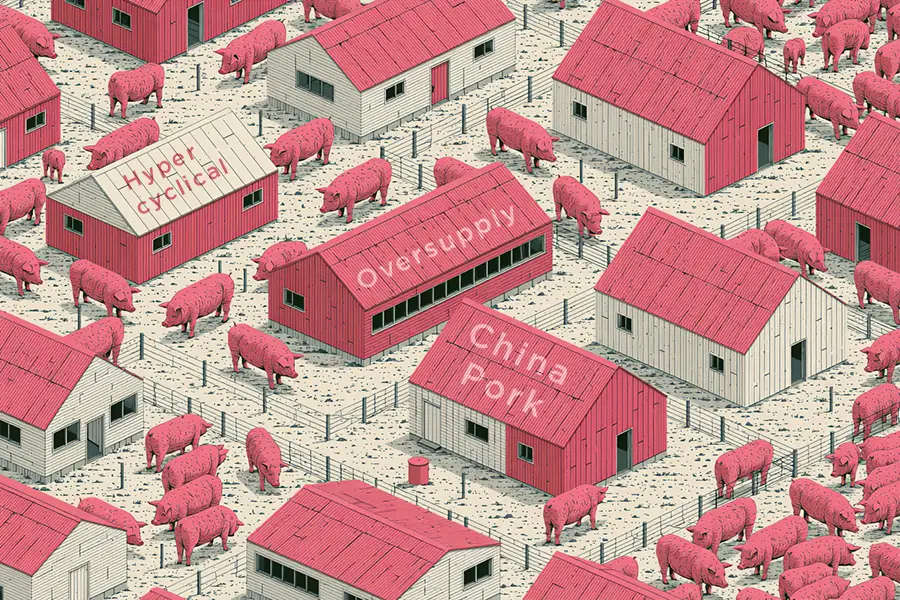
“Nobody wants to miss the boat and not be able to capitalize or capture part of the growth going forward. This is emblematic of China in just about every type of business.” – on why price wars are so common in China

Key Takeaways:
- China’s parcel delivery sector is finally seeing prices stabilize after government intervention to curtail years of cutthroat price wars
- Hog breeders are suffering massive losses due to plunging prices, yet they continue to expand capacity to grab market share
By Doug Young & Rene Vanguestaine
Oversupply is a common theme in China these days, affecting a wide range of industries. We’re currently watching this dynamic play out in two distinctly different areas: the country’s express parcel delivery sector and its massive pork industry. In the delivery space, several years of intense price wars may finally be easing under government pressure, while in the hog breeding business, top producers are swinging sharply into the red due to plummeting prices — driven by massive excess capacity. Despite their differences, both sectors highlight a uniquely Chinese business approach: an aggressive, unrelenting drive to capture market share, often at the expense of rational market economics.
China’s roughly half-a-dozen major delivery players have spent the last few years duking it out to see who can ship packages the cheapest. After a prolonged period of price declines, including a 6.3% drop last year, things finally appear to be stabilizing. The country’s parcel volume rose 5.2% in the first five months of the year, while revenue rose by a faster 7.2%. This implies the average shipping price per parcel rose 1.9% during that time, bolstered by an even bigger 3.6% jump in May alone.
This stabilization is likely the result of government intervention. Authorities have become increasingly concerned about the profitability of these companies. If competition is pushed to the extreme and businesses start going bankrupt, it leads to mass layoffs. For Beijing, maintaining employment and social stability is always paramount. We’ve seen similar interventions in the instant commerce sector, where regulators routinely instruct giants like JD.com (JD.US; 9618.HK), Alibaba (BABA.US; 9988.HK), and Meituan (3690.HK) to curb their aggressive tactics.
But is this kind of intervention sustainable? History suggests it’s difficult. Years ago, the government forced the steel sector to curb irrational competition and halt excess capacity building. It worked briefly, but then the cycle started all over again. The reality of China’s market is that local governments, especially those far from Beijing, have their own interests at stake. They prioritize local employment, tax revenues, and civic pride. When central directives filter down, local officials often push back or ignore the instructions, eventually allowing old practices to resume.
There are also structural reasons why China’s delivery companies can ship for so little and still remain profitable. During the first five months of the year, the average delivery price was about 7.67 yuan per parcel, or roughly $1. Compare that to the U.S., where a standard delivery costs $7 or $8. First, labor is obviously cheaper. Second, U.S. companies face high costs for insurance coverage, which isn’t as burdensome in China. Finally, there are some cases where delivery firms likely receive substantial help from local governments in the form of lower taxes, direct subsidies, or reimbursements, making a strict comparison with the U.S. or Europe almost impossible. Furthermore, we think there’s little room for true differentiation. Any new strategy would be replicated by competitors almost instantly.
A deeply cyclical appetite for expansion
We’re seeing another glaring example of overcapacity in China’s hog breeding business. Within the space of a single week, two leading companies, Dekon Food (2419.HK) and Muyuan Foods (2714.HK; 002714.SZ), announced they fell deeply into the red in the first half of the year, completely reversing their strong profits from last year.
The culprit is plunging prices resulting from massive oversupply. For instance, Dekon collected just 9.63 yuan per kilogram of hog sold in June, a steep 33% decline from the 14.31 yuan it commanded a year earlier. Yet, inexplicably, the company’s actual hog sales rose 15% to 5.91 million heads in the first half of the year.
Why are Chinese companies such enthusiastic builders of new capacity when prices are tanking? Pork is a main staple of Chinese consumers, and the sector is historically prone to upheavals from epidemics that periodically decimate hog populations. With living standards generally rising, producers expect long-term demand to increase. The government even maintains a strategic national pork reserve, underscoring the meat’s critical importance to the country.
However, the relentless expansion boils down to one primary goal: taking market share from the competition. Nobody wants to miss the boat on future growth. This mindset is emblematic of China across almost every sector — from solar manufacturing to electric vehicles. It’s a way of doing business that we don’t see as much in the West anymore, where economies grow slower and investors have become a lot more rational.
From an investment standpoint, the reaction to these cycles can be perplexing. After Dekon issued its profit warning detailing huge losses, its stock actually jumped 7% the next trading day, though it remains down 22% for the year. The pork industry is low-tech, mature, and highly cyclical. There are always investors willing to throw money at such sectors, much like the traditional U.S. airline industry, believing they can master the cycle better than anyone else.
But for the average investor, especially those outside the country who lack day-to-day access to local data, it’s virtually impossible to fully grasp these dynamics. For those without the appetite for extreme cyclical volatility, we believe it’s best to stay away and find something more predictable.
About China Inc
China Inc by Bamboo Works discusses the latest developments on Chinese companies listed in Hong Kong and the United States to drive informed decision-making for investors and others interested in this dynamic group of companies.
Subscribe to China Inc on your favorite app:


Related Articles
RELATED ARTICLES
-
Dekon swings to the red on Chinese pork glut
- Is China’s express delivery price war over? The answer will lie in profits
- Tinoos serves up lukewarm IPO hamstrung by weak Chinese meat market
- Rethinking bigger Is better: China’s long march toward higher-capacity energy storage cells
- BRIEF: Muyuan’s April sales plunge 32% on falling hog prices
-
Rising silver prices, appreciating yuan cast shadow over JinkoSolar
688223.SHG