Starbucks clears its China tables, as the robotics bubble quietly deflates

“There’s no way they can compete with Luckin Coffee and a cup of coffee at 9 yuan, They’ve got to go for the premium experience” – on Starbucks’ decision to discourage non-paying loiterers as it tries to recover its upscale café atmosphere.

Key Takeaways:
- Starbucks China is risking public backlash by asking non-paying squatters to leave its stores, as it tries to recover its premium lifestyle appeal
- Plunging valuations across Chinese tech, epitomized by hotel robot maker Yunji, show that China’s AI and robotics bubble has already burst
By Rene Vanguestaine and Doug Young
In China’s fast-evolving commercial arena, consumer brands and high-tech startups alike are running into uncomfortable market truths. Starbucks (SBUX.US) is embarking on a culturally sensitive campaign to clear non-paying loiterers from its stores in an effort to restore its premium sheen. Meanwhile, the steep fall of service-robot specialist Yunji Technology (2670.HK) demonstrates that China’s robotics and AI bubble isn’t merely under pressure — it’s already deflating at an alarming pace.
Starbucks made headlines across China after rolling out a policy targeting visitors who occupy seats without buying anything. While squatters aren’t unique to China, the practice is deeply entrenched there. Patrons frequently spend hours hogging tables, draining store wi-fi, playing cards, or taking afternoon naps. Starbucks has responded with polite table signage reminding patrons to purchase beverages, while store staff now regularly approach non-paying visitors to ask if they’re ready to order.
This touches a cultural nerve. Many Chinese consumers view public spaces as open to all — a communal mindset that may trace back to socialist notions of “People’s Stores” and “People’s Squares.” One only need visit an IKEA store in China to witness people sound asleep and snoring on showroom beds and sofas.
Enforcing store etiquette carries real risks. On Chinese social media, complaints against a prominent American brand can quickly blow up into nationalistic outrage. Yet Starbucks isn’t acting alone: its China operations are 60% owned by Chinese private equity firm Boyu Capital. Local ownership suggests the move was carefully weighed by domestic partners who feel equipped to manage any viral fallout.
More importantly, Starbucks has little alternative. Chinese coffee chains are locked in a relentless race to the bottom. There’s no way Starbucks can match Luckin (LKNCY.US), where customers grab an app-ordered coffee for 9 yuan ($1.25) and walk out the door. Starbucks isn’t just selling coffee; it’s selling an aspirational lifestyle and a comfortable space to work or socialize. When non-paying visitors monopolize seating, that core value proposition disappears. Doubling down on an unapologetically premium experience is the company’s only viable path forward.
China’s robot dreams meet market reality
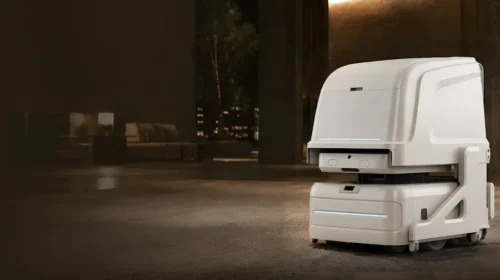
While Starbucks tries to protect its physical real estate, China’s hardware tech sector is losing ground on financial exchanges. Consider Yunji, a developer of commercial service robots for hotels and hospitals. Unlike companies building acrobatic or kung fu humanoid bots for media hype, Yunji sells functional products with proven demand and steady sales growth. Yet investors have fled, erasing over 90% of the firm’s value since June.
Yunji’s collapse isn’t an isolated incident. Share prices for Chinese robotics firms, large AI model developers, and tech infrastructure providers have tumbled by half or more since mid-year. While observers still debate whether an AI bubble will burst, in China the collapse might already be well underway.
Market valuations simply ran too far ahead of commercial reality. The STAR 50 index for China’s Nasdaq-style STAR Market plunged 40% in under four months, erasing roughly $480 billion in market value. Even after that correction, the index still trades at around 100 times trailing earnings — down from an eye-watering 250 times, but still more than triple the Nasdaq-100’s multiple of roughly 30.
Underlying these steep valuations is a murky road to profitability. In the U.S., major AI developers favor proprietary, closed models that charge commercial users. In China, most companies embraced open-source systems, making direct monetization far more difficult. Furthermore, Beijing’s aggressive push for technological self-sufficiency sits uncomfortably alongside the state’s drive for political control — a contradiction that becomes acute in open-source AI.
Global capital flows have also turned against Chinese tech. International investors seeking exposure to frontier technologies are directing funds into transparent, high-profile U.S. leaders like SpaceX (SPCX.US) and Anthropic. Faced with a choice between transparent Western champions and opaque Chinese ventures, global capital is voting with its feet.
Some Chinese tech companies can still raise funds — AI startup Z.AI (2513.HK) recently completed a substantial share issuance, and state-backed “national team” funds continue to support strategic sectors. Yet these piecemeal lifelines won’t shield the broader industry from a reckoning. As funding taps tighten and investors grow cautious, China’s crowded AI and robotics space could face an inevitable wave of discounted acquisitions and corporate failures.
About China Inc
China Inc by Bamboo Works discusses the latest developments on Chinese companies listed in Hong Kong and the United States to drive informed decision-making for investors and others interested in this dynamic group of companies.
Subscribe to China Inc on your favorite app:


Related Articles

RELATED ARTICLES
-
Yunji bills itself as China’s ‘Tesla of robotics.’ But investors need convincing
 2670.HK
- Slowing takeout dining wars leave Luckin with bitter aftertaste
-
Orbbec motors into rapidly cooling robotics IPO market
688322.SHG
-
Hesai eyes next big thing with robotics initiatives
HSAI.US2525.HK
-
Hony Media makes robotics foray with new joint venture
0419.HK
- Tiny income, big dreams: can True Health become the next robotics champion?
- To revenue and beyond: Defining valuations in China’s commercial space industry