Hisense catches chill from cooling Chinese economy
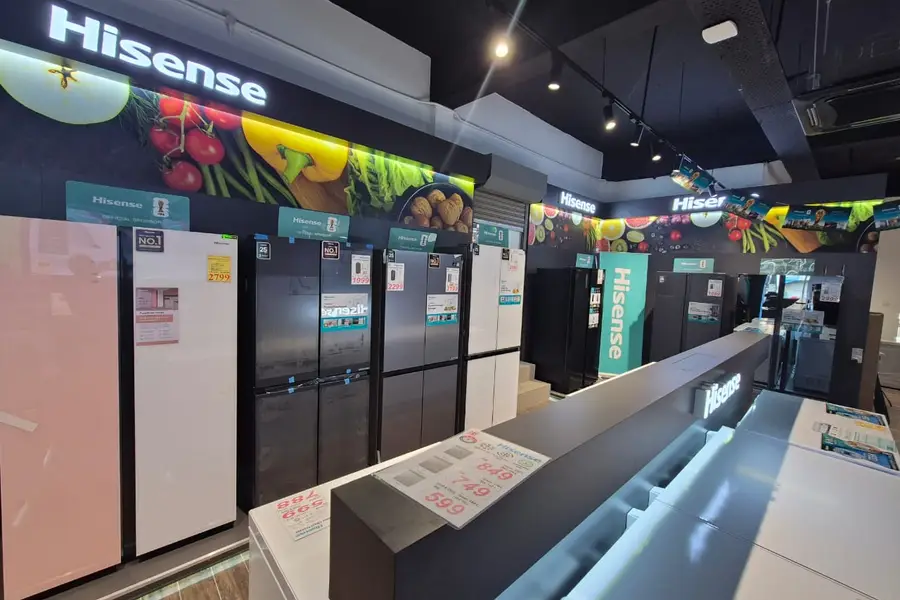
The air conditioner and refrigerator maker’s revenue fell 8.8% in the third quarter, accelerating from a 5.2% decline in the first half of the year
Key Takeaways:
- Hisense’s revenue fell 8.8% in the third quarter, while its profit excluding non-recurring items plunged 96.7%
- The home appliance maker’s receivables jumped 63% over the three months to September, indicating a growing number of customers weren’t paying their bills
By Doug Young
Like the air conditioners and refrigerators that are its two biggest sellers, Hisense Home Appliances Group Co. Ltd. (0921.HK; 000921.SZ) gave the market a blast of cold air with its latest financial report released last Friday. The chill looks like the result of a brewing storm of factors, led by weakness at home from China’s slowing economy.
Investors in Hong Kong gave the report the chilliest reception, sending the company’s stock down 4.6% in Hong Kong by the midday trading break on Monday. Investors across the border in Shenzhen gave the news a chilly but slightly warmer reception, with the stock down 1.6% midway through the trading day.
The bigger picture is that things look increasingly bleak for Hisense and its peers. The companies are facing growing pressure from China’s slowing economy, which shows up not only in slumping sales, but also in balance sheet items like growing write-offs for inventory and bad debt.
At the same time, Hisense and its peers are taking a hit from recent strength in China’s currency, the yuan, which is effectively undermining their business since a big chunk of their revenue comes from overseas sales. The euro, in particular, has lost about 10% of its value compared to the yuan this year, while the U.S. dollar has lost about 5%.
Hisense and its peers were also benefiting from a government program designed to stimulate consumption by giving subsidies to people who traded in old appliances for new ones. But that program is now winding down, and many consumers who wanted to take advantage of the subsidies have already done so.
Meanwhile, Hisense continues to invest heavily in new manufacturing, even as its revenue growth goes into reverse. The company had 1.28 billion yuan ($192 million) on its balance sheet for construction in progress at the end of September, up 40.8% from the 911 million yuan for that item just three months earlier. It attributed the jump to its construction of a new industrial park.
We attribute this to enthusiasm for upgrading and building new capacity by Hisense and its peers at least partly to their desire to curry favor with local government officials, who rely heavily on such investment to meet their economic growth targets. While companies should obviously keep investing in the latest technology and product design to remain competitive, some might argue such a big spending increase may not be the best approach in the current environment.
All of those factors effectively wiped out Hisense’s profit in the third quarter. Its net profit fell 74% year-on-year to 191 million yuan, accelerating from a 20% decline in the first half of the year. But after excluding non-recurring items like 54 million yuan in government grants, as well as 47.7 million yuan in gains related to the fair value of financial instruments, the company’s profit plunged 96.7% to just 16.7 million yuan in the third quarter.
Accelerating revenue declines
All that said, we’ll take a closer look at the many elements behind Hisense’s sagging business. The biggest indicator is its revenue, which fell 8.8% year-on-year to 20.2 billion yuan in the third quarter. The top-line declines aren’t new, dating back to last year. But the latest figure represents an acceleration from contractions of about 5.2% in all of 2026 and the first half of this year.
The company didn’t give any sales breakdown for its different product categories in the latest report. But its midyear report released in August showed that sales of air conditioners, its biggest single category, fell 5.7% in the first half of the year to 22.4 billion yuan, accounting for nearly half of its revenue. Its second-biggest category, refrigerators and washing machines, partly offset the decline with a 12.9% rise to 17.4 billion yuan, accounting for 37% of sales.
By region, the company’s revenue is split roughly 50-50 between China and international sales. But while its international sales rose 4.6% in the first half of the year, its China sales fell by 1.5%. That’s bad for the company’s bottom line, since its China sales carried a far higher gross margin of 28.2% in the first half of the year than foreign sales at 11.2%. Usually foreign sales carry higher margins than domestic sales for many Chinese manufacturers. But in this case the lower foreign figure probably owes to the fact that a big portion of Hisense’s overseas sales are as a contract manufacturer for other brands, which typically carry much lower margins than own-brand sales.
Away from the less-than-stellar top line, Hisense’s balance sheet was pockmarked with a number of items that also weren’t too encouraging.
Those were led by 63% jump in receivables to 536 million yuan at the end of September form 328 million yuan just three months earlier, indicating that a growing number of customers weren’t paying their bills on time. The company’s asset impairment losses also rose sharply to 102 million yuan in the first nine months of this year from 63.3 million yuan in the year-ago period, as it blamed growing provisions related to inventory that is likely to be written off eventually.
The company also recorded 21.8 million yuan in impairment losses on credit in the first nine months of the year, representing a sharp swing from 21.7 million yuan in gains for that item a year earlier, as it blamed higher bad debts in the latest period. Last but not least, the company’s financial expenses also nearly doubled to 234 million yuan in the first nine months of this year from 121 million yuan a year earlier, as it blamed fluctuations in foreign exchange rates related to the yuan’s recent strength.
Valuation-wise, Hisense’s Hong Kong-listed shares currently trade at a price-to-earnings (P/E) ratio of 7.7, while its Shenzhen stock trades at a higher 10.8, reflecting the bigger premium domestic investors have given the company. Both of those trail Midea (0300.HK; 000333.SZ), whose shares in both Hong Kong and Shenzhen trade at around 14.5, while Haier Smart Home (6690.HK; 600690.SH) is also stronger with 8.9 and 10.1 for its Hong Kong and Shanghai shares, respectively.
To subscribe to Bamboo Works free weekly newsletter, click here
Related Articles

RELATED ARTICLES
-
Budget air con giant catches chill from tepid home economy, Middle East war

-
Orbbec motors into rapidly cooling robotics IPO market
688322.SHG
-
Hello Group courts big spenders abroad as Chinese daters economize
MOMO.US
- DPC Dash bakes up Domino’s pizza giant with Chinese characteristics
-
Orbbec’s booming robotic ‘eye’ sales fail to wake up its bottom line
688322.SHG
- Who needs humanoids? Direct Drive Tech bets on simpler household robots
- Kinwong runs hot on AI boom, cold on plunging margins