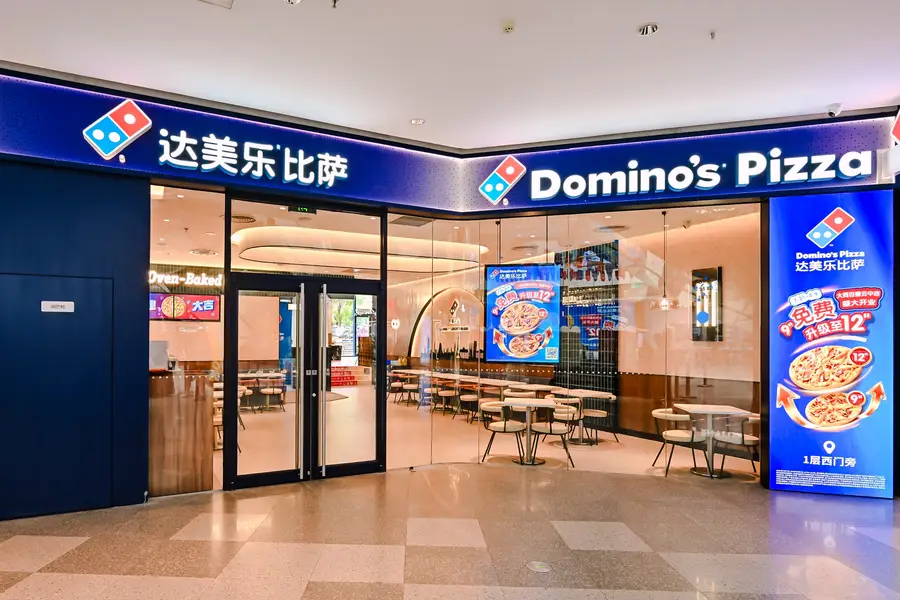
The operator of the Domino’s Pizza chain in China reported 20.8% revenue growth in the first half of the year, driven by rapid store expansion and rising transaction volumes
Key Takeaways:
- DPC Dash’s revenue rose 20.8% in the first half of 2026 to 3.13 billion yuan, as it opened 235 new Domino’s Pizza stores, bringing its total to 1,550
- Strong transaction growth, new-market demand and a growing national supply-chain network are supporting DPC’s continued expansion across China
By Doug Young
Call it pizza growth with Chinese characteristics.
That was the story in the first half of 2026 for DPC Dash Ltd. (1405.HK), operator of the Domino’s Pizza (DPZ.US) chain in Mainland China, Hong Kong and Macau. The company continued its rapid expansion into new markets during the period, while rising transaction volumes and improving group-level efficiency helped it deliver strong revenue and profit growth.
DPC’s store-opening campaign also got a major new boost in July, when it signed a new deal with one of China’s leading shopping mall operators. At the same time, its expanding supply-chain network is laying the groundwork for continued national growth. Its growth story also comes with a twist, as its recent big delivery gains have come on the back of work with third-party food delivery apps.
On Aug. 31, DPC Dash also announced the grant of 3.42 million share options to 15 employees and 1.02 million share awards to another 58. Notably, the share awards will be satisfied by purchasing existing shares in the open market, rather through than new share issuance, avoiding dilution. The options vest over four years and carry a HK$35.64 strike price, above the HK$33.30 grant-day close, providing a longer-term alignment between employee incentives and shareholder returns.
DPC began collaborating with Domino’s as early as 2010 and became the U.S. company’s master franchisee for Mainland China, Hong Kong and Macau seven years later. By comparison, leading Western rival Pizza Hut has been in China since 1990 and is currently the market leader with about 4,500 stores.
Despite its later arrival, DPC has been narrowing the gap through rapid expansion in recent years, largely by moving into smaller markets, which it calls non-tier 1 cities, where pizza is still considered a novelty by many consumers. It added 235 net outlets in the first half of 2026, bringing its total to 1,550 stores across 75 mainland Chinese cities. About two-thirds of its stores are now in non-tier 1 cities.
The company also entered 15 new cities during the first half. As of Aug. 14, it had opened another 27 stores and had 74 more under construction, signed or approved, meaning 96% of its full-year opening target was secured.
Tough market
China’s restaurant market, while huge, hasn’t been easy for anyone these last few years. China’s catering industry revenue rose 4.2% in the first quarter of this year to 1.46 trillion yuan ($217 billion), according to government statistics. But growth has been slower for larger operators like DPC, and the market has also been marred by constant cost cutting as companies cater to increasingly cautious consumers in a slowing economy.
Adding to that volatile mix, a subsidy-fueled price war among Alibaba, JD.com and Meituan’s food-delivery platforms pressured restaurant pricing and shifted some consumers from Domino’s own app to third-party channels. As a result, DPC’s delivery business increased by 8.6 percentage points to 51.7% of its total revenue in the first half of this year, mostly fueled by the third-party apps, with DPC reporting that sales over those channels rose 81% in the first half to make up 39.4% of its sales. By comparison, sales over its own channels fell 11.8% to account for 12.3% of total sales.
All those factors combined to produce strong growth in revenue, profits and transaction volumes, as consumers flocked to DPC’s online and offline channels to try out newly opened stores and take advantage of promotions. The company’s revenue rose 20.8% year-on-year in the latest six-month period to 3.13 billion yuan from 2.59 billion yuan a year earlier. Its overall transaction volume soared 33.7% during the period, as same-store transactions grew 7.1% year-on-year, marking a 22nd consecutive quarter of growth for that metric.
But the constant price pressure caused the company’s average transaction price to drop to 72.9 yuan from 80.7 yuan in the first half of 2025. That was a major factor behind a 4.8% same-store sales decline in the first half of the year. In a small positive sign, the company said same-store sales returned to slightly positive territory in May and June after a series of sales initiatives. The improvement is also probably coming from an easing in the takeout delivery wars as the three big platforms try to curb their own losses.
DPC also improved its performance with greater efficiencies that lowered its group-level expenses to 7.5% of revenue in the first half of this year from 8.1% a year earlier. Some of that is coming from its national network of supply chain centers (SCCs), which added the fourth one in August in the Central city of Wuhan to complement existing centers in Beijing, Shanghai and Dongguan. The Wuhan SCC can support more than 200 stores.
DPC said it has secured sites for two more SCCs in Chengdu and Nanjing, with operations set to begin in the second half of 2027. The expanded network should improve logistics efficiency and cost control as the company broadens its store base nationwide.
The company’s improved transaction volume and greater efficiency, despite the price pressures, helped to boost DPC’s net profit by 22.9% year-on-year in the first half to about 81 million yuan. Its adjusted earnings before interest, taxes, depreciation and amortization (EBITDA) rose 8.6% to 351 million yuan, while its adjusted net profit rose 7.4% to 98.2 million yuan.
Another recent highlight was a new partnership announced in July with SCPG, one of China’s leading shopping mall operators. That tie-up could give DPC preferred access to SCPG’s more than 220 properties across 55 Chinese cities, providing some new lift for its ongoing expansion. DPC said it has already reached agreements with SCPG regarding locations in second-tier cities such as Zhengzhou, Chongqing and Guiyang.
The company continues to focus on such non-Tier 1 cities, where the novelty factor often leads to huge business when new stores open. That’s helped DPC stores grab all top 70 positions for best first 30-day sales in Domino’s worldwide rankings. One of the latest additions came from the company’s first store in the Northern city of Harbin, which broke Domino’s global record for single-store, single-day sales by raking in over 700,000 yuan on its opening day.
But such huge crowds are also a double-edged sword, as they ultimately fade as the novelty factor wears off and business normalizes. That adds some short-term pressure.
With China still relatively under-penetrated in pizza restaurants and DPC operating just 1.1 stores per million people nationwide, the company sees considerable room to grow in both new and existing cities. Its faster expansion, strong new-store performance and strengthening supply-chain base position it to keep pursuing that opportunity.
The Bamboo Works offers a wide-ranging mix of coverage on U.S.- and Hong Kong-listed Chinese companies, including some sponsored content. For additional queries, including questions on individual articles, please contact us by clicking here.
To subscribe to Bamboo Works’ free weekly newsletter, click here.
Related Articles

RELATED ARTICLES
-
Slowing takeout dining wars leave Luckin with bitter aftertaste

- Auntea Jenny brews up bigger profits with focus on smaller cities
- Jiumaojiu’s Tai Er chain builds momentum after major brand refresh
- China’s shrinking ‘Chicken King’ scurries towards Hong Kong IPO
- Qdama misses listing window as revenue slumps, profit stagnates
- BRIEF: Yum China among bidders for KFC, Pizza Hut operator in Hong Kong, Taiwan