Qdama misses listing window as revenue slumps, profit stagnates
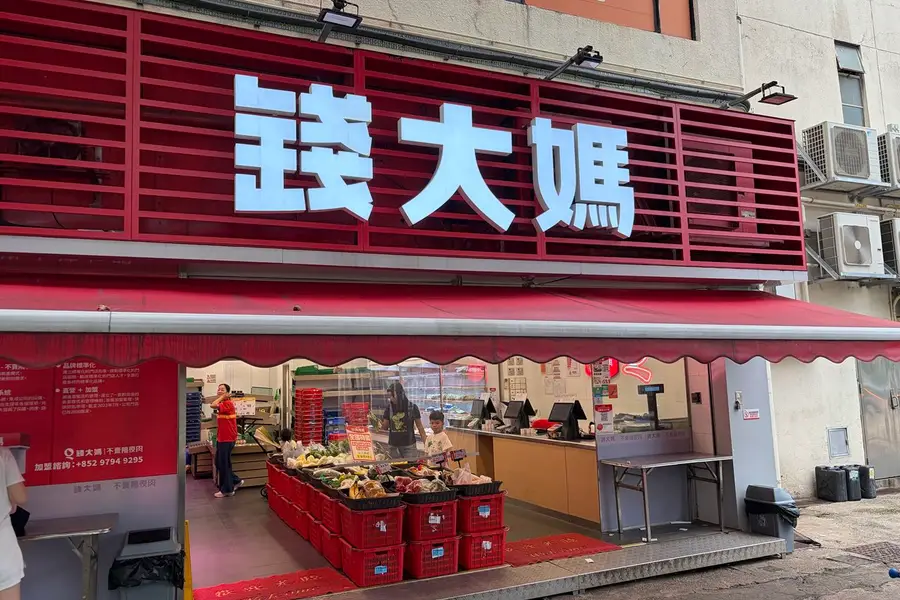
China’s largest community-based fresh food chain has reapplied to list in Hong Kong, planning to use the funds to boost its store network and supply chain capabilities
Key Takeaways:
- Qdama has renewed its Hong Kong listing application, reporting both its profit and revenue fell in the first half of 2026
- The community grocer’s footprint rebounded to more than 3,000 stores once again at the end of June
By Lau Chi Hang
Its slogan is “No overnight meat,” referring to its mission to only offer the freshest ingredients from its community-based shopping network. But a new IPO application from Qdama International Holding Ltd., filed last week, also looks just slightly stale.
The latest filing comes after Qdama’s original application at the start of this year lapsed after the maximum six months. But those six months look much longer in the current climate, which has seen Hong Kong’s wave of IPO fever earlier this year start to ebb. Even market darlings like companies involved in AI large models, chips and related infrastructure have seen their shares drop by half or more from recent peaks. That means more traditional companies like Qdama may have missed the best time to jump on the listing train.
Adding to its lukewarm timing, Qdama’s financial performance isn’t especially mouth-watering. Its revenue has been roughly flat for the last three years, ranging from 11.3 billion yuan ($1.68 billion) to 11.8 billion yuan. That continued in the first half of this year, when its revenue fell 2% year-on-year to 5.1 billion yuan.
At the same time, its net profit has been quite erratic due to fair value changes in its financial instruments unrelated to operations. The company earned profits of 169 million yuan and 288 million yuan in 2023 and 2024, only to drop to a 279 million yuan loss last year, before rebounding to a 68.05 million yuan profit in the first half of this year.
Unremarkable performance
The company’s gross profit has been similarly stagnant, rising slightly from 1.2 billion yuan in 2024 to 1.27 billion yuan last year. The metric was similarly flat in the first half of this year at 584 million yuan. Put differently, Qdama’s business hasn’t regressed, but it hasn’t advanced either, meaning its current situation can only be described as “stable” if you’re an optimist, and “stagnant” if you’re a pessimist.
That’s hardly ideal for a company seeking a compelling story for investors in search of diamonds in the rough. Understanding that, companies typically accentuate the positive in their prospectuses, often by saying how they’ll use their IPO proceeds to expand. Qdama is no different in that regard, saying it plans to use the funds to develop its store network and strengthen its supply chain capabilities.
To better understand the company’s prospects, it’s helpful first to better understand its business model. That model is fairly straightforward, mirroring the approach taken by many of China’s famous bubble tea, restaurant and toy chains. The founder typically opens a store, and spends the first few years perfecting the format and finding a path to profits. From there the next step is expansion and building up brand awareness, at which time the founder often turns to franchising to start turbocharging store counts.
By that time the founder has a more diversified revenue stream, derived from franchising fees, as well as sales from providing raw materials, equipment and store decorations to franchisees. Revenue from these franchise networks can easily exceed 90% of the company’s total. Meantime, self-operated stores often become an afterthought, functioning more like prototypes to demonstrate the business’ operations.
Such a model demonstrates that Qdama must keep building up its franchise network if it wants to jumpstart its growth and attract investors.
Shrinking footprint
But opening new stores is often easier said than done. Founded in 2014, Qdama evolved from a single small store into a vast network with thousands of locations in just a few years. As the business grew, founder Feng Jisheng, who has since left the company, aimed to create a national chain that had 3,700 stores at its peak in 2021.
But the company ran into headwinds with its plan to expand to North China, which went far less smoothly than in its base in the South. It discovered that Northern Chinese are less particular than their Southern peers, less worried about the freshness of meat and content to eat frozen products. It also discovered that rents in large Northern cities were sometimes exorbitant, leading to a crushing defeat that saw the company sharply downsize its footprint in that part of the country.
As it retreated, Qdama’s store count fell to just over 2,900 by the end of last year. It resumed expanding this year as it marched towards its IPO, opening new stores that brought its total to 3,014 by the end of June.
Roughly two-thirds of Qdama’s stores are currently located in South China’s Guangdong province. The company has not only failed to step out of the South, but is reaching saturation in its home province.
Fierce competition and low margins
In the absence of a growing store count, the company might still be able to attract investors with rising gross margins from its growing experience and economies of scale. But Qdama’s gross margin is quite thin and only growing slowly, a common predicament for many grocers. The figure rose from 9.8% in 2023 to 11.2% last year, and reached 11.5% in the first half of this year.
Making matters worse, Qdama has been forced to focus its expansion on Guangdong, resulting in geographic concentration that has led to cannibalization of its own stores, which sometimes can be as close as just 250 meters apart.
Hong Kong currently lacks any listed companies with similar profiles to Qdama’s. But comparable food ingredient companies include Guoquan (2517.HK) and Xiaocaiyuan (0999.HK). Weakening stock market sentiment is being compounded by a broader lack of interest in consumer companies, which are being forced to cut prices amid weak consumer demand. That doesn’t bode well for a company like Qdama.
Guoquan has tumbled from a high of HK$4.75 in June to just HK$1.76 recently, dropping its trailing price-to-earnings (P/E) ratio to just 8.5 times. Xiaocaiyuan’s stock has fallen by over 30% from its high in the past year, giving it a trailing P/E ratio of 13.5 times. Similar-level valuations for Qdama could give it a post-listing valuation of between HK$1.4 billion and HK$2 billion – hardly mouth-watering for investors looking to buy into China’s next grocery giant.
To subscribe to Bamboo Works weekly free newsletter, click here
Related Articles
RELATED ARTICLES
-
China’s shrinking ‘Chicken King’ scurries towards Hong Kong IPO
-
Is Shenzhen Pagoda still a top banana in China’s massive fruit market?
2411.HK
- Slowing takeout dining wars leave Luckin with bitter aftertaste
-
Miniso gets AI investment lift, as self-developed toys look for traction
9896.HKMNSO.US
-
Cafe de Coral emerges to new dawn, as hidden concerns remain
0341.HK