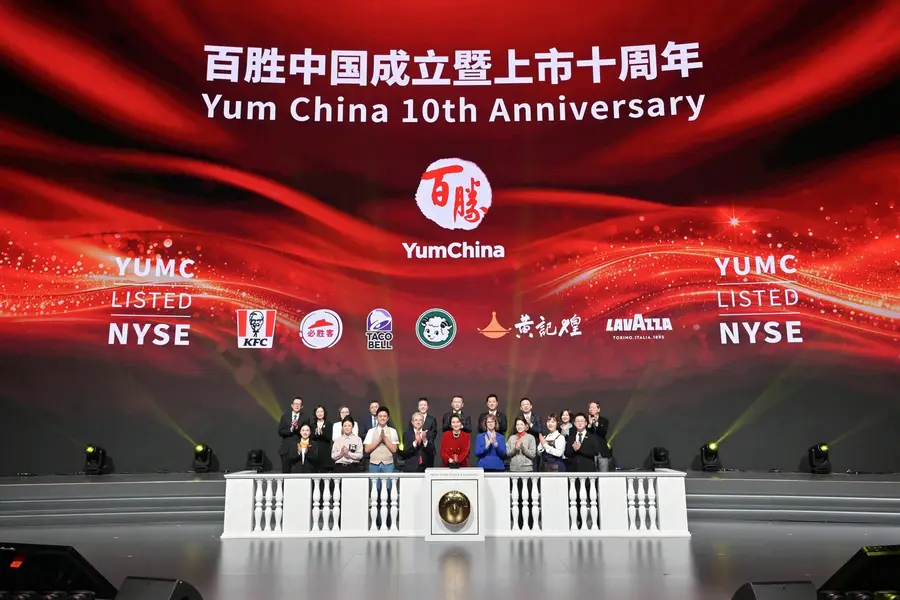
The operator of the KFC and Pizza Hut chains reached its latest milestone just six years after opening its 10,000th store in 2020
Key Takeaways:
- Yum China has opened its 20,000th store in China, with plans to add another 10,000 restaurants by 2030
- The operator of the KFC and Pizza Hut chains in China also unveiled a new “AI Store Assistant” designed to make store management easier and more efficient
By Doug Young
Yum China Holdings Inc. (YUMC.US; 9987.HK) celebrated a major milestone on Thursday, with the opening of six new restaurants simultaneously that brought its store count to the 20,000 milestone. Few could have imagined the company would eventually emerge as China’s largest restaurant company when it entered the market with its first KFC nearly 40 years ago. Today, that empire has grown into 14,307 KFCs at the end of September, as well as 4,740 Pizza Huts, the company’s other major brand.
Yum China also celebrated another major milestone on Thursday by marking the 10th anniversary of its spinoff as a separately listed company from Yum Brands (YUM.US). Since that split, the company has delivered some tasty returns to investors in the form of a doubling of its stock price, as well as more than $7 billion in dividends and share buybacks over the last decade.
Yum China also took the opportunity to showcase its latest AI initiative, an “AI Store Assistant” designed to make life easier for its thousands of store managers while also boosting restaurant efficiency.
The 20,000-store milestone is just the latest way station for the company, as it accelerates its pace of expansion with an eye to reaching the 30,000-store mark by 2030. The company took 33 years after opening its first KFC in Beijing in 1987 to reach the 10,000-store mark in 2020. It added the next 10,000 far more quickly in just the last six years. The latest target would see it add the same number in just four years, or one new store every three to four hours.
The expansion story is multifaceted, led by Yum China’s charge into the country’s many smaller markets in addition to its original cities like Beijing and Shanghai, where it competes with rivals like McDonald’s (MCD.US) and local chains like Tastien. To ease the pressure, the company is trying to outrun the competition with new stores openings, many in smaller markets. In the 12 months through September this year, KFC entered more than 370 new cities and towns, while Pizza Hut entered more than 350.
Yum China and its peers are also grappling with a slowing Chinese economy that is causing consumers to become more cautious and value-conscious. Reflecting that, revenue from China’s catering industry rose between just 1% and 2% in each month of this year’s third quarter, slowing sharply from 4.2% in the first quarter. In that climate, excluding a favorable foreign exchange impact, Yum China’s system sales still grew 3% year-on-year in the third quarter, outperforming the broader catering industry.
“In a dynamic operating environment, we remain laser-focused on execution — solving problems, turning strategy into action, and delivering sustainable profitable growth,” Yum China CEO Joey Wat said in an announcement of the latest milestone.
Yum China reached the milestone with the opening of one new store for each of its six major brands: its core KFC and Pizza Hut; as well as its Lavazza coffee chain; its Taco Bell Mexican chain; its Little Sheep hotpot chain; and Huang Ji Huang, its chain making traditional Chinese simmer pots.
The company also celebrated by bringing about 10,000 of its restaurant general managers to its annual restaurant general manager convention in the interior city of Chengdu, capital of Sichuan province, known for its spicy food and Chinese culinary prowess.
New formats, new modules
Yum China’s rapid expansion has owed in no small part to its experimentation with new store formats and intense menu localization over the years.
The original KFC in Beijing was revolutionary for its time, offering a level of customer service unseen before by most Chinese when it opened, even though its meals cost around 20 yuan, equal to about a fifth of the average monthly paycheck for many at that time.
The company initially stuck to a simple menu of its core products, including its signature Original Recipe Chicken, mashed potatoes, coleslaw, biscuits and a few soft drinks. Fast forward to the present, when KFC’s China menu features such things as whole chickens, egg tarts and sparkling coffee. Pizza Hut, Yum China’s second largest brand, also features such innovative items as durian pizza and Pizza Dough Burgers on the menu.
Yum China has rolled out a range of different formats for both KFC and Pizza Hut, including compact ones that are easier to open and more cost efficient in smaller markets. It has also begun rolling out newer modules over the last few years that operate side-by-side with existing KFCs and Pizza Huts, allowing for faster openings and greater efficiencies through practices like shared kitchens. Such modules include KCOFFEE cafes, with more than 4,000 locations at the end of September; light meal specialist KPRO, with more than 700 locations; and Pizza Hut’s Burger Bar, which surpassed 300 locations.
The company has also embraced franchising to accelerate its growth, after years of operating its own stores to ensure quality. Its network of franchised KFC and Pizza Hut outlets is expected to grow from more than 500 in 2018 to a target of 5,000-plus by 2028.
In its latest announcement, Yum China also unveiled its latest AI initiative, the “AI Store Assistant,” which builds on its “Q-Smart” AI-enabled assistant that began piloting last year to help restaurant managers with data-intensive tasks. The newest agent is designed to continue easing that burden and improve efficiency by integrating AI and advanced technologies with restaurant operating data and connected kitchen equipment to perform functions like recommending production adjustments and staffing needs based on restaurant traffic, staffing and inventory levels.
As those and other efficiency-boosting steps take effect, Yum China reported its restaurant margin rose by 0.5 percentage points year-on-year to 17.8% in this year’s third quarter, also crediting lower commodity prices. The company’s latest quarterly report, released earlier this month, showed its revenue rose 8% year-on-year in the quarter to $3.48 billion, as its net income rose 10% to $311 million. It opened 692 net new stores during the quarter to bring its total to 19,989 – more than double the 8,395 for McDonald’s in China, its closest rival.
Despite the challenging macro environment, the people who follow Yum China remain quite positive on the company. Twenty of the 21 analysts surveyed by Yahoo Finance rate the company a “buy” or “strong buy.” And the company’s stock is up modestly this year, a relative feat in a market where many Chinese stocks are down, reflected by a 5% decline in Hong Kong’s Hang Seng Index, and an even larger 7% decline for the Shanghai Composite Index.
The Bamboo Works offers a wide-ranging mix of coverage on U.S.- and Hong Kong-listed Chinese companies, including some sponsored content. For additional queries, including questions on individual articles, please contact us by clicking here
To subscribe to Bamboo Works free weekly newsletter, click here
Related Articles

RELATED ARTICLES
-
BRIEF: Yum China not included in second bidding round for Jardine Restaurant Group

- BRIEF: Yum China among bidders for KFC, Pizza Hut operator in Hong Kong, Taiwan
- DPC Dash bakes up Domino’s pizza giant with Chinese characteristics
- China’s shrinking ‘Chicken King’ scurries towards Hong Kong IPO
-
Xiaocaiyuan shuns takeout delivery for in-restaurant dining
0999.HK
- How foldable phones are opening new paths for flexible printed circuits
-
LDRobot chases European opening with low-cost acquisition
1236.HK