Hello Kitty’s political misstep and Pop Mart’s Labubu slump reveal China’s toy business realities
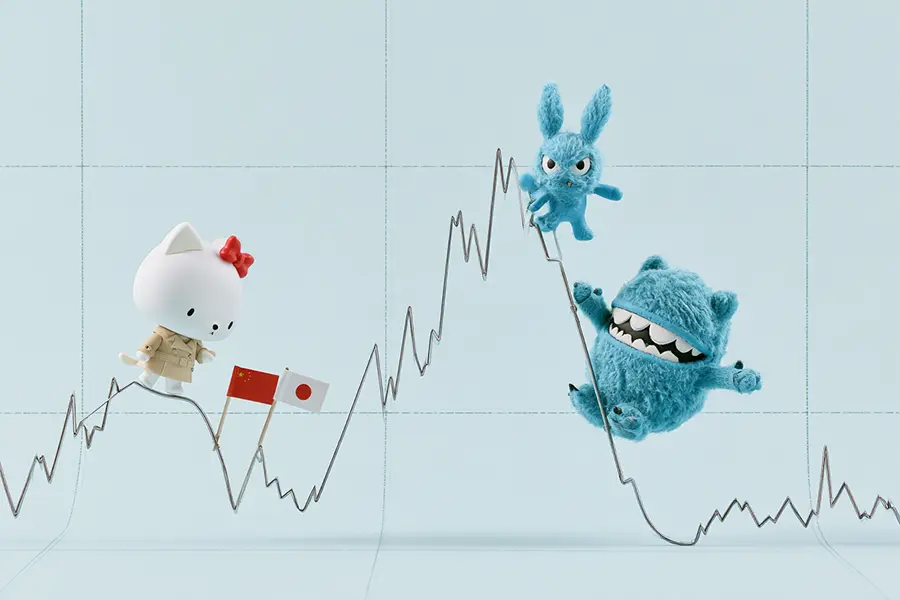
“In a calmer time, this would have been just a dispute about a TV drama, but today, the climate that we have with geopolitics, it can really become kind of a loyalty test or a test of national respect.” – on how heightened geopolitical friction turned a Hello Kitty costume controversy in China into an urgent corporate test.

Key Takeaways:
- Sanrio’s Hello Kitty misstep shows that global brands operating in China must grant local teams oversight over cross-border licensing before creative partnerships trigger nationalist backlashes
- Pop Mart faces a defining transition to prove its broader stable of character intellectual property can sustain long-term growth after its viral Labubu craze cooled
By Adam Najberg and Doug Young
Toys may look like simple child’s play, but in China, they’re big business — and deeply vulnerable to both geopolitical crosswinds and shifting consumer fads. Over the past several weeks, two distinct toy narratives highlighted the operational realities facing consumer brands in the country: Japanese icon Sanrio (8136.T) found its flagship Hello Kitty ensnared in a nationalist tempest, while domestic designer-toy leader Pop Mart (9992.HK) is confronting the painful aftermath of a viral toy craze that suddenly lost altitude. Both episodes show that whether a company is managing cross-border cultural flashpoints or trying to build a durable franchise, operating in the world’s second-largest consumer economy leaves little margin for error.
For Sanrio, trouble arrived when Chinese netizens objected to Hello Kitty merchandise styled after costumes from the Japanese television drama Vivant. The spy thriller’s latest season featured a fictional Chinese intelligence unit capturing and torturing Japanese agents. Faced with mounting online anger, Sanrio issued a swift apology and cut ties with the broadcast franchise.
When you do the math, Sanrio’s calculation was straightforward. Hello Kitty brings in approximately $4.3 billion in annual global sales, with China alone delivering about $62 million in the first quarter of this year — tracking toward roughly $250 million annually. Sacrificing a tie-up with a single TV drama to protect a 50-year-old brand in a vital market was really the only logical outcome.
Yet an apology alone doesn’t instantly clear the air. In China, when a controversy gets picked up and amplified by state media outlets like CCTV, offending companies generally have to spend time in an unofficial penalty box. Similar backlashes have hit entities from the NBA to Arc’teryx. While Chinese shoppers remain sophisticated and Japanese consumer brands still hold a firm place in their hearts, the current political climate — strained by Tokyo’s stance on Taiwan under Prime Minister Sanae Takaichi — acts as an amplifier. What might once have stayed a minor dispute over television imagery quickly morphed into a test of national respect.
Managing these flashpoints requires prevention rather than reactive damage control. There’re some cases where international companies avoid trouble simply by giving boots-on-the-ground teams in China early oversight of global licensing and creative partnerships to catch sensitive symbolism before rollouts occur. If a controversy does emerge, executives must quickly map exposure across customers, state media, and regulators, determine what can legally and ethically be conceded, and maintain one consistent factual message across platforms like Weibo and WeChat without offering conflicting statements in overseas markets like the U.S. Selective messaging rarely survives the scrutiny of modern digital audiences.
Pop Mart looks to build an empire beyond its first viral hit
While Sanrio grappled with cross-border sensitivities, Pop Mart faced a classic consumer-lifecycle dilemma. A year ago, its toothy Labubu elf figure was a ubiquitous global sensation, spotted with celebrities ranging from David Beckham and Rihanna to Kim Kardashian. But fads inevitably cool. A steep drop in Labubu sales contributed to Pop Mart’s overall sales falling by around half in the third quarter of this year, dragging its stock down from previous meteoric peaks.
We don’t view this pullback as a sign that the sky is falling. Instead, Pop Mart has reached the end of its Cabbage Patch doll, Pet Rock, or Tamagotchi moment. The critical question now is whether the company can build a true ecosystem flywheel. Labubu drove the bulk of recent revenue, but Pop Mart has assembled a diverse stable of creative intellectual property, including character families like Molly, Skullpanda, Crybaby, and Twinkle Twinkle. Combined, these non-Labubu lines are approaching what Labubu produced at its peak.
A visit to the company’s Popland attraction in Beijing illustrates this broader ambition. While Popland is not Disneyland, it reflects a similar aspiration. The inner-city park is meticulously managed, complete with a castle, themed culinary offerings, and rich character lore. In contrast to Disney, which pioneered its brands via films before moving to merchandise and theme parks, Pop Mart is working in reverse — leading with collectible characters and expanding into experiential entertainment and digital media.
Discretionary spending is softening globally, making the toy sector challenging. Yet Pop Mart marks an evolutionary step for Chinese manufacturing: shifting from simply assembling the world’s toys to capturing the upstream value of owning original character IP. Much like South Korean artist Psy’s viral “Gangnam Style” opened international gates for the wider K-pop industry, Labubu demonstrated that a Chinese toy character could achieve worldwide cultural traction. Pop Mart’s challenge is proving it isn’t merely a one-hit wonder. By converting casual trend-followers into long-term enthusiasts who buy into backstories and character ecosystems, the company has an opportunity to establish itself as creative China’s first enduring global brand.
Edited by Brent Li
About China Inc
China Inc by Bamboo Works discusses the latest developments on Chinese companies listed in Hong Kong and the United States to drive informed decision-making for investors and others interested in this dynamic group of companies.
Subscribe to China Inc on your favorite app:


Related Articles

RELATED ARTICLES
-
Pop Mart’s bubble bursts with fading Labubu craze
-
Miniso gets AI investment lift, as self-developed toys look for traction
9896.HKMNSO.US
-
Hello Group courts big spenders abroad as Chinese daters economize
MOMO.US
- Pop Mart’s second-half growth target looks difficult, sparking share selloff
- From pop concerts to plush toys, Damai expands its ecosystem
-
After nine lost years, China Literature opens new chapter with AI-IP combo
0772.HK
-
State subsidies and partner panic: What the latest cross-border deals reveal about business in China
0458.HK