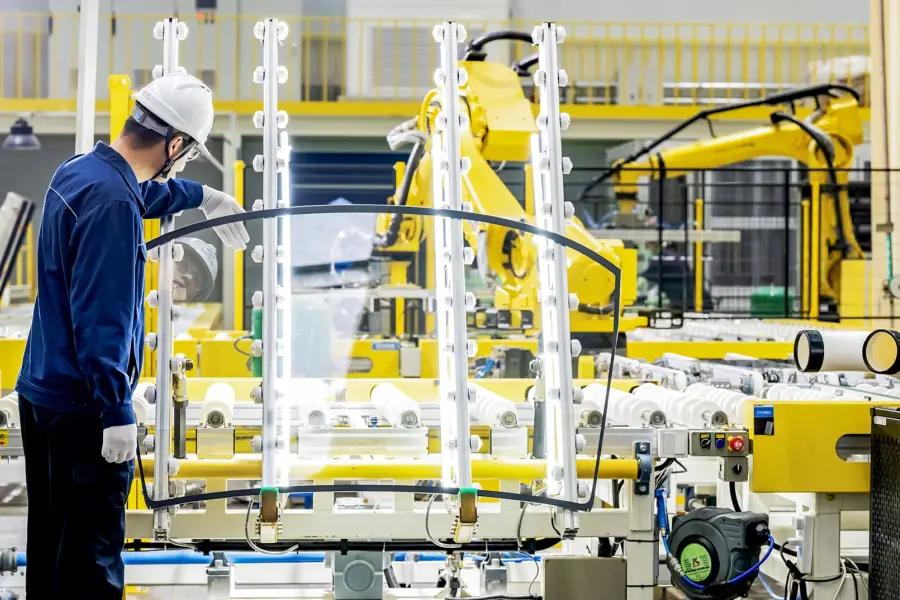
The automobile glass maker’s revenue rose marginally in the first three quarters, as it accelerates smart glass development to jumpstart its stalling growth
Key Takeaways:
- Fuyao Glass’ revenue rose 2.46% in the first three quarters of 2026, while its net profit dropped by 14.97%
- The car glass maker’s profit was dragged down by 1.07 billion yuan in foreign exchange losses during the nine-month period
By Lee Shih Ta
Chinese automakers are at an important fork in the road, racing to boost their exports to offset rapidly slowing domestic demand. Domestic retail sales of passenger vehicles tumbled by 28% year-over-year in September alone, while passenger vehicle exports drove in the other direction with a 73.7% surge.
An important part of that picture is automotive glass, which is evolving beyond a traditional safety component into other functions such as heat insulation, light control and instrument display, ushering in a new generation of smart cars.
At the center of that story sits the world’s largest automative glass maker, Fuyao Glass Industry Group Co. Ltd. (3606.HK; 600660.SH), whose latest quarterly report released last week reveals the tensions inherent in the transitioning world around it. Fuyao’s revenue expanded marginally in the first nine months of the year, rising 2.46% year-on-year to 34.12 billion yuan ($5.11 billion). Its net profit slipped into reverse, falling 15% to 6 billion yuan over that time.
The trends were similar in the third quarter, as revenue for that three-month period rose 2.51%. Its third-quarter profit dropped by 9.87% year-over-year, improving slightly from the first half’s decline rate.
Foreign exchange factors have been a primary culprit undermining profits for many Chinese companies with big overseas sales this year, as the yuan has appreciated sharply against the dollar and euro. Fuyao recorded forex losses of 1.07 billion yuan during the period, in contrast with 418 million yuan in forex gains a year earlier. After stripping out that impact, the company’s profit for the first three quarters increased, but by just 1.18% year-over-year, as both revenue and profits showed signs of stagnating.
Overseas markets represent a crucial source of revenue for Fuyao. The company’s revenue from outside China totaled 20.86 billion yuan last year, accounting for approximately 45.5% of its total. And foreign revenue rose 18.81% last year.
Faced with exchange rate volatility, Fuyao is also adjusting its hedging strategy. The company announced last week that its board of directors has authorized it to conduct foreign exchange derivatives trading over the next 12 months. The upper limit for the maximum contract value held on any given trading day has been increased from $500 million to $1 billion, covering product categories that include forwards, swaps, and options, with an aim of managing fluctuations in both foreign exchange and interest rates.
Meantime, the company’s net cash flow from operating activities during the first three quarters totaled 8.26 billion yuan, down 16.44% year-on-year. Cash received from the sale of goods and provision of services was largely flat, while payments for procurement and employee expenses rose. At a time when revenue growth remains limited, the rise in operating expenses is placing clear pressure on the company’s cash flow.
In a bid to jumpstart its growth, Fuyao is looking to growing penetration of new energy vehicles (NEVs), combined with the growing use of smart car features that use windows as displays. It’s also looking into other added roles for glass in cars, such as for heat insulation, light control and privacy.
With such features in mind, Fuyao is pushing car makers to upgrade their designs to include its newer lines of higher-value products. The company is also advancing industry standards for dimming glass, and has partnered with NEV maker XPeng to jointly develop AI dimming privacy glass. Such features are expanding the role of car glass from a mere safety component into more versatile functions, which is expected to boost the per-vehicle value of the glass it sells.
Growth awaits acceleration
The company’s midyear report shows that high-value-added products increased by 8.03 percentage points year-over-year in its product mix during the first half of 2026, though no related data was given in the new third-quarter report. The company’s overall gross margin for automotive glass improved by 1.55 percentage points year-over-year to 32.45% in the first half, consistent with the greater contribution for high-value-added products that typically carry higher margins.
Fuyao also manufactures train glass and operates in the float glass and automotive trim businesses. It also possesses mass-production capability for solar panoramic roof glass, though that remains an application of solar technology tailored to automobiles separate from the larger photovoltaic glass market.
The company’s automotive glass revenue totaled 20.27 billion yuan in the first half of this year, accounting for approximately 92.3% of total revenue during that time. That shows that despite their promise, other applications have yet to evolve into primary revenue pillars for the company.
That means the ebbs and flows of the mainstream automotive market will continue to set the pace for Fuyao’s financial performance for now. The rise of NEVs and China’s growing auto exports have created opportunities for high-configuration glass and overseas supply. But overall demand for vehicles within China has yet to show signs of a turnaround. Whether product upgrades can successfully jumpstart Fuyao’s anemic growth could ultimately hinge on an acceleration in the adoption of high-value-added products, as well as whether its overseas network can generate stronger gains.
Fuyao’s Hong Kong-listed shares plummeted the day after the latest quarterly report, sending its stock near the lower end of its 52-week trading range. UBS subsequently downgraded its price target for the stock by 6% to HK$75.20 and revised down its profit forecasts for 2026 to 2028 by 6% to 9%, though it maintained a “buy” rating.
Valuation-wise, Fuyao currently trades at a price-to-earnings (P/E) ratio of about 14 times, which is higher than the 11 for rival Xinyi Glass (0868.HK). That reflects investor belief in Fuyao’s stronger global supply capabilities, along with high expectations for its high-value-added products.
But when revenue growth slows and profit forecasts are revised down, those same investors will start clamoring for the company to show its competitive advantages can start translating into actual profits more rapidly. Moving forward, many will be watching to see whether the company’s new products can secure wider adoption among automakers, driving up per-vehicle sales, and rekindling business momentum at a time when the company’s overall growth is slowing.
To subscribe to Bamboo Works weekly free newsletter, click here
Related Articles

RELATED ARTICLES
-
Energized by strong profit growth, Zenergy Battery eyes Shenzhen IPO
 3677.HK
-
Fuyao Glass’ first-half profit falls 17% as FX losses drag
600660.SHG
-
Xinyi Glass posts revenue decline, but profit rises on cost cuts and lower losses
0868.HK
-
Lens Technology’s third-quarter profit halves on rising forex losses
300433.SHE
-
Forex losses, fair-value changes weigh on Sanhua Intelligent’s profit
2050.HK002050.SHE
- Losses, losses and more losses. How far down the road is WeRide’s profitability?
-
The next big EV idea for investors? Bethel bets on the intelligent chassis
603596.SHG