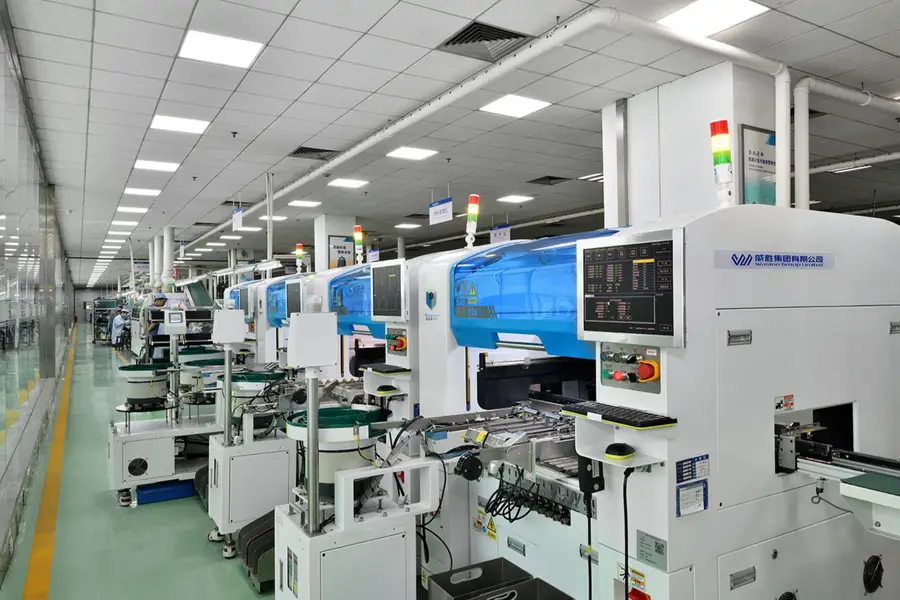
The provider of energy systems for data centers and utilities is expanding overseas and winning grid orders at home, although shareholders are seeing limited benefit
Key Takeaways:
- Wasion has won state utility contracts worth nearly $94 million this year and orders from AI data centers are surging
- But profits from smart grids and energy management systems are slipping, weighing on margins
By Lee Shih Ta
The buildout of AI data centers is sending ripple effects through industries from chips to power equipment, generating increased demand for enabling technology.
The data centers need reliable, high-capacity power systems and are also driving upgrades of electricity grids to handle the additional load. A beneficiary of both power needs is equipment maker Wasion Holdings Ltd. (3393.HK).
Wasion started out making electricity meters and has branched out into systems for power management, distribution and storage. Meanwhile, it has continued to supply China’s giant power grid and recently won fresh orders from the state-owned utility.
The company announced on Nov. 2 that two subsidiaries had won contracts from the State Grid Corporation of China worth around 241 million yuan ($36 million) for smart meters, transformers and data collection terminals. That brought its total contract wins from the utility’s centralized tenders this year to 624 million yuan.
Shift into power systems
Founded in 2000, Wasion listed in Hong Kong in 2005 and went on to push beyond energy metering to offer smart solutions for power use and distribution. Its move into data centers through prefabricated power distribution modules, modular IT units and high-voltage direct current supply systems builds on years of experience in customized design, integration, delivery and after-sales service.
The power grid provides another source of demand. Wasion has long participated in centralized procurement and says its high-end electricity metering products command more than 20% of the Chinese market. The latest contract wins underline its expertise and standing in the utility sector but are equivalent to just 4.5% of the group’s first-half revenue. As such they cannot alter the growth trajectory, and the resulting profits will also depend on delivery schedules and costs.
Evolving revenue mix
The data center business is growing more rapidly, with contract wins jumping 153% to 1.89 billion yuan in the first half. The company serves China’s three major telecoms operators while expanding its customer base among internet companies and third-party data centers. Beyond China, it has entered markets including Malaysia, Thailand and Indonesia. However, the contract figures represent orders yet to be delivered and recognized as revenue, and they cannot be entirely classified as AI business.
Still, international expansion is starting to show up in sales. Overseas income rose 92% to 2.39 billion yuan in the first half, amounting to around 44% of group revenue. In October around 1.25 billion yuan in smart grid orders from the Middle East was secured that should flow into delivery and revenue in stages over three years. While overseas production and service facilities help the firm meet local needs, they also come with risks around project execution and payment collection.
The company’s earnings mix is changing. Revenues from the provision of digital energy services, covering power distribution, data centers and energy storage, rose 97.6% to 2.39 billion yuan in the first half. The revenue share surged to 44% from around 28% a year to make it the biggest business segment, with profit rising to 345 million yuan from 121 million yuan.
It was a different story with the other business lines. First-half profit from the smart grid and energy management segments sank 20.6% and 37.1%, with a combined fall of around 169 million yuan offsetting most of the 224 million yuan increase derived from digital energy. The latest subsidiary results also reflect that pressure: Willfar (688100.SH) reported a 15.1% revenue fall and a 29.6% profit drop for the first nine months, leaving its earnings lagging year-earlier levels.
Group revenue rose 22.8% to 5.39 billion yuan over the same period, but overall gross margin slipped from 35.13% to 31.28%. Total profit increased 11.1% to 651 million yuan, while profit attributable to non-controlling interests rose 40.3% to 205 million yuan. As a result, profit attributable to shareholders grew just 1.4% to 446 million yuan. Returns from the new businesses have not translated into a comparable increase in earnings for shareholders.
Competition also warrants attention. Kstar (002518.SZ) and Kehua Data (002335.SZ) both supply power electronics and data center solutions, overlapping Wasion’s offering. Wasion’s grid technology and overseas service network help it compete for contracts, but do not necessarily give it pricing power. It must continue to invest in R&D and local services while balancing order growth with profitability.
News of the state grid contracts failed to lift the stock. Wasion fell 0.56% to HK$10.66 on the day of the announcement, ending 69% below a 52-week high of HK$33.80. Its trailing price-to-earnings ratio is around 9, below Kstar’s 22 and Kehua Data’s 33. Investors have sharply scaled back the value assigned to the company’s growth prospects.
Wasion’s valuation may look attractive compared with its mainland-listed peers, but any gains could still be capped by declining profits in some businesses, a lower gross margin and overseas delivery risks. If its digital energy business expands, other segments stabilize and margins recover, the stock could command a higher price. If revenue keeps rising while shareholder returns stagnate, the low valuation may persist. For investors, earnings growth and order delivery will carry more weight than another contract win.
To subscribe to Bamboo Works weekly free newsletter, click here
Related Articles
RELATED ARTICLES
-
Can crypto power supplier Boco plug into the AI boom?
-
Easy Smart’s meteoric AI surge masks its low-tech roots
2442.HK
- Booming electricity demand feeds KeLiang’s niche in power grid simulation
- After years on the sidelines, VNET seizes on China’s AI moment with new CATL tie-up
-
After pricy robotics push, CSG powers up for Hong Kong listing
300222.SHE
-
Digital China’s AI reboot gets stuck in its low-margin past
0861.HK
-
Lingyi pitched AI to Hong Kong. But the iPhone Duo may be powering its rebound
1688.HK002600.SHE