Kazakhstan taps Hong Kong to fund its new ‘Journey to the West’
KTZ is rumored to be planning a launch for its Hong Kong IPO as early as October, seeking to raise up to $5 billion to build new routes for western-bound Chinese freight
Key Takeaways:
- Rail operator Kazakhstan Temir Zholy is reportedly preparing to launch its Hong Kong IPO as early as October, after filing its initial prospectus in June
- Cross-border cargo accounted for only 10% of the company’s freight volume in 2025, but contributed 33.6% of its freight revenue
By Lee Shih Ta
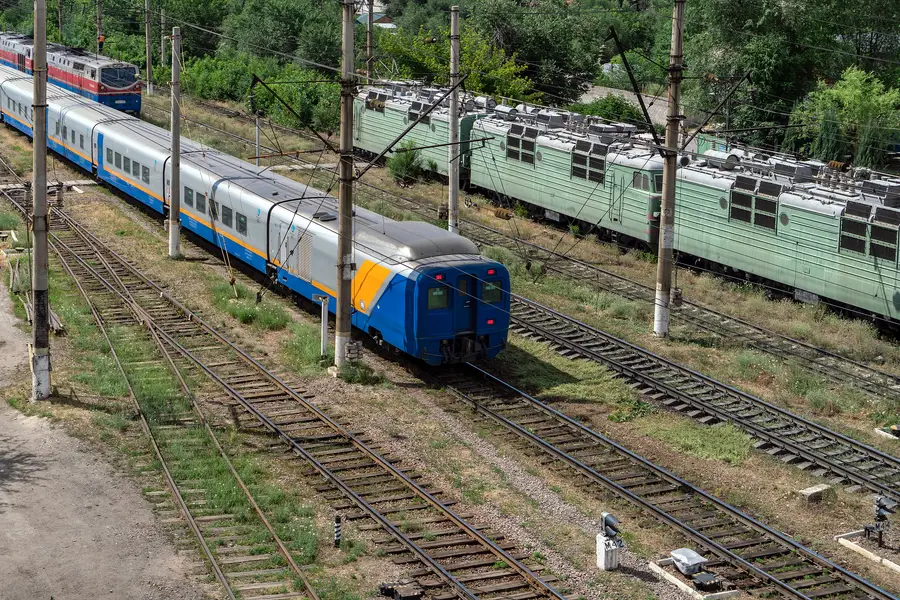
Freight trains traveling from China to the West often pass through Kazakhstan on their way to destinations across Eurasia, making the Central Asian nation an important link on this modern steel version of the Silk Road. Positioned at that crossroad, Kazakhstan Temir Zholy (KTZ), the country’s rail operator, is now looking eastward to finance its Eurasian overland transport dreams by tapping the Hong Kong capital market.
Specifically, the company is planning to raise up to $5 billion through a listing on the Hong Kong Stock Exchange, and could launch the IPO as early as October after filing its initial prospectus earlier this year, according to Kazakh media reports last week.
Saltanat Satzhan, a managing director at KTZ’s parent, the Kazakh sovereign wealth fund Samruk-Kazyna, previously told the South China Morning Post that KTZ aims to complete the Hong Kong listing before the end of this year.
Wholly owned by Samruk-Kazyna, KTZ operates approximately 16,000 kilometers of railway in Kazakhstan, connecting China, Central Asia, Russia, and the Caspian Sea region. Its network facilitates the movement of a wide range of goods between China and Eurasia, ranging from finished products, to commodities like coal, mineral ores, grain and petroleum products. The company transported 320 million tons of cargo last year, with the freight business accounting for nearly 90% of its revenue.
KTZ’s transit freight operations are likely to emerge as a crown jewel as it prepares to go public, and thus merit particular scrutiny. While this category accounted for just 10% of its freight volume in 2025, it generated 33.6% of freight revenue. Longer shipping distances for transit cargo and exemption from domestic Kazakh tariffs is partly to credit for the segment’s relatively large revenue contribution compared to its volume share. The company’s transit freight volume grew from 27.3 million tons in 2023 to 33 million tons in 2025. The figure could continue to climb at a similarly brisk pace if cross-border cargo flows continue to climb.
‘Middle Corridor’ prospects
As the world’s biggest manufacturer and one of its largest commodities consumers, China is pivotal to KZT’s expansion blueprint. KTZ operates the Khorgos Gateway dry port and is also has logistics operations in the Western Chinese city of Xi’an and the Eastern port city of Lianyungang.
In its prospectus filed in June, the company proposed funneling a portion of its IPO proceeds into constructing its planned 272-kilometer Bakhty-Ayagoz railway line, which would add another border crossing into China. For the company, the new line’s value hinges on whether the dry port, tracks, and transportation services can generate a surge in freight volume, since building extra capacity doesn’t guarantee it will get used.
Industry trends certainly provide a foundation for KTZ’s expansion plan. A 2023 World Bank study noted that the Trans-Caspian International Transport Route, or “Middle Corridor,” connecting China and Europe via Central Asia and the Caucasus, has the potential to triple its freight volumes and halve travel times by 2030 if necessary policy improvements and investments are made. However, cross-border cargo volumes remain constrained by the efficiency of ports, customs and railways along the route.
Data from KTZ’s prospectus also shows that not all Eurasian freight routes are expanding in tandem. The volume of transit containers traveling between China and the EU via Kazakhstan dropped by 31% from roughly 662,000 twenty-foot equivalent units (TEUs) in 2021 to about 458,000 in 2025, according to the document. While this doesn’t necessarily translate to a contraction in KTZ’s overall transit business, it illustrates that freight flows shift with trade patterns and geopolitical dynamics. How much cargo the new crossing can capture will still depend on actual transit times, costs, and route stability.
The company’s total revenue and other income climbed 27.4% last year to 2.76 trillion tenge ($6.26 billion). Its net profit for 2025 more than doubled to 343.6 billion tenge, as its gross margin climbed to 30.2% from 25.1% the previous year. The company said the growth was fueled by higher transit volumes, upward revisions in regulated tariffs, and favorable commodity market conditions. Notably, Kazakhstan’s regulated freight tariffs were raised by about 24% and 28% in 2024 and 2025, respectively.
Funding pressures
Behind its strong growth, KTZ still faces fierce competition from rival Eurasian transport routes. Shippers can opt for a northern route through Russia, the Middle Corridor across the Caspian Sea, or simply default to maritime shipping. Their choices ultimately hinge on freight rates, delivery times and route reliability.
KTZ’s routes also present a unique logistical challenge because Kazakhstan and China operate on different railway gauges, meaning cargo must be transloaded at the border. Therefore, even after expanding its domestic capacity, KTZ must continue to rely on its neighbors for tracks outside its borders, as well as seamless coordination of border crossings to successfully capture a larger share of Chinese freight flows.
Meanwhile, its ongoing expansion is also testing KTZ’s finances. By the end of 2025, the company’s net current liabilities stood at 963 billion tenge, with total liabilities swelling to 5.21 trillion tenge. For the year, its operating activities generated 746.8 billion tenge in cash, whereas investing activities consumed 932.3 billion tenge.
KTZ projects that its capital expenditures from 2026 to 2030 will exceed those of the previous five-year period, with roughly 61% of planned investments slated for funding through external borrowing. Aside from constructing the new border line into China, the company plans to use its IPO proceeds for digitalization initiatives and paying down a portion of its interest-bearing debt.
Determining its valuation will be the final hurdle KTZ faces on its road to a Hong Kong listing. The company is reportedly angling for a valuation of up to $30 billion, though some analysts believe the actual figure will fall short of that mark. A $30 billion valuation, combined with the company’s net profit of roughly $700 million in 2025, translates to a price-to-earnings (P/E) ratio north of 40 times, a goal that may prove overly aggressive.
On the whole, KTZ boasts a relatively unique railway network that is difficult to replicate, firmly positioning it to capitalize on the growing flow of goods between China and Eurasia. Its outlook will ultimately depend on whether its newly added capacity can attract sufficient cargo and revenue to justify the high valuation it’s seeking, while paying for its construction investments, and servicing its debt load.
To subscribe to Bamboo Works weekly free newsletter, click here
Related Articles

RELATED ARTICLES
-
PCI Technology stuck in low-margin ICT systems integration
 600728.SHG
 - Dobot taps Shenzhen market to fund its bet on humanoid robots
-
Junxin chases Hong Kong IPO, seeking funds to export its trash-to-cash story
301109.SHE
- Trunk Technology drives ahead in search of profits
- Leadrive IPO taps into China’s EV export boom
- ESWIN Computing powers up its RISC-V growth story for Hong Kong investors
-
Struggling Shimao looks on as creditors move in on its trophy Hong Kong hotel
0813.HK