Joinn’s profit figures spark market outbreak of “monkey fever”
Projected earnings at the drug research company have been inflated by the soaring value of research monkeys, but the on-paper gains may not be sustainable
Key Takeaways:
- Joinn Laboratories uses its macaques for in-house testing purposes and does not sell many on the open market, so the fair-value gains are largely unrealized
- Its principal business as a contract research organization has been hit by a price war, squeezing operating margins
By Molly Wen
China’s dash to develop novel drugs for cancer and other diseases has caused a curious side effect: a speculative rally centered on the supply of monkeys for medical research.
The frenzy on Chinese equity markets began with drug research firm Joinn Laboratories (China) Co. Ltd. (603127.SH; 6127.HK), which holds a valuable stock of research primates for use in medical testing. The investor exuberance even spread to banana seller Great-Sun Foods (603336.SH) and a travel company associated with a mountain habitat for wild monkeys, Emei Shan Tourism (000888.SZ).
Joinn, the company at the center of the rally, saw the sharpest price swings. Its Hong Kong shares rose for five straight sessions from July 9 to July 15, including gains of 11.46% on July 10 and 23.78% on July 14. The stock touched HK$29.98 in intraday trading on July 16, its highest level in three and a half years. Other contract research organizations also rallied, including InnoStar Bio-tech (688710.SH), Shanghai Medicilon Inc. (688202.SH) and Pharmaron Beijing (300759.SZ; 3759.HK).
On the evening of July 16, Joinn made a statement warning of extremely high risks of irrational speculation, saying that its shares were liable to fall at any time. Its Shanghai-listed shares plunged by their daily limit when the market opened the following day. The firm’s Hong Kong shares had already begun retreating, losing 13.54% over two trading sessions through July 17.
The trigger for the market upheaval was a seemingly spectacular profit forecast released by Joinn on July 14. First-half revenue was projected to be flat or modestly higher than the same period a year earlier, but the bottom line was forecast to make a staggering leap of around 885% to 1,377%, with net profit ranging from 600 million yuan to 900 million yuan ($89 million to $133 million). Minus non-recurring gains and losses the figure was projected to rise by an even more striking 2,334% to 3,551%, reaching between 561 million yuan and 842 million yuan.
But first-half revenue was estimated at between 669 million yuan, the same level as the previous year, and 739 million yuan, an increase of 10.5%.
What could account for such a big disconnect? The critical factor was the value of the biological assets on Joinn’s books, projected to soar to between 703 million yuan and 777 million yuan, compared with just 87.85 million yuan a year earlier, after supply shortages drove up the prices for research monkeys.
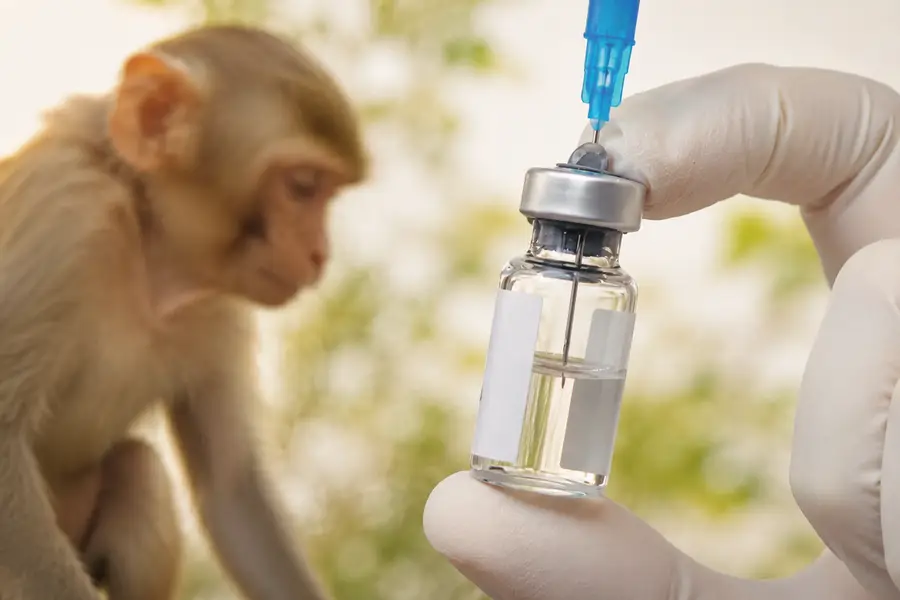
Research monkeys serve as stand-ins for humans in preclinical safety tests for new drugs. The price of a cynomolgus monkey, a type of macaque, has surged from 92,000 yuan in May 2025 to 178,000 yuan in June this year, recently peaking at 200,000 yuan. Supply is lagging demand after years of depressed prices discouraged breeding and resulted in ageing populations. Meanwhile, the Chinese innovative drug industry has been stepping up projects involving large-molecule drugs and antibody-drug conjugates, unleashing pent-up demand for preclinical testing. Founder Securities estimates that China will face an annual shortage of around 10,000 research monkeys from 2025 to 2027, with the gap continuing to widen. As a leading preclinical research organization with a stock of about 30,000 research monkeys, Joinn was naturally a beneficiary of the price surge.
Barely breaking even
However, excluding the paper gains from soaring monkey prices, the projected half-year net profit from its core laboratory services and other businesses ranges from a loss of 141.62 million yuan to a profit of 64.97 million yuan. Lingering effects of cutthroat competition meant revenue rose only slightly, while gross margins have yet to recover.
Over the past few years, a funding shortage in China’s innovative drug sector forced many drug developers to scale back programs and cancel preclinical and early-stage clinical projects, triggering fierce price wars among research providers. When Joinn listed in Shanghai in 2017, its gross margin stood at 56.27%. By 2025, the margin had fallen to 20.71%, while core revenue from non-clinical studies services declined by 17.75% and income from clinical trial and related services dropped by 27.12%. Joinn’s annual report attributed the pressure on gross margins to lower project prices and the lingering effects of fierce competition.
Major CRO companies typically maintain their own stocks of research monkeys to ensure they can fulfil customer orders. Joinn operates its own breeding facilities and acquired two suppliers of research primates in 2022. The firm told an earnings briefing in April that the animals were mainly used in its own work, with only a very small number sold externally. Therefore, the eye-popping gains in the accounts remain largely unrealized.
Over the longer term, a widening shortfall should give Joinn, with its sizeable stock of research monkeys, an advantage in securing more orders. But Joinn currently trades at about 32 times earnings, compared with just 20 times for industry leader WuXi AppTec (603259.SH; 2359.HK), which also has substantial research-monkey resources and boasts a gross margin of about 47%. That suggests a generous monkey premium has already been factored into Joinn’s valuation. If prices go into reverse due to changes in import policy or other uncertainties, investors may need to monitor whether the company can sustain itself on the core business alone.
To subscribe to Bamboo Works weekly free newsletter, click here
Related Articles