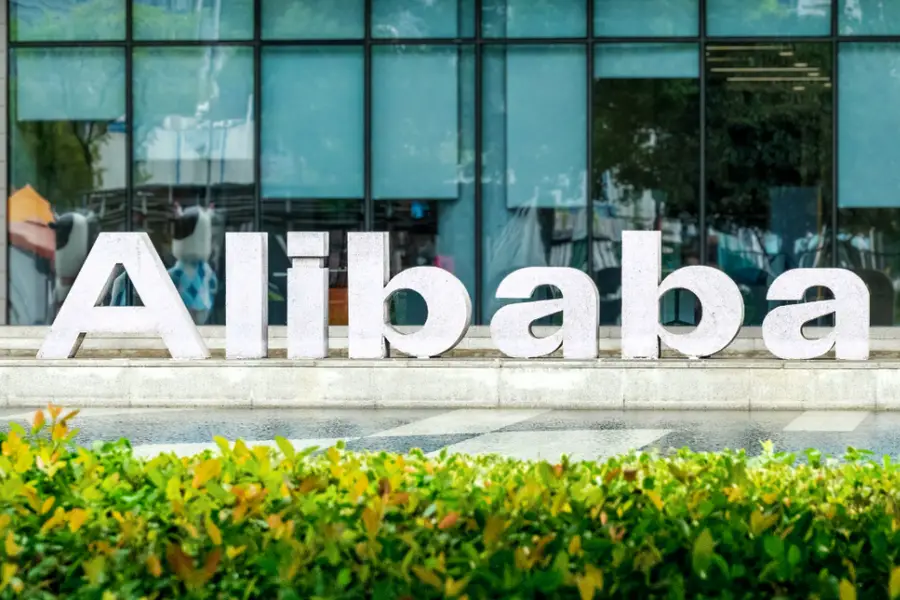
The e-commerce giant said it filed confidentially to separately list its chip-design subsidiary in Hong Kong
Key Takeaways:
- Alibaba has submitted a confidential application to list its T-Head chip design unit on the Hong Kong Stock Exchange
- Analysts estimate the listing could raise between $2 billion and $3 billion
By Lau Chi Hang
The Chinese name for Alibaba’s T-Head chip unit, Pingtouge, is popular slang for the honey badger, recognized by Guinness World Records as the world’s most fearless animal. Despite its diminutive size, the creature boasts a strong physique and distinctively fierce temperament. It battles massive predators without fear, and its extraordinary immunity to venom prompts even deadly snakes to give it wide berth.
Now, Alibaba is hoping investors buy into T-Head’s fearless nature as it clamors for a place in a Chinese market increasingly crowded with startups making advanced microchips for AI computing. T-Head made a major advance in that direction with its recent confidential filing for a Hong Kong IPO, according to a disclosure last week by Alibaba.
T-Head’s origins date back to 2018, when Alibaba acquired integrated-circuit designer C-Sky Microsystems and merged it with the chip team at its own Damo Academy. The new company’s team initially intended to name it Hummingbird. But at the time Alibaba co-founder Jack Ma had just returned from a trip to Africa, where he was impressed by the honey badger’s tenacious character and used his big boss privileges to name the new company after the animal. The English name, T-Head, appears to derive from the honey badger’s trademark flat head, similar to the top of the letter T.
According to Alibaba’s announcement last week, it filed with the Hong Kong Stock Exchange in September to spin off and list T-Head (Shanghai) Technology Co. Ltd. It said the spinoff would better reflect T-Head’s intrinsic value and allow investors to more easily assess Alibaba’s core businesses. Concurrently, T-Head could attract chip-focused investors and attain a higher valuation, which it could use to conduct its own future fund raising on more favorable terms than as part of Alibaba.
T-Head’s portfolio includes three main categories: Its Zhenwu series of chips used for AI model training and inference; its Yitian series of server CPUs designed for use in cloud servers and data centers; and its Xuantie division providing RISC-V processor core designs and related IP.
10 billion yuan in annualized revenues
Because Alibaba filed its application confidentially, it did not publicly disclose specific operational or financial data for T-Head. But during an analyst call this year, CEO Eddie Wu offered a glimpse into the unit’s operations. He noted that as of February this year, T-Head’s cumulative chip deliveries had topped 470,000 units, pushing its annualized revenue above 10 billion yuan ($1.45 billion).
In May, T-Head Semiconductor vice president Gao Hui further disclosed that cumulative shipments of the Zhenwu series AI chips had reached 560,000 units by the end of April, serving more than 400 clients across over 20 industries. By August, the Zhenwu series chips had achieved commercial application through Alibaba Cloud among 650 clients in more than 20 sectors — including autonomous driving, the internet and finance.
According to media reports, T-Head is planning the complete its Hong Kong IPO next year and could raise between $2 billion and $3 billion. Alibaba has not yet disclosed the specific offering size or listing timeline.
Unlocking value and facilitating financing
Alibaba’s stock dipped slightly after the announcement, instead of a rise that some might have expected. But the move should bring more pros than cons for the company over the longer term.
Most importantly, the spinoff and separate listing will unlock the value of its semiconductor business. Previously, T-Head was largely viewed as just a piece of the larger Alibaba Cloud puzzle, making it challenging for outsiders to value. Investors typically appraised it through the traditional valuation framework applied to the parent company, potentially leaving the chip unit significantly undervalued in the current market where such companies are viewed quite highly.
Even after a recent sharp pullback from recent highs for chip stocks, T-Head’s valuation will still command a premium over that of a traditional internet platform. With Alibaba retaining a majority stake, unlocking T-Head’s higher valuation through an IPO will undoubtedly serve the parent company’s interests.
What’s more, going public will allow T-Head to conduct its own financing in the future. That’s important when you consider that R&D for iterative microchip upgrades require large amounts of capital. Having a publicly listed platform will allow the company to directly tap into both equity and debt markets and secure bank credit facilities. Remaining under Alibaba’s wing would force the parent to keep injecting its own capital, turning T-Head into a financial burden in the likely absence of profits over the near to mid-term.
Strengthening market image
T-Head’s chips were previously designed exclusively for Alibaba as its only customer. But as its operations have grown, it has started catering to external clients as well. Nevertheless, market watchers continue to view it fundamentally as an in-house supplier for its parent, raising doubts over whether it provides its most cutting-edge products to outsiders and whether it genuinely puts clients first.
Operating with relative autonomy post-IPO — backed by its own management team and institutional investors — could help the company shake off the stigma of relying on a single client that gets special treatment with access to its best products. Such independence could prove reassuring to some of T-Head’s other clients and suppliers, while deepening market trust in its brand.
Earlier this year, JPMorgan pegged T-Head’s potential valuation in a relatively wide range of $25 billion to $62 billion. However, following a selloff for many chip stocks in the second half of the year, T-Head may have missed the prime window for its listing.
Calculations based on recent price-to-sale (P/S) ratios of 40 to 70 for Moore Threads (688795.SH) and MetaX (688802.SH), when combined with Alibaba’s estimate of over 10 billion yuan in revenue for T-Head this year, would value T-Head at roughly $60 billion at the more conservative end of that range.
To subscribe to Bamboo Works weekly free newsletter, click here
Related Articles
RELATED ARTICLES
-
Qdama misses listing window as revenue slumps, profit stagnates
- ESWIN Computing powers up its RISC-V growth story for Hong Kong investors
- Infinigence takes its AI chip-translator pitch to Hong Kong investors
- Who needs Dingdong? Alibaba answers Meituan with super-sized Pupu bid
-
Deye chases Hong Kong IPO in face of draining new energy valuations
605117.SHG
- To revenue and beyond: Defining valuations in China’s commercial space industry
- E-paper maker rewrites growth story using its chip stockpile