Lingyi pitched AI to Hong Kong. But the iPhone Duo may be powering its rebound
The Apple supplier credits new products for its quarterly profit recovery as it expands into server cooling, power hardware and robot assembly
Key Takeaways:
- Lingyi’s third-quarter profit rose 14%, which the company credited to demand that appears tied to Apple’s new foldable iPhone Duo launched in October
- Metrics for the phone component maker’s AI-related server and robot expansion, which were selling points during its Hong Kong IPO, remain hard to pin down
By Hu Minghe
Lingyi iTech (Guangdong) Co. (1688.HK; 002600.SZ) went to Hong Kong in June with a story about AI for prospective investors in its IPO. But the business behind its latest profit rebound, revealed last week in its third-quarter results, is one it has been in for two decades: making parts for phones.
The company, reportedly an Apple supplier, makes many of the small parts you never think about when using your smartphone countless times each day. That includes the tape that holds components in place, foam that cushions them against knocks, and thin plates that dissipate heat. It also makes metal frames that give phones their structure and chargers that keep them running.
Lingyi earmarked some of the proceeds from its midyear Hong Kong IPO for expansion into newer areas, including AI servers and robots that were popular investment themes at that time. But management credits new products from a major customer, and a shift toward more expensive phone parts, for its profit rebound in the third quarter. Both of those factors appear tied to Apple’s October launch of its iPhone Duo foldable smartphone.
Lingyi’s Hong Kong shares currently trade nearly 50% below their June IPO price, and in that way they are syncing with many of the AI and robotic stocks the company is trying to imitate. The stock closed below its IPO price on its trading debut day, the same day that other Apple supplier shares fell after the U.S. tech giant raised Mac and iPad prices linked to memory-chip shortages. Luxshare (2475.HK; 002475.SZ), a larger Apple supplier that also made its Hong Kong trading debut in July, also closed below its IPO price on its debut day and is now down about 27%.
Despite those pullbacks, business continues to look broadly positive for Lingyi and many of its non-AI peers with established businesses. The company’s revenue rose 11% year-on-year to 15.52 billion yuan ($2.3 billion) in the third quarter, and its net profit rose 14% to about 1.15 billion yuan, both quarterly records, according to its latest results.
Exchange rate hit
That said, the company’s profit for the first nine months of the year was still slightly below the same period of 2025, which Lingyi blamed on exchange-rate swings and heavier research spending. The company said its gross margin improved over those nine months, meaning it kept more of each yuan of sales after production costs.
Foldable phones, which took the spotlight last month with the release of the iPhone Duo, have become a recent bright spot for the company, offering a way to sell more valuable components. In an Oct. 29 investor update, Lingyi said it supplies hinge parts, screen supports, ultrathin cooling plates and battery casings for its major North American customer’s new devices. These parts help a phone fold, keep its screen flat, remove heat and protect its battery.
Lingyi said its foldable projects were ramping up production and deliveries in the third and fourth quarters, though it didn’t name any customers. But media reports have linked Lingyi’s hinge components, screen supports and cooling plates to the iPhone Duo.
Management said its parts used in foldable phones are worth several times those in conventional models, and its parts used in the unnamed customer’s latest models are worth more than in the previous generation. That offers a route to higher revenue without relying entirely on growing phone sales. That’s important in the current climate, since most major brands are reporting falling phone sales this year after hiking prices due to soaring memory costs.
Lingyi’s Apple relationship dates back to the company’s early years. Chairwoman Zeng Fangqin, a University of Houston graduate who worked in Silicon Valley, founded Lingyi’s predecessor in 2006. Before that, she managed the China operations for a precision-parts maker that supplied former cellphone giant Nokia. Foxconn, one of Apple’s key partners for iPhone manufacturing, was also among its customers.
A recent profile in Chinese media describes how her team raised yields on an early Apple project, meaning the share of parts that pass the customer’s checks, from below 30% to above 90%. “If you had said at the start that we’d need yields in the 90s, nobody would have believed it,” she said. The smartphone-parts business has made her a billionaire, according to Forbes, which listed her in 22nd place on its 2026 list of top Chinese businesswomen.
Phone business decline
The company’s midyear report paints an uneven picture within Lingyi’s various businesses in the first half of 2026. Revenue from imaging and display parts, such as camera brackets and screen modules, fell 37% from a year earlier. The company didn’t explain the decline, and the latest quarterly report didn’t go into that level of detail. Lingyi’s automotive and air-mobility revenue nearly tripled in the first half, helped by vehicle-parts businesses acquired late last year. The two moves roughly offset each other, resulting in modestly higher revenue in the first half of 2026.
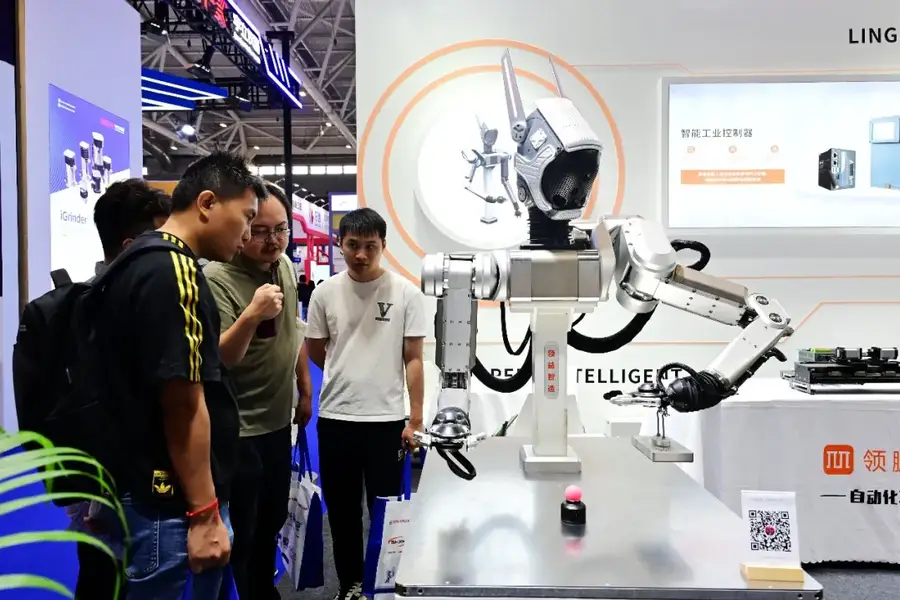
Lingyi is seeking growth beyond making phone parts for customers such as Apple. Zeng described the robotics push as a strategic “all in” in an interview last year, saying the company’s existing business would fund gradual investment into those new areas building on similar manufacturing skills. Lingyi says it is shipping server cooling and power products, and that its robot lines in several cities are delivering joints and complete humanoid robots.
The company doesn’t report revenue separately from its robot or server businesses. The clearest look at the new businesses comes from Readore, a server-cooling maker Lingyi took control of in January. From the Jan. 31 acquisition through June 30, the acquired Readore businesses recorded about 405 million yuan in revenue, equal to about 1.6% of Lingyi’s first-half sales. But the unit only recorded about 445,000 yuan in net profit, according to Lingyi’s interim report. The company’s other AI-related sales sit inside its broader product categories.
Zeng has started buying her company’s slumping Hong Kong shares to show her confidence in its future. She bought about 87 million yuan worth on Oct. 30, the first step in a plan to buy 100 million yuan to 200 million yuan worth within a year, according to an Oct. 31 filing. That’s provided some temporary support, with Lingyi’s stock up nearly 10% over the last three trading days.
Full-year results will offer the next test of whether the nascent recovery that looks tied to the iPhone Duo’s launch has legs. For now, at least, Lingyi may have pitched AI as its next big thing to Hong Kong investors, but its rebound is coming from phones.
To subscribe to Bamboo Works weekly free newsletter, click here
Related Articles

RELATED ARTICLES
-
Cowell remains tethered to Apple. But you could do worse

- Can crypto power supplier Boco plug into the AI boom?
- New SORL’s IPO plows into winter for China auto stocks
- From microchips to fast food: How Apple and Burger King are adapting to the Chinese market
- Infinigence takes its AI chip-translator pitch to Hong Kong investors
- Moonshot aims for meteoric valuation with a $3 billion Hong Kong IPO plan
-
Hong Kong Technology Venture’s May transactions up over 20%
1137.HK