Macao ‘guides’ gaming companies to pony up half of new $2.5 billion fund
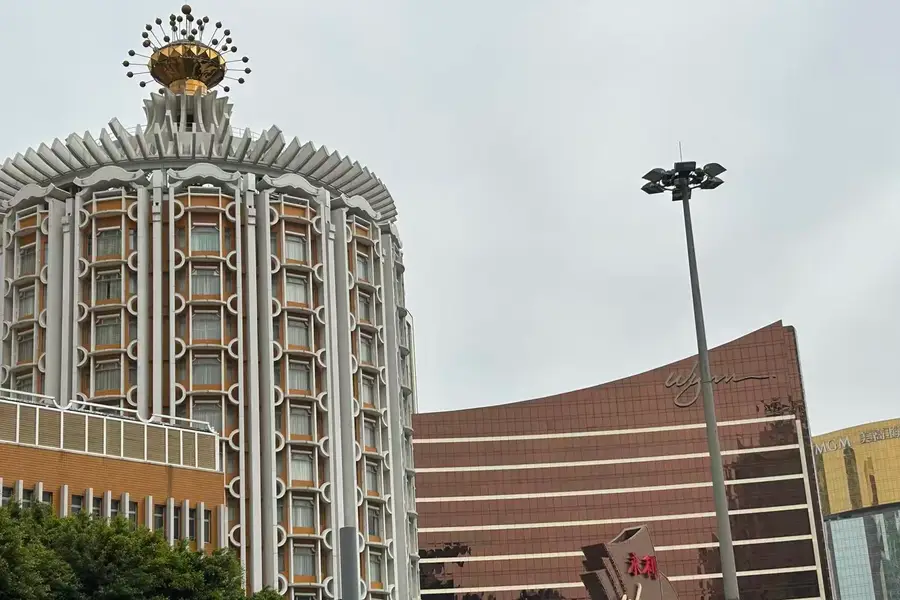
The city’s new ‘Guidance Fund’ aims to reduce its reliance on gambling and diversify its economy
Key Takeaways:
- The Macao government has launched a new 20 billion pataca ‘Guidance Fund’ to diversify the local economy, contributing 11 billion patacas of the total
- The fund primarily targets four major industries, in a bid to diversify the city’s economy away from its heavy reliance on gambling
By Lau Chi Hang
Macao’s gaming sector is its life blood, accounting for over 80% of the government’s fiscal revenue. But chronic dependence on gaming has led to a monolithic revenue stream that stifles the development of other industries, threatening the health of the regional economy. Aware of the vulnerability, the Macao government has spent more than two decades seeking “moderate economic diversification” to no avail.
Until now. Late last month, officials announced plans for a “Macao SAR Government Guidance Fund,” with initial financing of 20 billion Macao patacas ($2.48 billion) to breathe some diversity into the local economy. Of that, the government said it will inject 11 billion patacas, with major gaming companies pitching in the other 9 billion patacas.
Funding allocations to support the government’s agenda appear to be somewhat tied to gaming companies’ relative sizes or scales. Sands (1928.HK) and Galaxy (0027.HK) are the largest corporate contributors, kicking in 2.3 billion and 2.27 billion patacas, respectively. Wynn Macau (1128.HK) and MGM China (2282.HK) are committing 1.37 billion and 1.24 billion patacas, while SJM (0880.HK) and Melco (0200.HK) are injecting 993 million and 828 million patacas.
Seeded by government capital, the fund aims to steer various forms of social capital into Macao’s priority emerging industries and future-facing sectors. It also seeks to assist local existing businesses in making technological upgrades and diversification, commercialize scientific and technological achievements and incubate promising start-up teams and high-tech enterprises.
Specifically, the fund targets four core sectors. First is the “big health” industry, focusing on traditional Chinese medicine R&D and manufacturing, medical aesthetics and elderly and rehabilitative care. Second is the modern financial sector, primarily developing wealth management, the bond market and financial leasing. The high-tech sector will see investments that focus on chip design, new materials, artificial intelligence, big data and the internet of things.
Also set to receive money from the fund are entities, companies and ventures that support what the government calls “Tourism+,” a sector that includes conventions, commerce, culture and sports. The hope is that investments will lead to cross-sector integration, commercially viable world-class sporting events, the development of cultural and creative IP and the cultivation of major international exhibition brands.
Gaming operators fulfill commitments
The gaming companies’ contributions to the fund were preordained. During earlier negotiations for their casino concession renewals, they pledged to make non-gaming investments in Macao, regarded as a “social capital” investment.
The Macao government has, for its part, emphasized that the fund will adhere to the “patient capital” philosophy. Rather than chasing short-term financial returns, it aims to fully drive the qualitative upgrading of key industries through long-term, systemic capital deployment.
The implication is that the fund’s investments won’t be evaluated on short-term horizons or immediate yields. That means gaming operators can’t be certain their investments will yield any return. According to disclosures from individual operators, the investment horizon extends up to 15 years.
Whether the Macao government can leverage the guidance fund to breathe new life into the local economy in the long run is a question. Based on recent history and the government’s track record, there’s reason for doubt.
The fund’s purported goals and investment directions have been recurring themes in the Macao government’s annual policy addresses for over a decade. But until this year, there was more rhetoric than any innovative policy breakthrough.
In the financial sector, the government made a grand pronouncement in 2019 about establishing a stock exchange, but nothing concrete has emerged. To date, the only outcome has been the Chongwa (Macao) Financial Asset Exchange Co. Ltd. (MOX), established by Nam Kwong Group in 2018. But by the end of August last year, its cumulative scale of issued and listed bonds stood at merely around 1 trillion patacas. Based on the volume of bond issuances in Macao over the past two years, the annual total equates to no more than 250 billion Macao patacas.
In stark contrast, issuances of Hong Kong dollar debt securities, renminbi bonds and international bonds in Hong Kong reached $423.5 billion and $468 billion in 2024 and 2025, respectively, according to Hong Kong Monetary Authority data. Hong Kong’s annual bond issuance dwarfs the total volume achieved by MOX since its inception; Macao simply can’t hold a candle to its neighbor.
Consider also the Macao government’s longstanding emphasis on developing the convention and exhibition sector. After two decades of effort, the annual non-gaming revenue generated by convention and exhibition events over the past three years hovered at merely 5 billion patacas to 6 billion patacas, accounting for less than 2% of total GDP.
As for the “big health” sector, the Macao government integrated traditional Chinese medicine into its moderate economic diversification strategy as early as the early 2010s. Since 2019, it has explicitly earmarked “big health” as a core emerging industry. But by 2024, its annual economic contribution had never exceeded 14 billion patacas. Despite years of operation, it has failed to mint any renowned, influential health enterprises or yield major breakthroughs in pharmaceutical research.
The guidance fund’s operational model departs from past approaches that relied entirely on government subsidies. Rather than directly cherry-picking specific enterprises to invest in, the fund entrusts market-driven management to professional fund managers. These managers will interface with market investors and venture capital firms, leveraging the capital to crowd in more social capital, such as venture capital, private equity and foreign investment, to co-found sub-funds, further amplifying capital efficacy.
Though the guidance fund’s framework is novel and both the government and private sector are putting their money where their mouth is, Macao economic reform and diversification-watchers have reason for skepticism. They’ve seen previous efforts and approaches come and go with little change. They’ll likely need convincing, through tangible results, that this time, it’s the real thing.
To subscribe to Bamboo Works weekly free newsletter, click here
Related Articles
RELATED ARTICLES
-
INDUSTRY BRIEF: Macao gaming revenue up 6.7% in May

- Macao July gaming revenue tops 20 billion patacas in post-World Cup rebound
- Macao gaming revenue falls for fourth consecutive month in September
- Macao’s gaming revenue falls 10% in October as Golden Week loses its luster
- Macao’s June gaming revenue falls nearly 20% month-over-month
-
Yalla’s gaming push bears early fruit as new titles sweeten its revenue mix
YALA.US
-
Yalla eyes return to solid growth as new gaming drive revs up
YALA.US