Chinese fintechs look abroad as Nasdaq tightens the screws on penny stocks
“It’s pretty much game over in terms of major business opportunity in that sector in China for anybody who would want to come in now.” – On how domestic regulatory tightening has curtailed growth for private consumer lenders in China

Key Takeaways
- China’s beleaguered fintech lenders are battling depressed valuations at home while newer fintech entrepreneurs seek friendlier pastures abroad
- The Nasdaq is aggressively shutting down penny-stock listing abuses, marking the end of an era for waves of small Chinese IPOs on Wall Street
By Rene Vanguestaine and Doug Young
U.S.-listed Chinese companies are facing a severe dual test. In consumer finance, embattled online lenders are struggling to stay afloat amid brutal domestic constraints, prompting a new generation of entrepreneurs to abandon their home market entirely. At the same time, American exchange operators are moving decisively to sweep away dubious micro-caps that have damaged market integrity. Whether navigating tighter regulations in Beijing or facing a harsher compliance environment in New York, the freewheeling days for small-cap Chinese issuers are rapidly drawing to a close.
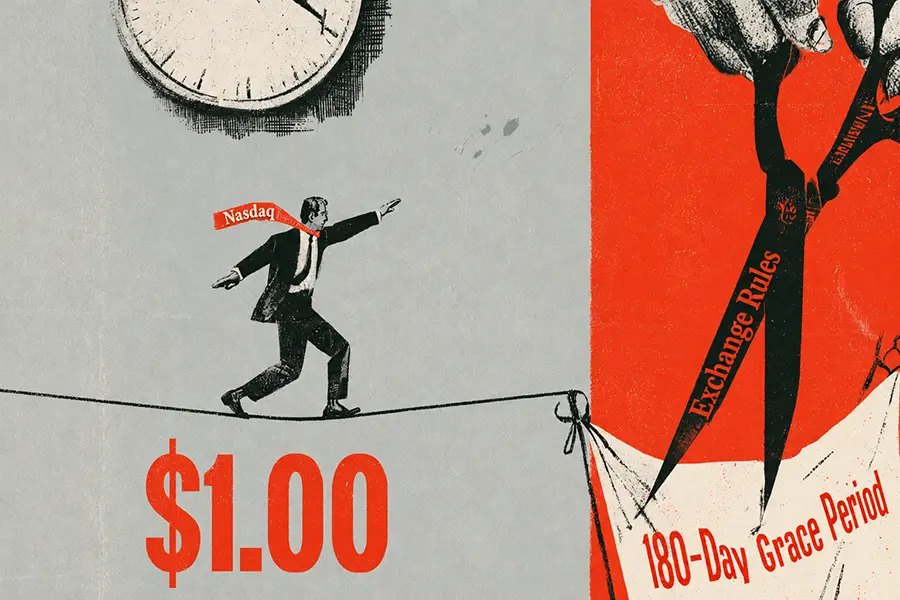
The woes for established consumer lenders just keep coming. Shares of LexinFintech (LX.US) recently slipped below the $1 threshold for 30 consecutive trading days, triggering a delisting warning from the Nasdaq. The pressure is compounded by new exchange rules that treat repeated reverse stock splits within a single year far more harshly. Yet LexinFintech isn’t necessarily in desperate straits. Its revenues and borrower numbers are eroding at a manageable pace, and it holds a respectable cushion of cash and short-term reserves. With a standard 180-day grace period for returning to above the $1 mark, there’s no reason to rush. Management can wait four or five months to gauge market sentiment before executing a reverse split substantial enough to keep its stock comfortably above $1 for the subsequent 12 months.
That said, LexinFintech’s depressed valuation reflects a broader industry malaise. Over the past 18 months, domestic regulators have ratcheted up rules that strictly cap the profitability of consumer lenders to protect consumers and state-owned banks. Compounding the pain, poor financial stewardship has pushed some players to the brink. Yiren Digital (YRD.US) saw its chairman detained after the firm admitted it couldn’t repay investors in one of its wealth management products. That disaster chilled sentiment across the board, even dragging down resilient operators like FinVolution (FINV.US), which has managed the storm relatively well.
With domestic avenues effectively choked off, Chinese entrepreneurial talent is decamping for friendlier turf. A prime example is OPay, which recently filed for a $320 million New York initial public offering, but ultimately delayed it at the 11th hour. Helmed by Chinese executives, the fintech chose to base itself in Singapore while building a thriving lending and payments business in Nigeria.
Yet breaking away from Beijing isn’t as simple as updating an incorporation document. OPay’s prospectus asserts that it has no Mainland operations and isn’t subject to Chinese securities oversight. We’ve heard similar assertions before. Shein (0625.HK) attempted to rebrand itself as a Singaporean enterprise, only to discover Chinese regulators still claimed jurisdiction over the company. Looming large is the cautionary tale of DiDi Global, which proceeded with a New York debut and was subsequently forced to delist. If a cross-border fintech employs proprietary Chinese technology or runs afoul of African regulators over high borrowing rates and fees, Beijing may intervene to protect its diplomatic standing in Africa. For U.S. regulators, permitting such listings without accounting for Beijing’s long reach risks leaving American investors holding the bag once again.
Nasdaq closes the door on penny stock abuses
While established lenders look overseas, the Nasdaq is eliminating the loopholes that previously enabled dubious micro-caps to linger in New York. The days of endless delays are ending, as demonstrated by the rapid demise of Pomdoc (POM.US).
Unlike legitimate businesses that simply encountered tough market cycles, Pomdoc has spent its brief one-year tenure as a public company in free fall, displaying the hallmark characteristics of a pump-and-dump listing. Having already executed one reverse share split, its stock swiftly plunged below $1 once more. Under Nasdaq’s newly tightened policies, companies attempting a second reverse split within 12 months no longer receive an automatic 180-day grace period to return above the $1 mark. Faced with immediate delisting, Pomdoc abruptly announced the termination of its American depositary share program on Oct. 19, effective Oct. 21.
There are some cases of foreign companies from other jurisdictions engaging in similar pump-and-dump schemes, so the rule isn’t aimed exclusively at China. Nevertheless, between 2020 and 2023, U.S. exchanges witnessed an influx of 18 to 30 tiny Chinese IPOs per year, with most raising under $15 million or $20 million. At the peak a few years ago, roughly 360 Chinese companies were listed in New York, and approximately 250 of them held market capitalizations below $150 million.
The SEC and Nasdaq took an uncomfortably long time to address the fallout, but their current cleanup is decisive. We believe the era of mass micro-cap listings from China is over for good. While a handful of globally minded firms may still seek U.S. capital — perhaps three to five per year, strictly outside sensitive sectors like AI — most Chinese issuers will look to Hong Kong instead. The pipeline has run dry, and rightly so.
Edited by Brent Li
About China Inc
China Inc by Bamboo Works discusses the latest developments on Chinese companies listed in Hong Kong and the United States to drive informed decision-making for investors and others interested in this dynamic group of companies.
Subscribe to China Inc on your favorite app:


Related Articles
RELATED ARTICLES
-
Got change? Lexin’s penny-stock plunge reflects sinking fortunes for China fintechs
 LX.US
- Pomdoctor lands in crosshairs of Nasdaq’s ‘pump and dump’ cleanup
-
FinVolution finds balance with prudence at home, growth abroad
FINV.US
- Declawed in China, UP Fintech faces challenges in global marketplace
- For Futu and UP Fintech, regulatory bombshell may finally clear global path forward
-
Shein’s U.S. buyout hits a political wall, as China’s fintech lenders face ruin
0625.HK
- Hong Kong tightens listing oversight to build lasting trust