Same-store sales for the ‘sauerkraut fish’ chain rose 6.1% in the second quarter, marking a second quarter of growth after a double-digit decline in 2025
Key Takeaways:
- Jiumaojiu’s Tai Er restaurant chain posted a second consecutive quarter of same-store sales growth in the second quarter, as its other metrics were also generally positive
- The chain launched a major brand refresh last year, and has closed about a quarter of its outlets since the end of 2024
By Doug Young
After two difficult years of soul searching, restaurant operator Jiumaojiu International Holdings Ltd. (9922.HK) is finally showing some positive results with its new recipe for success. And after reaching a milestone with a return to same-store sales growth for its signature Tai Er chain this year, the company is now trying to replicate the model with some of its smaller chains, according to a second-quarter business update released on Friday.
The Tai Er chain maintained its recent momentum in the latest quarter, including 6.1% same-store sales growth – a metric that only turned positive this year after a double-digit decline in 2025. Trends for the chain’s other major metrics were also generally positive, including spending per customer and table turnover. The same wasn’t true for its other brands, which continued to sag and could be next in line for much-needed overhauls.
Jiumaojiu’s earlier rapid rise and even faster fall shouldn’t surprise too many restaurant stalwarts, who know you can never sit on your laurels in this fast-moving industry. But most of China’s newest national chains are quite young, with often a decade or less of history as major operators. As a result, most have learned the hard way that restaurant brands can fall out of fashion as quickly as they gained their trendy cache.
Jiumaojiu started out with its namesake Jiu Mao Jiu brand, which offered low-cost meals in Northwestern Chinese-style cuisine. But it found its biggest success with its newer Tai Er chain, launched in 2015, serving up trendy “sauerkraut fish” that mimicked the hotpot style favored by many young Chinese.
The chain briefly boomed through the early 2020s, with lines often forming outside its stores, many of those located in shopping malls. But then diners quickly tired of the format, and some began to criticize it for using fish prepared off-site in central kitchens, contrasting with the older tradition of keeping large tanks full of live fish at many restaurants and killing, cleaning and cooking each fish to order.
Jiumaojiu’s stock rose and fell with its fortunes, climbing as high as HK$32 at its peak, valuing the company at a healthy HK$55 billion ($7 billion). But nearly all that value has vanished in the last few years, with its current market value at just HK$1.6 billion. As its stock sank to new lows, including its latest close last Friday of just HK$1.23, many joked the company’s name, which means 99 cents in Chinese, was the same as the value of its stock.
The company has experimented with quite a few other brands since the Tai Er success, including names like Song Hot Pot, Lai Mei Li, Fresh Wood and Shanwaimian. But none of those have gained any traction, leaving it mostly reliant on the Tai Er and Jiu Mao Jiu brands. But even those two brands were overbuilt, following a pattern for many successful Chinese chains that often expand into marginal locations as they seek growth at any cost.
Footprint slimdown
Jiumaojiu has spent the last two years trying to “right-size” Tai Er and its other chains, and that trend continued in the second quarter. The Tai Er chain had 477 restaurants at the end of June, down from 499 at the end of last year and a quarter below its 634 outlets at the end of 2024. Jiu Mao Jiu has undergone a similar slimming, though its network has dropped by a milder 14% to 61 stores at the end of June from 71 at the end of 2024.
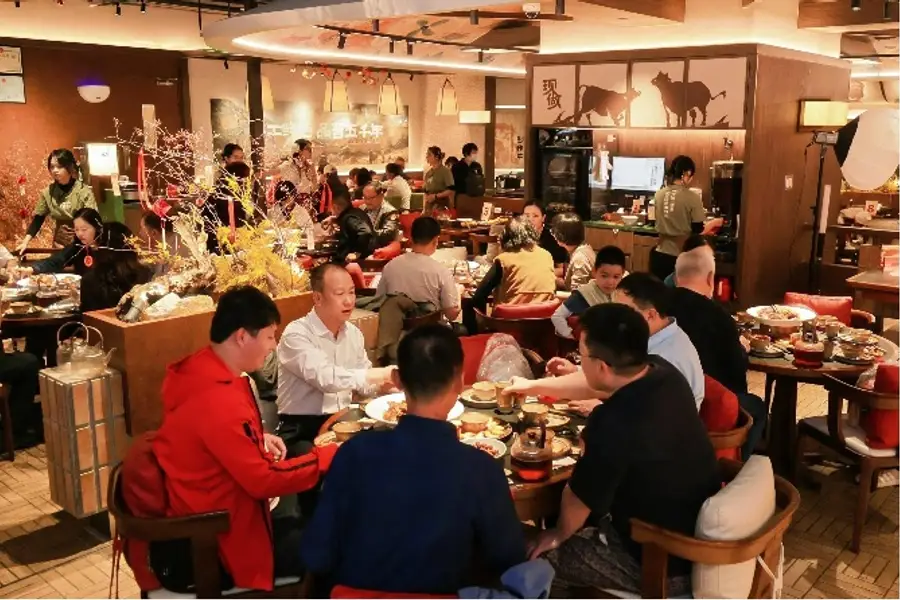
The big story for the Tai Er chain was a complete brand refresh that was sorely needed, led by a return to the practice of killing and preparing live fish on the premises. In addition, the company also focused on use of other fresh meats like chicken and beef, and adopted an open-kitchen format allowing customers to see the entire process of their food being prepared.
The overhaul began bearing results this year, as the Tai Er chain returned to same-store sales growth of 6.9% in the first quarter. The growth rate fell slightly in the second quarter to 6.1%, though that was still a huge improvement from an 11.5% decline for that metric in 2025. The Jiu Mao Jiu chain did far worse with a 13.5% same-store sales decline in the second quarter, easing just slightly from a 15.8% decline for 2025.
The Tai Er chain’s spending per customer and table turnover rates also held relatively stable in the second quarter compared with the first, suggesting its rebound could be starting to plateau. But all the figures from this year represent notable improvements from 2025.
As the company rolls out its “fresh and live” campaign, the number of stores with the new format reached 340 by the end of June, or about 70% of all Tai Er outlets. It also pointed out that the new format is very much a work in progress, and is now up to its sixth iteration with the launch of its 6.0 Fresh Model in its hometown of Guangzhou last month.
“The group believes that, with the continued iteration and upgrade of the ‘Fresh’ model and the gradual completion of the remaining store conversions, Tai Er’s operating resilience in the Chinese Mainland will continue to manifest in the second half of the year,” it said.
The campaign’s promising signs have yet to be reflected in its stock, which has lost another 31% of its value this year. But the analyst community seems more positive, with 10 of the 15 who follow the stock rating it a “buy” or “strong buy,” according to Yahoo Finance. Then again, at least some of those probably believe the stock may be significantly undervalued after all the declines, leaving it trading a price-to-sales (P/S) ratio of just 0.28 and a forward price-to-earnings (P/E) ratio of 7.6.
Jiumaojiu also indicated that a similar overhaul is on the way for its namesake Jiu Mao Jiu chain, which is far smaller than Tai Er but is still its second-largest brand. It said the company has opened six new stores for the chain under the new format, called “Jiu Mao Jiu Shanxi Cuisine Restaurant,” with locations in Guangzhou, Shenzhen and Foshan, all in South China’s Guangdong province.
To subscribe to Bamboo Works weekly free newsletter, click here
Related Articles

RELATED ARTICLES
-
BRIEF: Jiumaojiu reports same-store sales growth for its Tai Er chain in first quarter

- Eyewear chain looks to an IPO to reframe its business model
- Chinese spirits maker ZJLD laments latest anti-corruption crackdown
- Haidilao dishes up overseas profits with a sour aftertaste
- PPLabs eyes capital refresh as losses linger on heavy investments
- DPC Dash gobbles up Domino’s global leader board
- Move over, burger joints. Yuen Kee dishes up China-flavored fast-food IPO