Trademark tussle could further dilute Helen’s incredible shrinking bar tab
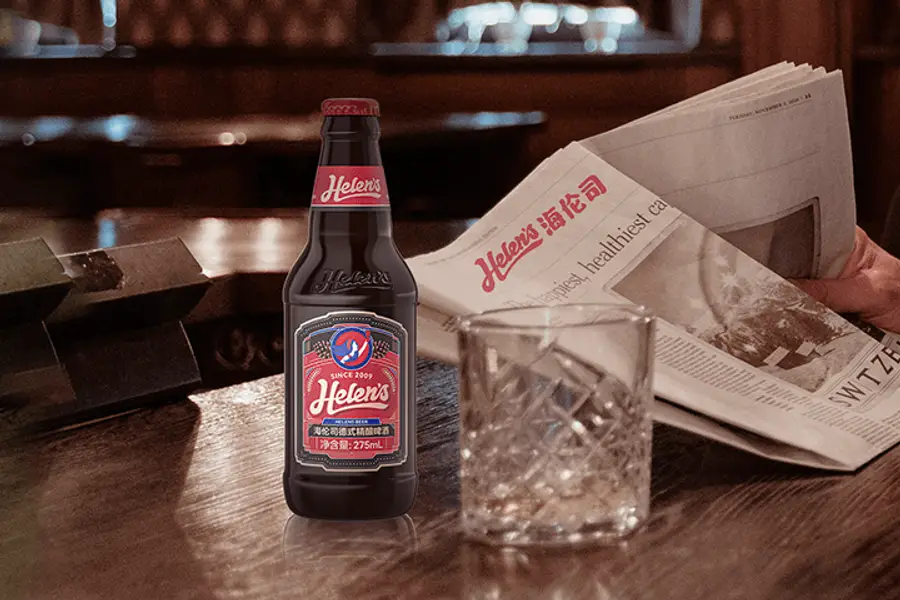
The operator of China’s largest bar chain lost a key trademark court battle, as it brought in two new co-CEOs to try to revive its sinking business
Key Takeaways:
- Helens International replaced founder Xu Bingzhong with two new co-CEOs days after the company lost a case involving its namesake trademark
- The bar chain operator’s revenue fell 28% last year, while its adjusted profit was mostly stagnant
By Edith Terry
In September 2021, Helens International Holdings Co. Ltd. (9869.HK, HLS.SI) was riding high when it raised a foamy HK$2.51 billion ($320 million) in its Hong Kong IPO.
The leading bar operator had just become China’s first “pub stock,” and was a rising star soaking up money from a recently minted class of free-spending Chinese youth embracing Western bar culture. The company’s shares jumped 23% in their trading debut, as its market cap touched HK$30 billion ($4.4 billion), making it a winner with 1.8 billion yuan (264.9 million) in annual revenue and adjusted profit of 100.2 million yuan.
Fast forward five years when the froth is long gone, drained by a slowing Chinese economy plagued by increasingly cost-conscious consumers. Adding to its woes, the company lost a key trademark case involving rights to its Chinese brand name last week, as its founder, Chairman and CEO Xu Bingzhong was shown the exit door, replaced by two new co-CEOs on June 26.
The changing of the guard, despite the tumultuous way it happened, was welcomed by investors, since the company clearly needs some new blood at the top. One of the newly named co-CEOs, Wang Hao, was a former private domain consultant to coffee giant Luckin, while the other was company insider and executive director He Daqing. Helens shares rose by 20% in the five trading days after the pair of announcements.
Wang and He have their work cut out. Helens market cap currently hovers at around HK$2.2 billion – less than a tenth of its peak – and its shares are down more than 92% from their post-IPO highs. Its most recent financial report, for 2025, showed its revenue slumped by 28.3% last year to 539 million yuan, marking a fourth consecutive year of declines.
The news in its latest financial report wasn’t all bad, as Helens returned to the black last year with a profit of 33.9 million yuan, reversing a loss of 77.9 million yuan in 2024. But much of the swing owed to non-recurring and non-cash items, and the company’s adjusted profit rose by a less impressive 3.5% to 67.7 million yuan last year from 65.4 million yuan in 2024.
National expansion
Helen achieved its early success through a national expansion of its signature pubs from their origins in Beijing’s university district, tapping into a youth culture that was primed for clubbing. After-hours spending in the nation’s bar and pub market reached 112 billion yuan in 2024, and was estimated at 117.5 billion yuan last year, according to the Hong Can Network consultancy.
But tastes are changing among China’s unpredictable Gen Z consumers, and low-alcohol beverages like wines and craft beers and have become the fastest growing segment, according to Chinese media. What’s more, many of those drinks are being consumed in non-traditional bars, which include bookstores, art exhibitions and music performances. And less people are splashing out big money on drinking overall, with 60% of people recently surveyed by leading Shanghai media The Paper saying they spent less than 1,000 yuan annually on alcohol.
Helens has been swimming against the tide in terms of changing consumption preferences. Beer, which was Helens’ core product in 2021, accounted for just 6.5% of revenue last year, while spirits made up 28.1% and third-party alcoholic drinks were 16.3%. One-third of its revenue came from franchise fees, with operators paying their own costs and making their own decisions about product mix.
Same-store sales from the company’s self-operated and franchised bars tumbled 18.4% last year, while the total number of bars rose from 560 at the end of 2024 to 578 as of March this year. Average daily sales for its self-managed stores rose from 7,000 yuan in 2024 to 7,700 yuan in 2025. But franchisees for its HiBeer brand, which makes up the bulk of its stores, were struggling, with daily sales dropping from 5,000 yuan in 2024 to 4,100 yuan last year.
Unsettled brew
While business was already hurting, the trademark court loss adds yet another element of uncertainty into Helens’ unsettled brew. That court battle began in 2023, and involves a case brought by the similarly named Helen Dazzling Hotel Co., whose hotels in Chengdu, capital of Sichuan province, also use the Helen name. The hotel company registered the Helen trademark in 2016, while Xu only registered his Helen’s trademark in 2018, even though Xu Bingzhong set up his first bar in Beijing back in 2009.
The China National Intellectual Property Administration, which was hearing the matter, ruled against Helens International in May 2025. Helens then appealed the ruling with the Beijing Intellectual Property Court, which ruled in its favor. But the hotel company appealed that decision to the High People’s Court in Beijing, which ruled against Helens.
Helens said the latest ruling would “have no material impact” on its business. But with its franchisees already under pressure, any uncertainty over the trademark’s future might lead some to leave the brand. The litigation affected only the versions of the company’s Chinese name, Hailunsi, with the English unaffected.
The management change removes Xu Bingzhong from his CEO role, though he remains an executive director and the company’s chairman. The two new co-CEOs will be responsible for day-to-day management and “steady development” of the business, according to the announcement of the change. Wang Hao specializes in digital marketing, while He Daqing, who joined Helens in 2020, comes from a media background, including work as a senior editor at the prestigious Xinhua News Agency.
The pair has their work cut out for them at company known for its frequent pivots under Xu. Now 52, Xu worked in the Chinese military and as a security guard before moving to Laos in 2005 to open a bar. He used money from his first business to open his first Helen’s Bar in the Wudaokou area of Beijing’s university district.
His early business strategy was simple – offer half price beer to become a fixture in student life. His initial business model when he began to expand used franchised partnerships. But he switched to self-managed stores, and then to an “asset-light” franchise model. Along the way, the company’s HiBeer segment became its dominant brand, accounting for about 80% of its stores, largely operated by franchisees. At the end of March this year, only 108 of the company’s 578 bars were directly operated, while the remaining 470 were franchised or partner stores.
Higher average daily sales for Helens self-managed bars suggests another turn away from franchised operations may be in the cards under the new co-CEOs. Franchised operations contributed 183.3 million yuan in revenue last year, compared with 355.6 million yuan for Helens’ self-managed bars.
But more self-operated outlets would mean taking on more costs, more property leases, and more workers, while the franchise operations put little pressure on Helens’ balance sheet. While investors seemed to like the arrival of fresh faces in the CEO’s office, the new chief executives will have to get to work quickly restoring Helens to its earlier post-IPO glory.
To subscribe to Bamboo Works weekly free newsletter, click here
Related Articles

RELATED ARTICLES
-
‘Plum king’ sweetens fourth IPO bid with new products, price cuts

- China’s shrinking ‘Chicken King’ scurries towards Hong Kong IPO
- Its losses widening and margins shrinking, can DataStory tell an attractive tale?
-
Haidilao brings its chief ‘firefighter’ back to China to rekindle growth at home
6862.HK