Nayuki faces investor backlash over costs, pay and products as shares tank
By Sina Finance
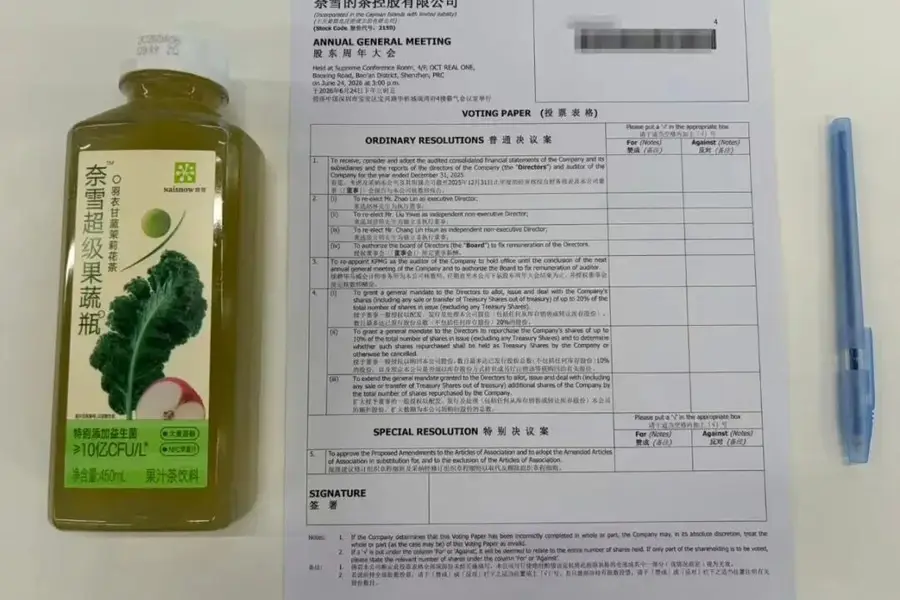
Shares of Nayuki Holdings Ltd. (2150.HK) have plunged about 96% from their peak since listing in Hong Kong, wiping out more than HK$30 billion ($3.82 billion) in market value and fuelling investor anger that spilled over at a late-June shareholder meeting, where founders Zhao Lin and Peng Xin faced pointed questions over costs, pay and product strategy.
Once branded the “first stock of new-style tea drinks” when it debuted in 2021, Nayuki has struggled to keep pace with fast-expanding rivals and shifting consumer habits in China’s highly competitive beverage sector.
At the meeting, which attendees described as unusually tense, one shareholder holding more than 4 million shares said he had lost several million yuan and questioned why Nayuki’s costs were significantly higher than its peers. He urged management to link executive compensation to performance and suggested the founders take a symbolic annual salary of 1 yuan.
The company responded that Zhao and other founders had not sold any shares since the listing and had not relied on stock disposals for income. “We live on salaries,” the company said, adding that a token 1 yuan salary was “not realistic.”
Zhao’s annual pay stood at about 1.37 million yuan ($190,000) in 2025, relatively modest compared with peers in the listed bubble tea sector. By contrast, Mixue Group (2097.HK) founder Zhang Hongchao earned about 24.08 million yuan, while Chabaidao’s (2555.HK) Wang Xiaokun and Guming’s (1364.HK) Wang Yun’an earned roughly 2.61 million yuan and 1.6 million yuan, respectively.
Investors also challenged changes to Nayuki’s bakery offerings, a key part of its brand positioning. One shareholder said that bread purchased recently appeared to be reheated rather than freshly baked, raising questions about the company’s earlier pledge to maintain quality while cutting costs.
Co-founder Peng Xin said the company had reduced input costs without compromising safety standards, for example by sourcing smaller-sized fruit that meets pesticide residue requirements. She added that consumer ordering patterns had shifted online, making pre-prepared bread a more reliable way to ensure consistent taste.
“If freshly baked bread is left in display cabinets and reheated after cooling, the taste can be worse than products delivered through cold-chain logistics,” Peng said.
The operational adjustments come as Nayuki trims its store network. The company reduced its total number of outlets to 1,646 in 2025 from 1,798 a year earlier, a net decline of 152 stores.
That contrasts sharply with aggressive expansion by its rivals. Guming added more than 3,600 net new stores in 2025 to exceed 13,000 locations, while Auntea Jenny (2589.HK) expanded by 2,273 outlets over the same period.
Analysts say Nayuki’s premium positioning, once a differentiator, has come under pressure as consumers become more price-sensitive and competitors scale rapidly with lower-cost models.
The company did not provide updated guidance at the meeting, but reiterated its focus on improving operational efficiency and adapting to changing consumption patterns, including greater reliance on online ordering and delivery.
For shareholders nursing steep losses, however, the explanations offered limited immediate reassurance, underscoring the challenges facing Nayuki as it seeks to regain investor confidence in a crowded and fast-evolving market.
Sources: Sina Finance, sourced from 21st Century Business Herald, Beijing Business Today, National Business Daily
To subscribe to Bamboo Works free weekly newsletter, click here
Related Articles

RELATED ARTICLES
-
‘Plum king’ sweetens fourth IPO bid with new products, price cuts

- Cancer screening company faces tough IPO test as market cools
- GoNature treks to Hong Kong in search of investor dollars
-
Yiren Digital left in the cold after parent freezes $4.4 billion in wealth products
YRD.US
-
What robot boost? Zhaowei Machinery faces challenge as growth stumbles
2692.HK003021.SHE
-
Xunlei charms market with share buyback, as global business faces slowdown
XNET.US