Xinyi Energy’s profit dives as China suffers from ‘solar hangover’
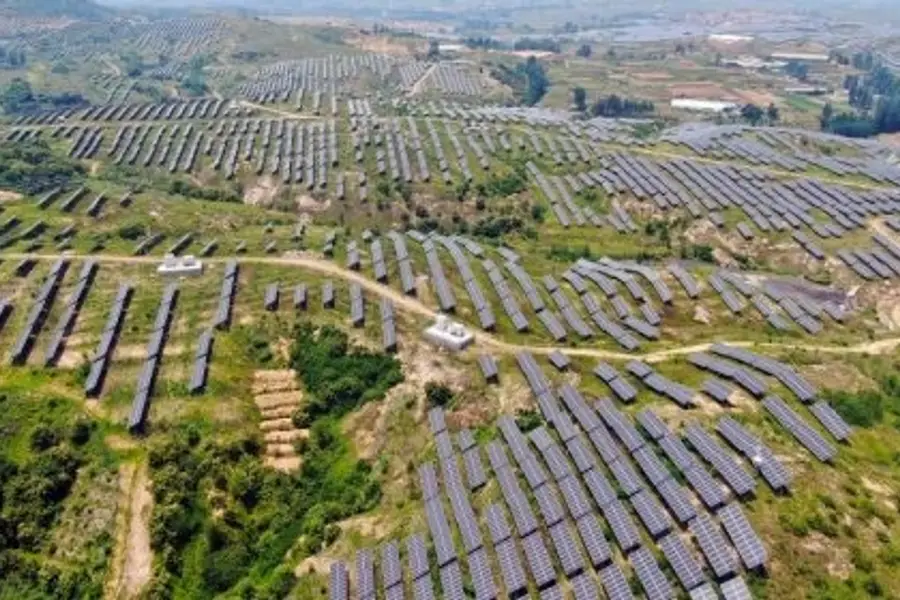
The solar farm operator said it expects to report its profit fell between 25% and 35% in the first half of this year
Key Takeaways:
- Xinyi Energy said its profit fell sharply in the first half of 2026, as its margins declined on falling prices with the phasing out of government subsidies for solar power
- China added a massive 315 GW of solar capacity last year, causing the abandonment rate for new plants to rise above 6% as the grid struggled to accommodate new supply
By Doug Young
Call it a “solar hangover.”
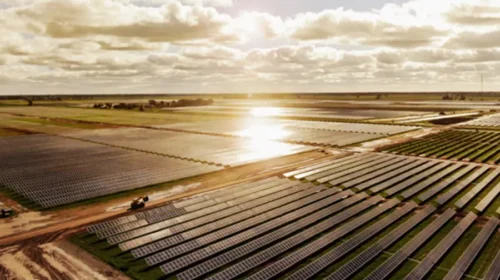
After several years of frantic building, China is suddenly struggling to digest massive amounts of new solar power capacity built by companies eager to cash in on state subsidies over the last three years. Many of those subsidies were sharply curtailed or eliminated last year, resulting in a frantic rush to get projects connected to the grid before deadlines in the middle of the year.
At the same time, the massive addition of so much capacity in such a short time has led to a jump in the abandonment rate of new capacity that simply can’t be absorbed by China’s electric grid so quickly. And while all this goes on, the country is gradually rolling out more market-based electricity pricing for renewable energy, replacing an older system where rates were guaranteed at higher levels for builders of new power plants.
All those factors were summed in a forecast on Friday from Xinyi Energy Holdings Ltd. (3868.HK), which warned it expects to report its profit fell between 25% and 35% in the first half of this year from the year-ago period. The company reported a profit of 449.8 million yuan ($66.4 million) in the first half of 2025, meaning it expects to report a profit of 292.4 million yuan to 337.4 million yuan in the first half of this year.
The decline reverses a 27.8% profit increase in 2025, when the figure reached 1.01 billion yuan for the year.
The company blamed the drop in part on lower electricity sales to the grid as it was forced to abandon some of its new capacity that couldn’t be connected, especially for subsidized projects. It also blamed new electricity pricing policies aimed at setting more market-based pricing for solar power, which has resulted in lower overall prices. Lastly, it also blamed the sale of its stake in one solar project at the end of last year, which resulted in a discontinuation of contributions from that project.
Xinyi Energy is one of China’s larger solar farm operators, with about 50 projects in operation at the end of last year with 4.8 GW of approved capacity. It is part of the Xinyi family of companies founded by Li Xianyi, who harkens from the same hometown in South China’s Fujian province as Cao Dewang, China’s “King of Glass.” Xinyi Energy’s parent, the separately listed Xinyi Solar (0968.HK), is China’s largest photovoltaic glass maker.
The company has benefited from a Chinese solar power buildup that has made it the world’s largest producer of the renewable energy source over the last few years. The country added a record 315 GW of solar capacity last year alone, lifting its cumulative total to 1.2 TW. Its additions accelerated toward the end of the year as developers raced to meet building deadlines, with more than 40 GW added in December alone.
Most analysts expect installations to decline this year, ending several years of explosive growth, citing a high comparison base, the reduction of subsidies and introduction of market-based pricing, and ongoing supply chain adjustments.
Growing abandonment rate
An important factor weighing on Xinyi Energy and its peers right now is the inability of China’s grid operators to connect capacity from their recently constructed solar farms after last year’s boom. Acknowledging that, the central government in 2024 raised the maximum allowable electricity abandonment rate for renewable energy plants to 10% from the previous 5%.
Put differently, that means the government only guarantees grid operators will buy up to 90% of any new plant’s installed capacity, instead of the previous 95%.
China’s abandonment rate, also know as the curtailment rate, for solar power has been climbing steadily with the recent building boom, underscoring the wasted spending that is ultimately showing up as lower gross margins and profits for operators. The abandonment rate was as low as 2% at the start of 2023, then doubled to around 4% a year later as the building binge accelerated. It rose further still to 6.6% in the first half of last year.
Xinyi’s falling profits reflect what’s happening to solar farm operators as they are forced to abandon capacity and accept lower, more market-oriented prices. The company’s revenue grew just 0.5% last year to 2.45 billion yuan from 2.44 billion yuan in 2024. But the company actually generated 10.1% more power during the year, thanks to contributions from recently acquired plants in its portfolio, meaning its revenue grew far slower than the power it generated.
As its costs continued to rise and its revenue plateaued, Xinyi Energy’s gross margin slipped nearly 4 percentage points to 61.8% last year from 65.6% in 2024.
“With the continuous development of the photovoltaic market, the power trading models are gradually evolving toward market-based mechanisms,” the company said in its 2025 annual report. “However, certain market-based transaction prices remain lower than the traditional feed-in tariffs, resulting in a decline in the group’s electricity revenue.
The company managed to report the much stronger 27.8% profit growth that we previously mentioned, though that was mostly due to a one-off gain from the sale of the stake in one of its solar farms, and lower financing and income tax costs. Its earnings before interest, taxes, depreciation and amortization (EBITDA), which better reflects operations of its core power business, rose by a far smaller 6% last year to 2.37 billion yuan.
So, what does the future hold for Xinyi and others like it after this latest bout of “solar indigestion” passes? We expect the company’s situation should quickly stabilize, and it should probably return to profit growth as it becomes more efficient at managing its large portfolio and adapts to the new system. That said, its days of rapid growth through acquisitions of new solar farms could be limited due to the ending of many government incentives.
Reflecting its position, the company currently trades at a trailing price-to-earnings (P/E) ratio of 6.6, similar to the 6.1 for China Suntien Green Energy (0956.HK), and higher than the 5.8 for traditional power supplier Datang International (0991.HK). At the end of the day, none of these companies will impress anyone with their breakneck growth, and are instead more attractive for their dividends and long-term durability. And while subsidies may be winding down, these solar power generators are likely to still enjoy strong government support in other forms going forward.
To subscribe to Bamboo Works free weekly newsletter, click here
Related Articles
RELATED ARTICLES
-
Canadian Solar advances North American shift with new plant, new CEO
- Rethinking bigger Is better: China’s long march toward higher-capacity energy storage cells
-
Solar subsidies likely to top agenda at Trump-Xi meeting
688223.SHG
- After years on the sidelines, VNET seizes on China’s AI moment with new CATL tie-up
- Shifting identities: Shein’s acquisition and Canadian Solar’s return to North America
-
Rising silver prices, appreciating yuan cast shadow over JinkoSolar
688223.SHG