Junion brings embodied intelligence to the factory floor – and finds profits there
As enthusiasm for embodied intelligence builds, the IPO candidate represents a standout case of a robot maker that can back its hype with profitability
Key Takeaways:
- Junion Intelligent has filed for a Hong Kong IPO, backed by sustained profitability that includes a 70% year-on-year profit increase in the first nine months of last year
- More than 90% of the company’s revenue comes from intelligent embodied industrial robots, underscoring its strong focus on industrial applications
By Lee Shih Ta
Waves of hype surrounding embodied intelligence and humanoid robots make for good headlines, even as the industry has yet to reach a true tipping point when companies can boast commercial viability. Beyond the catchy demo videos, staged robot performances and founders dishing out their grand visions, what investors really need are hard profits to determine whether these emerging technologies can support sustainable businesses.
One case study of what the future could hold comes from Suzhou Junion Intelligent Technology Co. Ltd., which this week wooed investors with a Hong Kong IPO application that included a rare instance of a profitable company.
Unlike many startups that position embodied intelligence as their starting point, Junion’s path has followed a more pragmatic, demand-driven evolution shaped by industrial needs. Founded in 2017, the company did not begin with humanoid or embodied intelligence concepts. Instead, it entered the market with industrial logistics and mobile robots, building engineering expertise in perception, navigation and task scheduling within real factory environments.
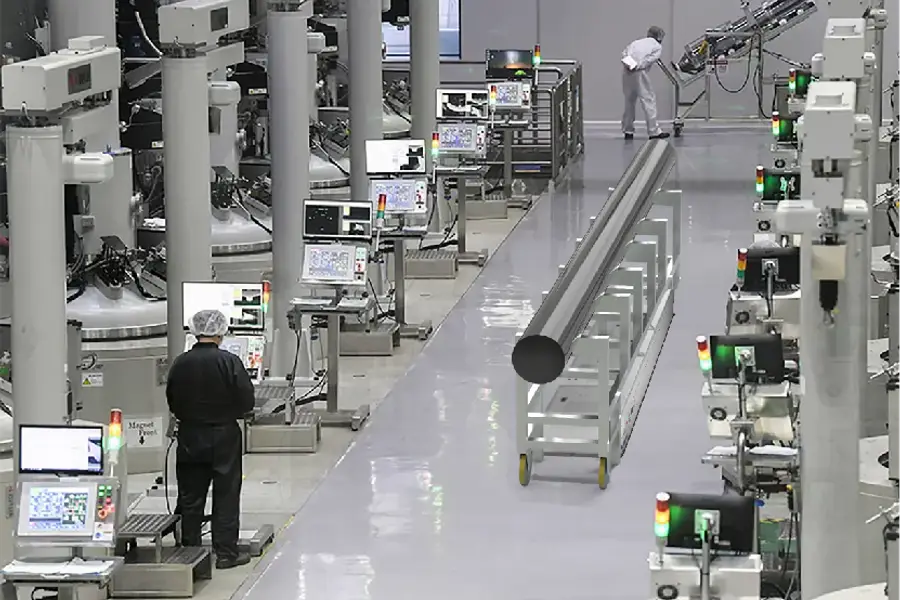
A year after its founding the company launched its self-developed JOS robot operating system, integrating perception, motion control, and task planning within a unified architecture. Unlike fancier systems designed for eye-catching demonstrations, JOS was built to meet demands associated with highly uncertain, long-duration operations in industrial settings. As the platform matured, the company expanded into higher-barrier sectors such as clean energy, electronics and semiconductors, deploying embodied intelligent robots in tasks like crystal pulling, wafer slicing, battery manufacturing and other high-precision electronic processes.
Industrial deployment
By repeatedly delivering in such complex industrial environments, Junion has gradually carved out a role as provider of end-to-end intelligent embodied robotics solutions tailored to specific industrial processes. Rather than selling standardized standalone equipment, the company gets deeply involved in the design and restructuring of its clients’ production workflows, covering everything from early-stage assessment and system integration to ongoing maintenance. As a result, Junion does not compete directly with traditional industrial robot manufacturers, but instead operates more as an engineering-focused enabler of embodied intelligence in real-world industrial settings.
This positioning has made Junion a solutions-based business provider, rather than simply a company that cranks out thousands of standardized machines. Revenue from intelligent embodied industrial robotics solutions accounted for 96% of Junion’s total revenue in 2024, rising higher still to 97.9% in the first nine months of 2025.
As the business scales, this strategy has begun to deliver tangible results. The company’s revenue rose from 207 million yuan in 2023 to 366 million yuan in 2024, representing year-on-year growth of 76.9%. Over the same period, its profit more than tripled from 9.13 million yuan to 32.64 million yuan. In the first nine months of last year, revenue climbed another 70% year-on-year to 410 million yuan, while its profit also grew close to 70%.
Among companies broadly grouped under the “embodied intelligence” label, Junion stands out as one of the few that has already closed the profitability loop. Its “industrial-first, general-purpose later” approach is also reflected in its margin trajectory, with its gross margin improving from 22.5% in 2023 to 25.4% in 2024, and rising further to 32.1% in the first nine months of 2025.
That said, as a project-based industrial solutions provider, Junion also faces typical structural pressures. Its operating cash flow was negative in both 2024 and the first nine months of last year, largely reflecting long payment cycles and extended project timelines. Customer concentration is another factor, with its top five clients accounting for 63.2% of Junion’s revenue in the first nine months of 2025. While these issues aren’t huge red flags, they’re likely to influence how investors assess Junion’s valuation and risk levels.
Investors have embraced embodied intelligence companies already listed in Hong Kong, assigning them premium valuations on all the talk about the sector’s big potential. Shares of Ubtech (9880.HK) are up about 60% from their 2023 listing price, including a 68% rise over the past six months, giving the stock a premium price-to-sales (P/S) ratio of roughly 35.7 times. Dobot Robotics (2432.HK) has seen its shares nearly double since it listed at the end of 2024, giving it a similar P/S ratio of around 34.7 times.
Notably, neither company has achieved stable profitability. Investors are largely banking on such companies to grow quickly by scaling up and leveraging their general-use products and platform potential. In such an environment, uncertainty about their big potential can even become an asset, adding to their mystique and valuation premiums.
Junion’s situation is more nuanced. On one hand, it has successfully engineered embodied intelligence into industrial scenarios, delivering stable revenue and profits that validate its business model. On the other, this relatively early monetization may also constrain investor imagination, to the company’s detriment.
When a business is clearly anchored to specific processes and industrial workflows, investors can more easily imagine its growth limitations. That makes them more inclined to value it as a growth company with real-world applications and constraints, rather than paying lofty premiums for vague talk about huge future potential. At the same time, Junion’s case creates an important benchmark for investors, asking if they will continue to value imagination over verifiable business models and profits as embodied intelligence moves from concept toward deployment.
To subscribe to Bamboo Works weekly free newsletter, click here
Related Articles