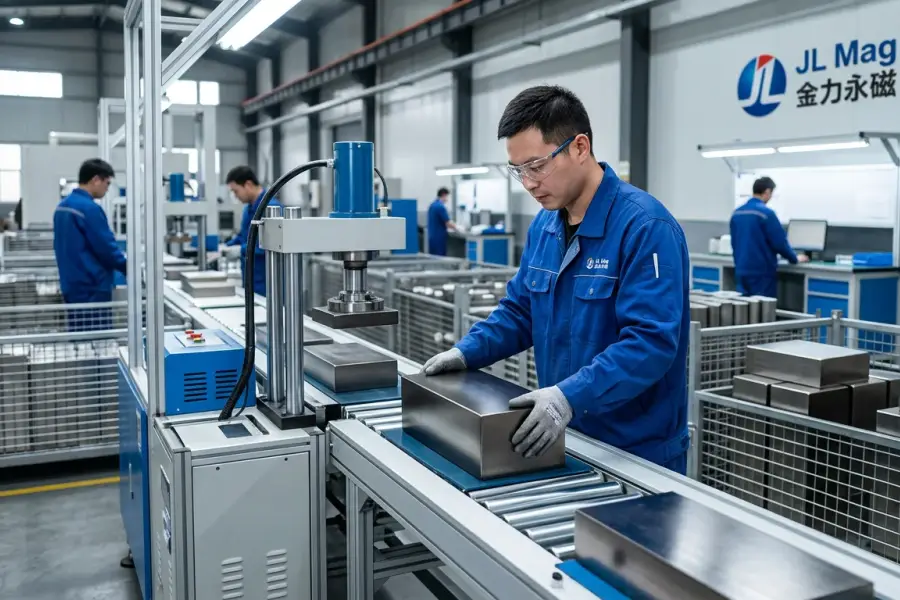
The Chinese producer of magnetic materials has dropped plans to invest in an Australian minerals firm after the target pivoted towards North American partners
Key Takeaways:
- The plan was meant to diversify JL MAG’s supply chain but changes in ownership of the mining assets diluted the deal benefits and amplified geopolitical risks
- China’s tighter controls on overseas investment and cross-border technology transfers are also complicating the quest for rare-earth resources
By Lee Shih Ta
As global competition for rare earths intensifies, China is finding it tougher to gain control of overseas mineral resources.
Although Chinese companies dominate the fields of processing and magnetic materials, they still need to diversify and strengthen their international supply chains. But they risk being shut out of deals as the United States and Australia step up efforts to bypass China in their supply chains. Meanwhile, China itself is tightening oversight of strategic resources and outbound investment, making overseas expansion ever more complicated.
Against this backdrop, JL MAG Rare-Earth Co. Ltd. (6680.HK; 300748.SZ) has axed a two-year plan to invest in Australian rare-earth company Hastings Technology Metals. The Chinese magnetic materials company issued a statement on Aug. 7 saying the conditions for the equity subscription had not been met but it did not expand on why the plan had unraveled. No payment had been made, and the terms had never formally taken effect, the company said.
On the same day, a Chinese mining company suspended a rare-earth project in Laos, citing a need to comply with China’s evolving policies on mineral resources.
In their different ways, JL MAG’s Australia decision and the move by Chifeng Gold (6693.HK) to halt its Mengkham project both represent a slowdown of overseas expansion in rare earths. At a time when China still encourages overseas mineral cooperation, why are companies beginning to pull back?
A changed landscape
For JL MAG, the nature of the investment target itself had changed. Two years ago, the deal with Hastings was intended to strengthen the Chinese company’s supply of raw materials for its high-performance magnetic products. At the time, Hastings owned 100% of the Yangibana rare-earth project in Western Australia, where neodymium and praseodymium accounted for about 37% of total rare-earth oxides.
Hastings later enlisted Australian mining investment company Wyloo to help finance the project. After the transaction was completed last year, Wyloo acquired a 60% interest in Yangibana and took over management control, leaving Hastings with just 40% of the project. If JL MAG had proceeded with its plan for a 9.8% stake in Hastings, its indirect exposure to Yangibana would have been diluted to roughly 3.9%. The structure of the core asset underlying the agreed price had changed significantly.
At the same time, Yangibana’s strategic direction had shifted. Wyloo, Hastings and Canada’s Ucore signed a framework agreement last year to explore supplying up to 37,000 metric tons of rare-earth concentrate annually and to evaluate midstream processing in the United States. Ucore positioned the partnership as part of a North American “ex-China” supply chain, linked to the U.S.-Australia cooperation framework for critical minerals.
An investment originally meant to strengthen JL MAG’s resilience risked becoming embedded in a Western supply chain designed to exclude China. Even putting political considerations aside, the changes at Hastings and Yangibana were enough to call the commercial value into question.
Chifeng Gold’s move, meanwhile, points towards a trend for tighter Chinese regulation of the rare-earth industry to keep control of key technologies. The company cited a “progressively improving” policy framework for its Laos suspension, without detailing specific rules. New regulations that took effect in July have tightened oversight of outbound investment and cross-border transfers of restricted technologies. Rare-earth mining, smelting and magnetic-material technologies had also previously been included under stricter export licensing rules. Although those requirements were later suspended, they still suggest a broader direction of regulation.
Tighter controls
The regulatory scope even covers investment, consulting and joint R&D arrangements, showing that the authorities are closely monitoring whether China’s expertise in mining, smelting and magnetic materials risks being transferred overseas along with such projects.
The Mengkham project is still in the trial-mining stage, with the permit currently being renewed. The project made a loss of about 54 million yuan ($8 million) for Chifeng Gold in 2025, meaning the suspension should barely affect overall results. Meanwhile, a joint venture between Chifeng Gold and Xiamen Tungsten became embroiled in an environmental controversy late last year, highlighting how Chinese companies seeking mineral resources in Southeast Asia must also contend with rules on licensing, the environment and corporate responsibility.
JL MAG is in a stronger position to walk away from Hastings than it was two years ago. China Northern Rare Earth and China Rare Earth together accounted for about 72% of the company’s total procurement last year, while JL MAG also recycled 3,681 metric tons of rare-earth raw materials. Long-term domestic supply deals and recycling capacity therefore underpin its raw-material security. Revenue rose 14% to 7.72 billion yuan last year, while net profit jumped 142% to 706 million yuan. Net profit for the first half of this year is projected to rise by 31% to 51%.
JL MAG’s Hong Kong-listed shares edged down 0.3% to HK$17.90 in the first session after the announcement, suggesting investors see little earnings impact from the cancelled deal. Still, the company’s current supply is concentrated in the two Chinese rare-earth groups, leaving a continued need to diversify going forward.
Australian resources are increasingly being integrated into Western supply chains, while China itself is tightening oversight of overseas investment and strategic resources. For JL MAG, finding a viable overseas project may be considerably harder than it was two years ago.
To subscribe to Bamboo Works free weekly newsletter, click here
Related Articles

RELATED ARTICLES
-
BRIEF: JL Mag profit jumps over 20% in first quarter
 300748.SHE
 -
JL Mag forecasts big first-half profit increase
300748.SHE
-
CiDi drives beyond China with new British partnership
3881.HK
-
BRIEF: Yancoal Australia to buy 80% of Kestrel Coal Mine for $2.4 billion
3668.HK
- Can crypto power supplier Boco plug into the AI boom?