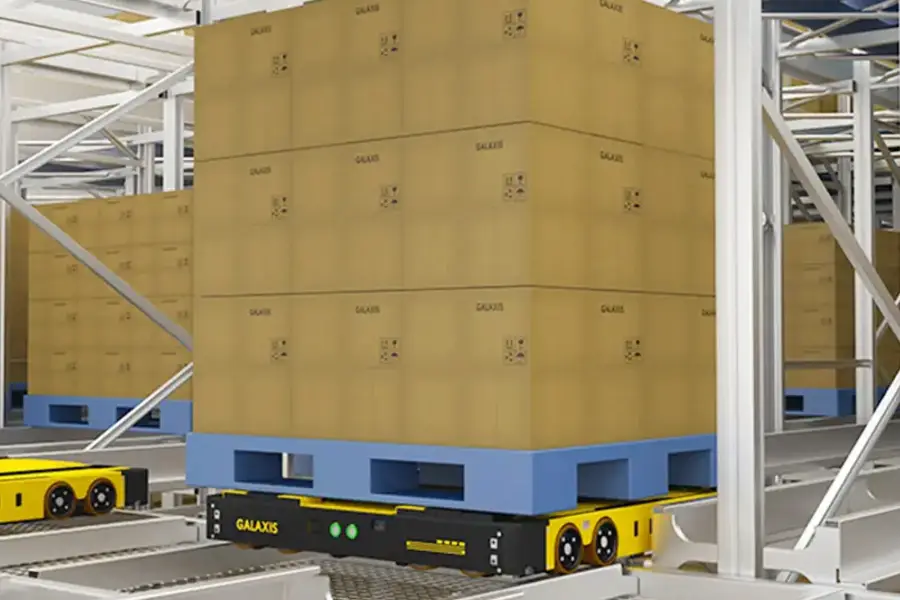
The maker of robots used in warehouses is aiming to build up its international business, which currently accounts for less than 2% of its revenue
Key Takeaways:
- Galaxis has opened three new regional sales and service centers targeting the Southeast Asian, North American and South American markets
- The company’s revenue rose 45% in the first half of the year, but its sales outside China fell by two-thirds to account for just 1.6% of its total
By Doug Young
If nothing else, you have to credit Zhejiang Galaxis Technology Group Co. Ltd. (2729.HK) for thinking big. The logistics robot maker has big plans to expand globally, which it detailed in a Thursday announcement of its first major step outside China with the opening of sales offices in Singapore, the U.S. and Brazil.
The company also included detailed discussion of the progress it’s making in various global markets in its midyear report in August. Despite all that, however, international sales remained a miniscule 1.6% of Galaxis’ revenue in the first half of this year. Even worse, its 8.25 million yuan ($1.24 million) in sales outside China during the six-month period was actually down by about two-thirds from the 27.6 million yuan in the year-ago period.
All that said, the global market for the kind of logistics-use robots Galaxis makes should be quite large. In the prospectus for its March IPO this year, the company cited third-party research saying the global market for intelligent intralogistics robotics is expected to grow about eightfold from 42.6 billion yuan in 2020 to an estimated 344.1 billion in 2030.
What’s more, Galaxis has quite strong credentials and a relatively long operating history, even though its business has been limited almost completely to China so far. The company was founded in 2014 by the husband-and-wife team of Gu Chunguang and Yang Yan, who both did their undergraduate studies at Tsinghua University, China’s leading sciences school, before pursuing doctorates in the U.S. at MIT and Cornell, respectively.
And while some other companies cite longer histories, Galaxis can genuinely say it’s been making robotics from the get-go, rolling out its first-generation four-way shuttle robot designed to handle containers in warehouses back in 2014.
But talking global is often easier said than done, especially in a complex area like robots that require strong technical support and after-sales service. That said, you have to start somewhere, which is what Galaxis’ latest announcement does by laying a foundation for its global roadmap.
The company said that Singapore will act as headquarters for its global business among its three new offices, emphasizing those facilities will only engage in sales and not manufacturing. It didn’t specify where the other two facilities, one in the U.S. and the other in Brazil, were located. The Singapore office will act as a hub for expansion into Southeast Asia, while the U.S. will anchor North America and Brazil will serve as a springboard into South America.
Galaxis said it will work closely with local systems integrators and service partners in all three regions to control costs, meaning its headcount outside China is likely to be limited in the beginning. That looks like a shrewd strategy, as it’s much easier to build up your own support teams once you have proven business in a market. But it also forces Galaxis to rely on local partners for support services, making quality control more difficult.
“Through the aforementioned deployment, the group can upgrade its operating model from direct product exports to “Made in China + Localized Operations” and establish local sales and technical service teams in close proximity,” Galaxis said.
Warm reception
Investors were generally positive on the announcement, with Galaxis’ stock up nearly 13% in Friday morning trade the next day. But the rise is a bit of a “dead cat bounce,” as the stock has been on quite a roller coaster ride since it first debuted in March, reflecting the bumpy ride for robotics stocks this year.
Galaxis raised HK$556 million ($71 million) in the listing, whose retail portion was more than 2,000 times oversubscribed at a time when robot stocks were all the rage. The stock nearly doubled from its HK$16.66 IPO price on its first trading day, and the company was briefly a “unicorn” with a market value of more than $1 billion as it traded as high as HK$42 as recently as September.
But investors have gone chilly on robot stocks lately, as it becomes increasingly apparent that many won’t achieve the kind of meteoric growth that many were hoping for anytime soon. Even after the Friday morning rally, Galaxis’ current price of about HK$5 is less than a third of its IPO price. Many robot stocks are down even more, and Galaxis’ saving grace is that its products actually have a proven market for use in warehouses.
The company’s revenue rose 45.1% to 505 million yuan in the first half of this year from 348 million yuan a year earlier, though its gross margin came under pressure from growing competition, dropping to 17.5% from 17.8% over that time. On the bottom line, its net loss narrowed slightly to 81.3 million yuan from 85.9 million yuan a year earlier.
Importantly, the company said it had a backlog of 2.2 billion yuan in orders at the end of June, which it said it expects to fill over the next three years. It noted that 710 million yuan of that – or about a third – comes from 56 overseas projects.
There was lots of discussion about those overseas opportunities in the company’s midyear report, despite the lack of actual revenue. In one of the biggest developments, Galaxis said it officially entered the global shuttle system supplier directory of a “globally renowned Swedish home goods retailer,” during the period, which sounds like it could refer to home furnishings giant Ikea.
Additionally, Galaxis said it made a “significant breakthrough” in Australia, where it received orders for its very-narrow-aisle fork-type robots (VFRs) from a health supplement company. It also reported two new customers in Japan, one a “leading global electronics manufacturer” and the other a domestic furniture retailer, after starting to develop that market with a local partner last year. Lastly, it said it also won a new pallet shuttle project in Brazil with a local food processing company, adding to its winning bid involving a factory under construction by Chinese manufacturer in the market last year.
The bottom line is that you have to credit Galaxis for its efforts to expand beyond China, including its latest three-pronged strategy for developing the North American, South American and Southeast Asian markets. Now, it just needs to show some stronger results for those efforts in the form of actual revenue from its global expansion.
To subscribe to Bamboo Works weekly free newsletter, click here
Related Articles
RELATED ARTICLES
-
Ubtech charms investors with companion robots – until reality sinks in
- INTERVIEW: Cainiao rolls out ZeeBot in latest step toward ‘Dark Warehouses’
- Mapping commercial paths for robots in industry and at home
- New labor clocks in: How humanoid robots are moving into everyday jobs
- The embodied intelligence puzzle: A deep dive into China’s humanoid robot industry
-
Orbbec’s booming robotic ‘eye’ sales fail to wake up its bottom line
688322.SHG
-
Yunji bills itself as China’s ‘Tesla of robotics.’ But investors need convincing
2670.HK