51World wins Nvidia’s nod. Now it just needs to translate that to sales
The company’s shares rallied 30% on its inclusion in an Nvidia driving simulation program, as its fast-growing simulation segment is on track to overtake its older digital twin business
Key Takeaways:
- Nvidia has included 51World’s simulation subsidiary in its self-driving safety initiative, extending a collaboration announced in March
- Simulation services rose more than sixfold to supply 41% of the company’s first-half sales this year, and are on track to become its biggest revenue source
By Hu Minghe
When property and asset management veteran Li Yi founded Beijing 51World Digital Twin Technology Co. Ltd. (6651.HK) in 2015, he was a relative newcomer to harnessing the power of technology for business. So he combined the virtual-reality technology that had captivated him with his background in property, selling developers virtual tours of homes that had yet to be built. A decade later, his company faces another test of turning impressive technology into paying work.
The company got an endorsement from one of the tech world’s hottest companies last week, when Nvidia named 51World’s 51Sim subsidiary as a member of its new program helping carmakers assess the safety of self-driving software. 51World’s shares jumped 30% the day after the announcement, as investors welcomed the nod from such a major tech player. But 51World still loses money, leaving the question of whether the recognition will help bring in more sales.
Li has said the virtual-property business sustained his company through its early years. But that business is suffering now from a prolonged property slump, and finding another such application has proved harder, he acknowledged in a January interview. Bamboo Works last examined 51World ahead of its IPO last December, when its Earth Clone ambition and widening losses dominated the story. Much has changed since then.
From homes to machines
The connection between virtual apartments and the self-driving car business at the heart of the new Nvidia announcement is less far-fetched than it sounds. Both require computer models of physical surroundings that can be used to plan, test or manage new products and services.
51World extended its original modeling work beyond real estate into cities, industrial sites and water systems. Its grand ambition is the company’s Earth Clone project, which would build a digital representation of the entire planet. But the company still needs more practical day-to-day applications like driving simulation to keep the revenue flowing.
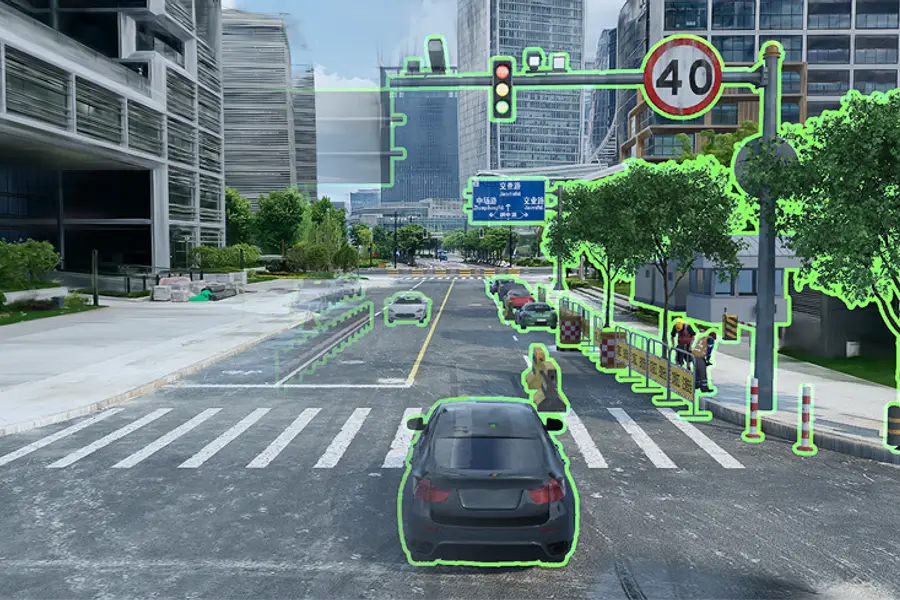
Driving simulation isn’t new to 51World. The segment has been part of its business since 2017, letting carmakers test how their software behaves in virtual road environments, including dangerous or unusual traffic situations that can’t easily or safely be staged on real roads.
The company’s driving-simulation business was already working with Nvidia before October. In March, the U.S. chipmaker named 51World among companies integrating technology that reconstructs real-world scenes into digital environments. October’s announcement extends the relationship into safety testing.
Nvidia’s Halos SAFE framework brings together simulations, physical tests and monitoring to help carmakers assemble evidence about how their driving software behaves. 51World says its 51Sim subsidiary will work to connect its simulation tools to that process, and describes 51Sim as the only Chinese participant in SAFE.
51World says that joining SAFE could expand its safety-testing work for carmakers at home and abroad. The China piece is important, since 51World’s home market is a global leader in smart car technology. But the overseas opportunity could be just as important. Customers outside China supplied less than 2% of 51World’s sales in the first half of this year, meaning Nvidia’s stamp of approval could help to win over international customers that might be wary of working with a Chinese partner.
Growth at a cost
There is already evidence that customers are spending more on 51World’s broader suite of simulation tools that are one of its two main business segments. Revenue from the simulation business surged 545% in the first half of this year, though at 51.2 million yuan ($7.7 million) in latest six-month period the figure is still relatively modest. But its share of the company’s sales rose to 41.4% from just 14.8% a year earlier.
In addition to driving applications, the simulation business also likely includes two robot products, whose latest versions were unveiled in August. One of those, AperData, pairs camera gear, worn or held by workers as they do tasks, with software that turns those recordings into data for training robots. The other, AperOne, helps customers train, test and operate robots in real settings.
Meanwhile, the company’s older digital-twin business serving cities and industrial customers remains its largest breadwinner. Its sales also rose by a healthy 65% in the first half of this year to 72.3 million yuan, or 58.5% of revenue.
The changing revenue mix gives investors a more concrete reason to follow the company than its lofty but perhaps less commercial ambition to recreate the planet.
Led by simulation’s strong gains, 51World’s revenue more than doubled to 123.7 million yuan in the first half of this year from 53.8 million yuan a year earlier. Over the same period, its net loss narrowed to 70.1 million yuan from 94 million yuan, as its gross margin also improved to 44.8% from 41.1%. But R&D spending rose 80% to 54.3 million yuan, absorbing much of the benefit from higher sales.
Investors have had a wild ride in the 10 months since 51World’s shares first floated. After the rally on the Nvidia news, the shares were more than double their IPO price, but were less than half their all-time high in June. The company seized on its high share price to raise HK$394.5 million ($50 million) in fresh funds In July, adding to its cash reserves that stood at 656 million yuan midway through this year.
The year-end test
The next measure of commercial progress could be what happens to the company’s robot-related orders. Last month 51World said combined orders for AperData and AperOne exceeded 200 million yuan, larger than its entire first-half revenue. It expected more than 90% of that to be delivered during 2026.
The timing makes the company’s next annual results particularly important. Last year 84.5% of 51World’s 347.8 million yuan in revenue came in the second half, according to calculations using the company’s earlier filings. That makes a simple doubling of first-half revenue a poor guide to the full year.
Results for all of 2026, typically published in March the following year, should give investors a clearer view of how much the new robot business has contributed to sales and whether growing revenue is helping the company to narrow its losses without compromising R&D spending.
Li’s early VR business succeeded because it found customers with a real reason to pay. Nvidia’s recognition could help 51World to do that again by bringing in more carmakers as customers. That means investors will be watching closely to see whether 51World’s simulation business continued to zoom in the second half of the year, potentially overtaking the older digital twin business to become its top revenue source.
To subscribe to Bamboo Works free weekly newsletter, click here
Related Articles
RELATED ARTICLES
-
ZJK tooling up for Nvidia?
 ZJK.US
- Booming electricity demand feeds KeLiang’s niche in power grid simulation
- China gains ground in open AI race, but can its models turn adoption into revenue?
-
51World Digital Twin revenue up 130% in first half of 2026
6651.HK
-
Digital China’s AI reboot gets stuck in its low-margin past
0861.HK
- Who needs humanoids? Direct Drive Tech bets on simpler household robots
-
Jack Ma-backed insurer seeks riches in Hong Kong gold tokenization foray
0376.HK