Yunji bills itself as China’s ‘Tesla of robotics.’ But investors need convincing
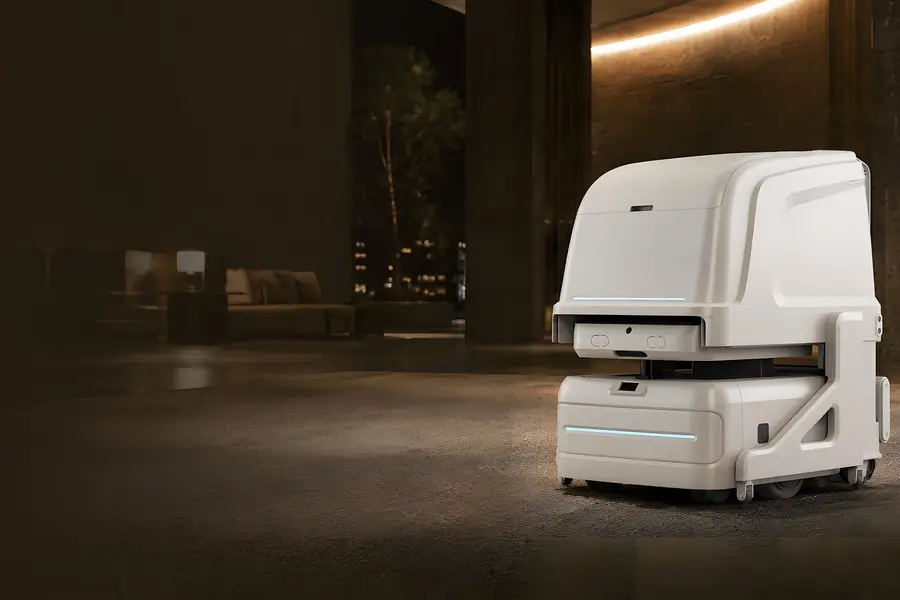
Known for its hotel-use robots, the company compares its new pay-for-use revenue model to the model used by Tesla and robotaxi operators
Key Takeaways:
- Yunji’s business model is shifting to AI-driven subscription and fee-based services away from hardware sales
- The company’s shares have dropped nearly 90% from a peak in late June, as it reported revenue from its core hotel-use robots fell 17% in the first half of this year
By Edith Terry
Beijing Yunji Technology Co. Ltd. (2670.HK) had a good story to tell at the time of its Hong Kong IPO last October, despite floating shares into a market crowded with other embodied intelligence robotic companies. The buzzword refers to robots that incorporate AI, improving their ability to interact with environments in factory, workplace, residential and other settings.
Yunji’s story was initially embraced by investors, but more lately has fallen out of fashion. The company has been trying to reverse a slide that has seen its stock lose nearly 90% of its value since late June. Its latest effort came last week in a business update highlighting a shifting model that’s seeing it move from hardware seller to a more pay-for-service model that provides stabler, recurring revenue.
Shenzhen Dobot (2432.HK) kicked off the robotic rush to market in December 2024, and 14 such companies have listed in Hong Kong since then. The quality of those offerings has been all over the map, with some companies making practical models and components for use in factories while others focused on high-concept robots with little practical use.
Yunji was in the former group, making robots for use in the hospitality business, a market worth 938 billion yuan ($140 billion) in 2024, according to its prospectus. Hotels were the largest market segment in that business, including 50.2 billion yuan for software and 369.9 billion for hardware.
Yunji served 34,000 out of 349,000 hotels in China in 2024, and was cultivating a second market with slightly adapted models used in more than 150 hospitals. It led the 3.7 billion yuan market for AI-based hospitality robots, with a 6.3% share, including 13.9% of the market for hotel-use models. Yunji’s robots do things like delivering items for room service, brewing coffee for guests, and managing check-ins.
Investors liked the story, initially bidding Yunji’s shares up by more than 20% after its trading debut. But fast forward to the present, when the company’s robots have gone from stock market superstars to taking up residence in the investor doghouse. The stock’s recent plunge has left it trading at about a third of its IPO price.
Business transition
The company’s latest business update and a string of recent similar announcements have failed to halt the slide. Yunji is transitioning from hardware manufacturer to a platform and subscription-based software business, following in the footsteps of U.S. auto giant Tesla (TSLA.US) and others in search of stabler and more recurring revenue streams to replace one-off product sales.
“When we discuss things internally, we feel that some of Yunji’s current thinking is quite similar to Tesla’s approach,” CFO Liu Ying explained to reporters at an event for Chinese media. “First, deploy enough terminals into the network, then have a cognitive and decision-making brain, and finally move towards charging based on results and services.”
To get to those stabler, recurring revenue streams, Yunji will need to be able to manage fleets of robots using online channels. It tried to show its progress on that front in the new business update, saying the average daily number of concurrently online robots managed by its network increased by 20% to 25% year-on-year in the third quarter, while the number of tasks managed by that fleet rose by 25% to 30%.
The same day as the business update, Yunji also separately announced an extension of the lockup period for shares held by Chairwoman Zhi Tao and CEO Li Quanyin, who collectively hold more than 10% of the company’s stock. But those efforts failed to stabilize the shares, which have shed nearly a third of their value since the pair of announcements.
Mixed results
The latest efforts came just a couple of months after Yunji released a midyear financial report that looked decidedly mixed. It had an average of 36,000 “concurrently online” robots each day in the first half of the year, up 30% from the previous year. Those robots completed 479 million tasks during the six-month period, up 46% year- on-year. The types of environmental events that robots could understand increased by 130%, and the types of service tasks they could perform increased by 570%.
Its non-hotel clients include Ye Niao Technology, a garbage collection company, as well as Tianjin Nankai Hospital under its Runyi project targeting hospitals, according to last week’s business update. In March, Yunji also announced a deal with SF Express City Delivery, one of China’s top delivery companies, targeting last-mile delivery.
But all those upbeat numbers and new partnerships failed to cover up some worrisome trends in the company’s midyear report. Its overall revenue rose 71.6% year-on-year to 188 million yuan ($28.2 million) in the first half of the year. Its loss narrowed by 22% to 111 million yuan during the period, though the loss more than tripled to 108.8 million from 31.4 million on an adjusted basis.
And more worrisome, a closer look at its top line showed revenue from the company’s core hospitality sector slipped by 12.2% from the year before to 88.9 million yuan, dropping to 47.3% of revenue compared to 92.4% a year earlier. Revenue from the hotel segment of hospitality fell by 17% to 82.8 million yuan, also declining sharply to 44% of total revenue compared to 91% in 2025.
Those declines were more than offset by a new category, “ecosystems partners,” which describes sales to other companies that customize Yunji’s products for their own requirements. Revenue from that category totaled 90.5 million yuan during the first half, up manyfold from 2.66 million yuan a year earlier. In that process, that category rose to 48.1% of total revenue from just 2.4% a year earlier.
That move from direct selling to actual end users to a heavy reliance on more intermediary companies apparently spooked investors, with Yunji shares losing three-quarters of their value since the midyear results announcement.
All that said, Yunji is hardly alone among the field of robot makers that have fallen out of investor favor. Geekplus (2590.HK) and Laifual Drive Co. (3952.HK) have both lost about two-thirds of their value over the last six months, while Huayan Robotics (1021.HK) is down 72%. Even first-mover Dobot is down about 52% over that time.
But Yunji may still be worth another look once the market settles down. Huaxin Securities forecasts the company’s revenue will continue to grow at a steady clip, rising from 458 million yuan this year to 1.25 billion yuan in 2028. That seems to show the company still has strong growth potential, and its revenue could become stabler as it transitions from a hardware seller to a services provider.
To subscribe to Bamboo Works weekly free newsletter, click here
Related Articles

RELATED ARTICLES
-
Ubtech charms investors with companion robots – until reality sinks in
- INTERVIEW: Cainiao rolls out ZeeBot in latest step toward ‘Dark Warehouses’
-
Tongcheng’s rosy report fails to discuss the worrisome elephant in its house
0780.HK
- Topstar rolls out shaky robotics IPO, complete with volatile profits, falling revenues
-
H World rolls out red carpet for shareholders with new $2.5 billion return plan
HTHT.US1179.HK
- Who needs humanoids? Direct Drive Tech bets on simpler household robots
- Dobot taps Shenzhen market to fund its bet on humanoid robots