
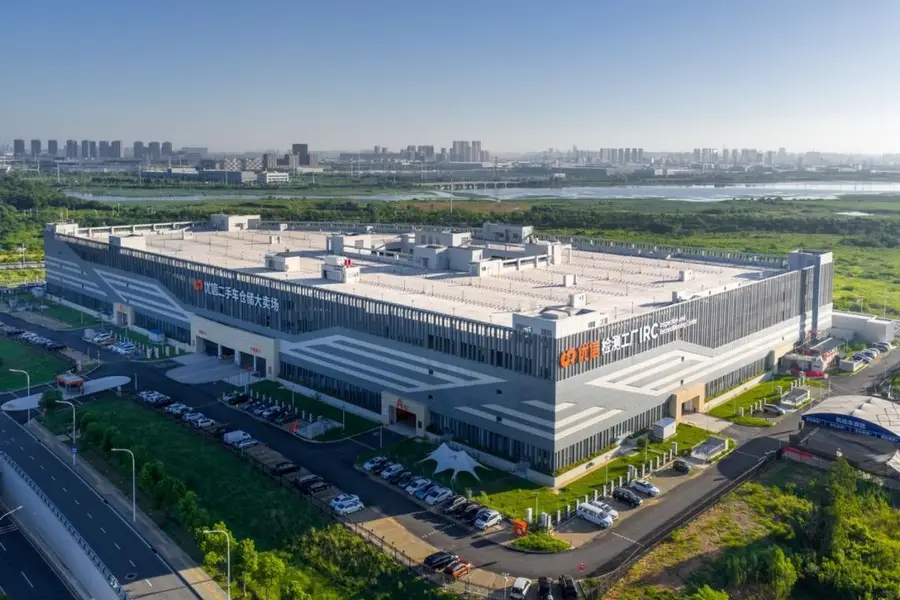
The company’s gross margin turned negative in the second quarter, as an intensifying price war among new car sellers spilled into used cars
Key Takeaways:
- Uxin’s revenue and transaction volume rose by around 80% in the second quarter, as it rushed to unload inventory amid tumbling used car prices
- The company aims to operate more than 50 used car superstores with annual retail transaction volume of more than 1 million units by 2030
By Doug Young
If nothing else, you have to credit used car seller Uxin Ltd. (UXIN.US) with its high degree of transparency about the rocky road it traveled in the second quarter. The company is just one of many suffering in a Chinese car market afflicted with massive overcapacity after years of rapid buildup.
The big question for Uxin is how long it will take for the current correction to play out, and whether it can stay in business until that happens. Truth be told, the company looks quite well positioned if it can weather the current storm. Its superstore business model is similar to U.S. giant Carmax (KMX.US), which has generally thrived by offering fair prices and the promise of after-sales support to consumers wary of buying used cars.
But unlike the relatively mature U.S. market where Carmax operates, China’s car market has been much more volatile lately. Growing consumer caution in a slowing Chinese economy caused new passenger vehicle sales to plunge about 20% year-on-year in the first five months of this year, prompting sellers in the already-oversupplied market to slash prices to clear out inventory in the second quarter.
That pressure quickly filtered down to the used car market, where prices for traditional gas-powered vehicles fell between 10% and 15% in just two months, Uxin said in a market update in June. The rapid decline prompted Uxin to accelerate efforts to clear out its inventory before prices fell even more. As it did that, its revenue jumped 75% year-on-year to 1.15 billion yuan ($172 million) in the second quarter, as its transaction volume rose 88.7% to 21,899 vehicles, according to its second-quarter report released late last month.
But the fast-falling prices, combined with rising transaction volumes, ultimately dropped Uxin’s gross margin to a negative 0.7% for the quarter, meaning it sold each car for less than it paid to acquire the car, before even factoring in other costs like sales and marketing.
“We moved quickly to sell through inventory affected by decreasing prices,” said founder and Chairman Dai Kun. “While this put significant pressure on near-term profitability, it allowed us to realign our inventory more quickly with the new pricing environment.”
CFO Lin Feng said the volatility has already begun to ease, and, as the situation stabilizes, the company expects its gross margin to return to positive territory at 6% or higher in the third quarter, similar to the 7% it reported in the first quarter.
Despite the words of reassurance, investors still aren’t convinced that Uxin has a long-term future. The stock has lost nearly two-thirds of its value this year, most of that over the last six months as the latest price war heated up. Still, even after that selloff, the company – which has never earned a profit – trades at price-to-book (P/B) ratio of 6.4, four times higher than Carmax’s 1.32, showing some investors believe it still has potential.
Uxin is following a path similar to many Chinese companies that started out as middlemen in their product areas, but later switched to direct selling to give them better quality control. The company started out operating a used car trading platform, before switching to direct sales with the opening of its first used car superstore in the city of Xi’an in December 2022. It spent several years perfecting that model, and more recently has begun opening new stores at a rapid clip. It currently operates seven superstores across China, including its latest opening in July in Shaoxing of East China’s Zhejiang province.
Big growth potential
Shaoxing was Uxin’s second store opening this year, following one in the Northern city of Tianjin in April. The company has previously announced two additional sites that have yet to open in the cities of Yinchuan and Jiangyin, and has said it expects to open a total of four to six new stores this year.
Over the longer term, Uxin says it has identified more than 200 cities in China that it believes have the economics to support stores using its business model. It said its five-year objective is to operate more than 50 superstores with annual retail transaction volume of more than 1 million units by 2030. That would represent a huge increase over the roughly 80,000 retail unit sales it could log this year, based on its second-quarter retail sales of 19,610 cars. Then again, no one has ever accused Chinese companies of being too conservative when it comes to talking up their growth prospects.
Uxin is well placed to capitalize on a Chinese used car market that is still playing catchup with Western peers in terms of penetration, as more people grow comfortable with buying secondhand products. Used vehicle transactions totaled 20.1 million cars last year, or about 60% of the country’s 34.4 million new vehicle sales for the year. By comparison, used car sales typically outnumber new cars in most developed markets, typically by a factor of 1.5 to 2 times.
The big question for Uxin is whether it can stay in business long enough to enjoy the kind of success that companies like Carmax have seen in more mature markets like the U.S. The company has come under nonstop financial pressure since switching its business model due to the big capital requirements for self-operated stores combined with price pressures and other China-specific factors.
The company recorded an operating cash outflow of 64 million yuan in the second quarter, and posted a non-GAAP EBITDA loss of 120 million yuan for the period, up sharply from a 16.5 million yuan loss on that basis a year earlier. It had just 82.6 million yuan in cash at the end of June, and added that its current liabilities now exceed its current assets by about 200 million yuan. Still, it has a couple of steady backers that keep supplying it with cash, most notably the venture arm of electric vehicle maker Nio, and said it believes it has enough money to meet its capital requirements for the next 12 months.
As if to demonstrate its longer-term potential, Uxin previously pointed out that representatives from asset management majors including CICC, China Merchants Securities, Deutsche Bank and Invesco Great Wall Fund Management all attended its investor day conference in June. That does seem to show there’s belief in the investment community that Uxin could someday become a leader in China’s used car sector. Now, the company just needs to survive the current turmoil until the industry finally enters a more settled state, which could take the next one to two years or even longer.
To subscribe to Bamboo Works weekly free newsletter, click here
Related Articles
Can Longcheer buy its way to the top of the AI rack?
Two auto giants hitch wagons to combat harsh industry winter
RELATED ARTICLES
-
Yusheng IPO tests bumpy road for China’s used car market

-
Autohome skids as China’s car market slams on the brakes
ATHM.US2518.HK
-
Tuhu Car drives out of China garage with Australian acquisition
9690.HK
-
Chery tiptoes into Japan with EV ‘kei’ microcar joint venture
9973.HK
- Canaan gets doubly squeezed in latest crypto downturn
-
Ganfeng rediscovers profitability as volatile lithium prices test its mettle
002460.SHE
-
Wall Street renaissance for China stocks? DSC listing offers mixed picture
DSC.US


