What an AI breach of WeChat and Jollibee’s listing choice mean for U.S.-Asia tech and capital
“If you want to ensure the success of a company that is still very much regional Southeast Asia when going to market, it’s probably a bit easier in Hong Kong than in the U.S.” — Explaining why a Southeast Asian consumer brand would prefer a Hong Kong listing over Wall Street.

Key Takeaways:
- A U.S.-developed AI tool’s mock breach of WeChat highlights escalating cybersecurity risks and could trigger tighter oversight from Beijing
- Jollibee’s decision to list in Hong Kong over the U.S. underscores the city’s growing appeal for regional consumer brands seeking Asian capital
By Rene Vanguestaine and Doug Young
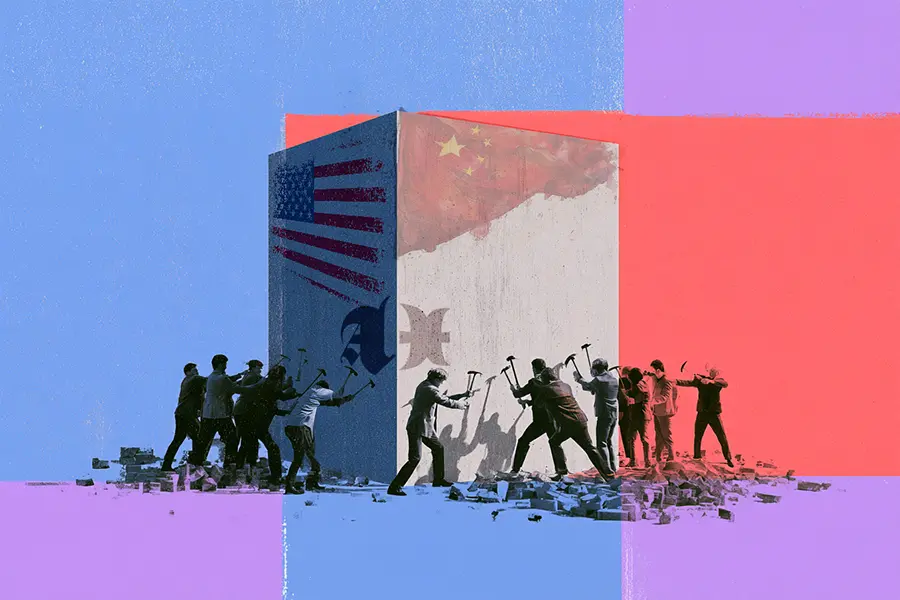
A couple of recent stories are reflecting a shift in the trans-Pacific business landscape. On one hand, a mock AI attack on China’s premier WeChat messaging app has exposed the vulnerabilities of the country’s digital ecosystem to U.S.-developed technology. On the other, a major Southeast Asian fast-food conglomerate has decided to bypass Wall Street in favor of Hong Kong for its international listing. Both events underscore the evolving regionalization of Asia’s digital and financial infrastructure — and the intricate push-and-pull dynamics with the U.S.
We’re learning that a group of benign researchers in California recently used U.S. AI to build a tool that could breach millions of accounts on WeChat, the ubiquitous app owned by Tencent (0700.HK), in just hours. Their tool, dubbed WeWorm, can hijack a user’s account, call their contacts, and spread from phone to phone without anyone ever answering a call.
For a platform boasting 1.4 billion users that essentially functions as a telecoms carrier in its own right, this is deeply alarming. We believe Beijing isn’t reacting well to this development. Usually, the shoe is on the other foot, with the U.S. accusing Chinese hackers of infiltrating its digital spaces. WeChat is the nexus of communication for the Chinese population. The ability to control this network and reach such a massive audience carries severe risks of abuse by anyone seeking to incite social instability and spread disinformation.
While Beijing doesn’t directly own the network, it maintains heavy indirect control, likely communicating with Tencent on a daily or even hourly basis. Beijing has consistently demonstrated its ability to control the internet in ways previously thought impossible. If the Chinese security apparatus believes Tencent isn’t doing enough to contain this AI threat, we’re sure the government will step in with heavier oversight to bring the situation under control.
The AI angle is equally compelling. Until just a few days ago, the major tech heads pushing AI were essentially telling the world not to worry — assuring us that while there might be a minuscule chance of disaster, everything would generally be okay. Then, they suddenly reversed course, warning that the technology might be getting out of control and require immediate slowing down.
We’re sure WeChat is working to fix this specific vulnerability that was uncovered by the California team. But as we’ve seen with social media companies losing control or maliciously manipulating users, this certainly isn’t the last time we’re going to talk about this kind of risk.
In response to offshore threats, we expect Beijing to crack down and implement stronger oversight on domestic AI companies. While China’s public focus has largely been on AI applications to boost manufacturing productivity and counter a shrinking working-age population, it’s highly probable the government is heavily involved in behind-the-scenes military and defense applications.
Shifting tides in Asian IPOs
Shifting gears to the capital markets, we’re seeing another interesting regional play. Jollibee, a Philippines-based fast-food giant that owns brands like The Coffee Bean & Tea Leaf, recently announced a change of direction for its international operations. The company scrapped plans to spin off and separately list the international operation in the U.S., choosing to move the listing to Hong Kong instead.
Wall Street has long held the upper hand in attracting major Asian listings, but Hong Kong is gaining momentum. Much of this is driven by Mainland Chinese companies that currently face a hard time getting Beijing’s approval to list in the U.S. But Jollibee’s case highlights a different trend. Fast food doesn’t typically boast the high margins or name recognition required to excite U.S. retail investors, who already have no shortage of domestic food and beverage IPOs to choose from.
In contrast, Hong Kong hosts a sizable, dedicated pool of investment money — including funds from the U.S. and Europe — focused specifically on Asia and Southeast Asia. These investors have a much better understanding of local economies in the region and why this company is successful. There are some cases where consumers have tried the brand in Hong Kong and responded positively, reflecting this deeper regional familiarity. Going to market in Hong Kong is simply easier for a regional Southeast Asian business.
This presents a vital test for Hong Kong: can its stock market attract more Southeast Asian companies to diversify away from solely Mainland firms? We think Hong Kong is far better equipped for this than Singapore. Despite being the financial capital of Southeast Asia where Jollibee is strongest, the Singapore Stock Exchange just doesn’t seem to have the liquidity depth and trading volumes to satisfy companies of a certain size. Hong Kong’s advantage is further bolstered by having China as its massive financial benefactor. That doesn’t mean Wall Street is losing its crown entirely. For unproven, early-stage high-tech companies, the U.S. remains the better market. U.S. investors better understand the tech sector and are more willing to risk capital, offering sustained valuations beyond just the current AI hype. But for the regional consumer sector, Hong Kong is proving to be a much more welcoming home.
About China Inc
China Inc by Bamboo Works discusses the latest developments on Chinese companies listed in Hong Kong and the United States to drive informed decision-making for investors and others interested in this dynamic group of companies.
Subscribe to China Inc on your favorite app:


Related Articles

RELATED ARTICLES
-
Xtep races ahead on Southeast Asia running craze
 1368.HK
 -
Wall Street renaissance for China stocks? DSC listing offers mixed picture
DSC.US
- China’s AI advances mask widening gap with U.S. in private capital investment
- TikTok, Southeast Asia boost prospects for Miduoduo IPO
- Jollibee dines close to home with Hong Kong selection for IPO spinoff
- What listings? Small Chinese firms withdraw their Wall Street IPO applications
-
Why regulating capital and serving burgers are both getting tougher in China
WEN.US