“In China it’s all about control, especially when it comes to capital.”

Key Takeaways:
- China’s move to push out cross-border stock brokers underscores the state’s desire to control capital allocation and benefit state-owned enterprises
- Wendy’s ambitious plan to open 1,000 stores in China faces steep hurdles due to fierce competition and an increasing consumer preference for domestic brands
By Doug Young & Rene Vanguestaine
Recent events highlight two narratives about navigating the Chinese market. On one hand, we’re seeing a final crackdown on cross-border trading by Chinese retail stock buyers — a move that reinforces Beijing’s tight grip on capital movement. On the other, we’re watching a major U.S. fast-food giant attempt to enter the Mainland market decades after its peers. Both developments illustrate the intricate dance of regulation, timing, and local execution required to survive in China today.
We’ll start with some big news for Chinese investors who like to buy stocks in offshore markets like the U.S., Hong Kong, Japan and Singapore. China’s securities regulator has formally fined the country’s two largest cross-border stockbrokers, Futu (FUTU.US) and UP Fintech (TIGR.US), for operating without brokerage licenses. More importantly, the pair must wind down their China business entirely, leaving Chinese stock buyers with highly limited options for overseas trading.
This move wasn’t completely out of the blue. Three years ago, the China Securities Regulatory Commission stated the pair were operating illegally and banned them from accepting new clients in China, though it allowed them to keep their existing accounts. Now, even those legacy accounts are coming to an end. It’s a regulatory bombshell that effectively ends their domestic operations.
Some observers might’ve hoped the regulator would offer a path to legal licensing, but we aren’t terribly surprised by this outcome. Over the last 15 years, there are numerous cases across different industries where Chinese regulators have taken a similar stepped approach — initial warnings followed by a gradual squeeze — all aimed at reining in what the government considers unruly behavior. It’s a method to bring sectors firmly under state control.
The market reaction was swift, with shares of both companies losing about a quarter of their value following the decision. This sell-off might seem disproportionate, considering both firms have spent the last three years diversifying. Today, they only get about 10% to 15% of their business from China. But the reality is they’re now completely shut out of their home market, and their overseas growth has so far been mostly limited to ethnic Chinese communities, which puts a ceiling on their potential customer base.
If we look at this with clear eyes, it resembles earlier crackdowns on private financial companies, such as online lenders. While those early crackdowns were partly driven by massive fraud, state-owned banks also complained about unfair competition. In this current crackdown on fintech brokerages, it’s really about capital allocation. The Chinese government wants to ensure that capital from domestic institutions and individual investors is directed toward the national economy and state security. The inevitable beneficiaries here are state-owned brokerages like Citic Securities (600030.SH) and Guotai Junan (601211.SH). Ultimately, it’s all about control.
A late bite at the fast-food table
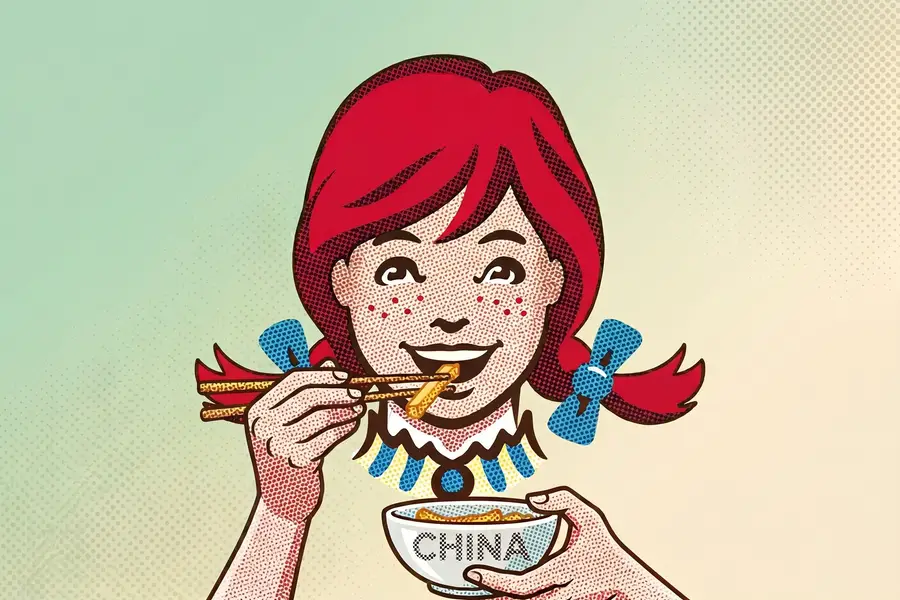
Shifting gears, we’re also looking at the latest Western brand trying to crack the Chinese market. In a somewhat low-key manner during its recent earnings call, Wendy’s (WEN.US) unveiled a plan to finally bring its brand to China. The company didn’t provide much detail, simply stating it signed an agreement with a local franchise partner — described as a large restaurant operator with decades of experience. True to the industry’s usual lofty style, they announced a goal of opening 1,000 restaurants in the market within a decade.
Our immediate question is: Why now? KFC (YUMC.US; 9987.HK) and McDonald’s (MCD.US) have been operating in China for over three decades. Starbucks (SBUX.US) is approaching its 30-year anniversary there. Given the immense head start of these entrenched competitors, why bother?
Wendy’s has been struggling in the U.S. for a while, making this move look like a desperate search for growth avenues while its domestic business faces serious challenges. The fact that the announcement was so low-key suggests the C-suite isn’t entirely confident about the outcome. Other Western chains like Burger King (QSR.US), Popeyes (QSR.US), and Tim Hortons (THCH.US) have tried and faced significant struggles.
When a Western brand enters China’s restaurant sector today, success hinges almost entirely on the local partner and execution. We don’t have particular knowledge of Wendy’s chosen partner, but their responsibilities — understanding the market, pricing products appropriately, and deciding where to compete — will make or break this venture.
Furthermore, this comes at a very tough time. We’ve seen a noticeable repositioning of Chinese consumer appetites, shifting away from foreign brands in favor of domestic ones across many sectors, including food and beverage. Even a giant like Starbucks has found itself struggling against local competitors like Luckin Coffee (LKNCY.US). The 1,000-store goal could rely heavily on a franchise model. In China, there’re no shortages of individuals looking to get rich quickly, so attracting a first batch of franchisees might work well, enabling rapid initial growth. The real test is sustainability — whether the economics work out and if franchisees can financially afford to stick around. We’re a bit skeptical of this ambitious target, but we’ll certainly keep an eye out and maybe even try one of their burgers when they finally open their doors.
About China Inc
China Inc by Bamboo Works discusses the latest developments on Chinese companies listed in Hong Kong and the United States to drive informed decision-making for investors and others interested in this dynamic group of companies.
Subscribe to China Inc on your favorite app:


Related Articles