Zhejiang Energy Marine steams ahead on green shipping boom
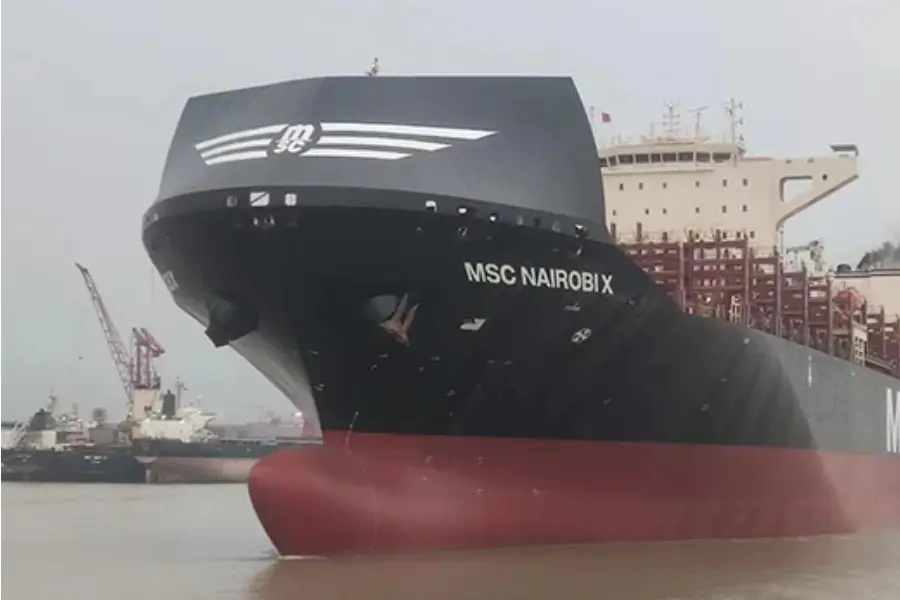
Revenue nearly doubled this year for the leading provider of green shipping equipment and systems, as it renews its attempt at a Hong Kong IPO
Key Takeaways:
- Zhejiang Energy Marine has renewed its Hong Kong listing application, aiming for a first-to-market premium in the booming field of green shipping equipment
- The company’s revenue nearly doubled in the first five months of this year, as two of its newer businesses overtook its original exhaust gas emission control systems
By Doug Young
The U.S.-Iran conflict may be wreaking havoc on global shipping, but that doesn’t seem to be affecting Zhejiang Energy Marine Environmental Technology Co. Ltd., which bills itself as the global leader in green shipping equipment and systems. Instead, the company seems to be thriving on booming demand for cleaner-running ships that are the backbone of world trade.
Zhejiang Energy Marine is hoping investors buy into its high-growth story, as it submitted an updated application for a Hong Kong IPO last Friday after its original January application lapsed. While its story looks quite positive, driven by demand for cleaner-running ships, the company is also notable for the choppy nature of its business.
That’s not difficult to understand, since its work isn’t very standardized and is highly project-based, in a global shipping sector where the top 10 companies control around 85% of the market, according to its listing document. The largest of those shippers, the privately held Mediterranean Shipping Co., or MSC Group, appears to be Zhejiang Energy Marine’s biggest customer by far, which is a double-edged sword that we’ll discuss in more detail shortly.
Zhejiang Energy Marine operates in a space that’s growing rapidly, as shipping companies try to install the most cutting-edge technology to reduce their emissions. The global green shipping equipment and system market is expected to grow by an impressive 31.7% annually between 2025 and 2030 to reach 151.6 billion yuan ($22.5 billion) by the end of that period, according to third-party market data in the listing document.
Zhejiang Energy Marine was founded in 2018 as a maker of vessel exhaust gas emission control and cleaning systems. It was a product of China’s experimentation at that time with “mixed ownership reform,” which attempted to breathe new life into inefficient state-run entities by bringing in private investors. In this case the state-run entity that provided the company’s initial business was Zhejiang Energy Group, while the private-sector partner was Wang Xinru, who has a long career working in China’s state-dominated shipping industry.
Reflecting that public-private hybrid, Wang is currently the company’s president, while its Chairman Guo Jinrong has a long background in the government of Zhejiang province. Such hybrid management can be good when everyone agrees on strategy, and also provides strong channels to government entities that are key for things like funding and permits. But it can also become problematic when disagreements occur between the state-owned and private stakeholders. In such cases the state-owned parties – who are sometimes more interested in politics than profits – almost always win.
While internal politics remains a major risk factor going forward, the company is doing quite well right now, based on the data in its listing document.
Its revenue jumped 90% in the first five months of 2026 to 2.51 billion yuan from 1.32 billion yuan a year earlier, as two of its newer business areas gained major new momentum. The company started out mainly selling vessel exhaust gas emission control and cleaning systems, which accounted for nearly all of its revenue as recently as 2023. But two newer segments, vessel energy efficiency enhancement systems, and vessel retrofitting services, have been growing rapidly since then, and both passed the original vessel exhaust gas emission control and cleaning systems in terms of revenue this year.
Sputtering original business
The company’s legacy vessel exhaust gas emission control and cleaning systems grew 25.5% to 767 million yuan in the first five months of this year to account for 31% of total revenue. But that segment was falling steadily before that, with revenue down by a third between 2023 and 2025. The drop owed to sharply falling prices, which saw the average system tumble from a price of 15.3 million yuan in 2023 to just 5.18 million yuan this year. The company blamed the steep drop to its shift from doing more retrofitting work on existing ships to installing more systems on new ships, with the former typically costing much more than the latter.
But vessel energy efficiency enhancement systems did much better, with revenue up 144% year-on-year to 860 million yuan in the first five months of 2026, as that segment became the company’s biggest breadwinner at 34% of total revenue. Unlike the legacy business whose prices have been falling, average selling prices for vessel energy efficiency enhancement systems have been on a sharp uptick, rising from 1.79 million yuan in 2024 to 2.9 million yuan in the first five months of this year.
Vessel retrofitting services rose by a similar 145% to 800 million yuan, making up 32% of total revenue.
Gross margins for the three main business segments are quite variable, with retrofitting services notably low in the 10% to 18% range. That reflects the non-standardized nature of the business, with most sales involving high degrees of customization and different levels of support services.
But one of the most notable things, and biggest risk factors, for Zhejiang Energy Marine is its extremely heavy reliance on a single customer, which, while not named directly, appears to be MSC Group. That single customer supplied 68% of the company’s revenue in the first five months of this year – a huge total by any measure, and one that could quickly change if the relationship deteriorates or MSC finds better or cheaper products.
What’s more, the company’s second-largest customer is a small company with a fleet of just four vessels engaged in dry bulk shipping. That means the customer, which accounted for 13.5% of Zhejiang Energy Marine’s revenue in the first five months of this year, is likely to disappear as soon as its small fleet is upgraded and equipped with the latest green equipment.
That said, this company is quite solid in terms of its financial health. Its operating cash inflow has ramped up steadily in step with its business, rising to 756 million yuan in the first five months of this year from 663 million yuan for all of 2025. That’s helped the company to build a war chest of 1.5 billion yuan in cash by the end of this May, up from 794 million yuan at the end of 2025. And on the bottom line, the company also saw its profit more than double to 622 million yuan in the first five months of this year from 277 million yuan in the year-ago period.
Zhejiang Energy Marine would be the first from its class to go public if it completes its Hong Kong IPO, with major rivals like Feen Marine, Panasia Co. and Innomotics GmbH all still private. That first-to-market status, combined with its relatively solid financials, despite its heavy reliance on a single customer and fading original business, could prove enticing for investors looking for exposure to the global shipping industry.
To subscribe to Bamboo Works free weekly newsletter, click here
Related Articles
RELATED ARTICLES
-
Plummeting cash flow and a stake-trimming top shareholder: What’s up at Zhejiang Shibao?
 1057.HK002703.SHE
 - Leadrive IPO taps into China’s EV export boom
-
Deye chases Hong Kong IPO in face of draining new energy valuations
605117.SHG
- Can crypto power supplier Boco plug into the AI boom?
- Qingtao Energy reaches solid-state battery milestone, but model remains unproven
- Rethinking bigger Is better: China’s long march toward higher-capacity energy storage cells