The newest robotic member of e-commerce giant Alibaba’s logistics arm is notable for its ability to move not only horizontally, but also to climb within warehouses
By Doug Young
Logistics is one area where robots and automation are rapidly finding new homes, and Alibaba Group Holding Ltd.’s (BABA.US; 9988.HK) Cainiao logistics unit has been helping to lead that charge. Robots of all shapes, sizes and abilities are finding their way into the vast warehouse networks operated by Cainiao and its peers, doing everything from stacking newly arrived goods to picking out products to fill individual orders.
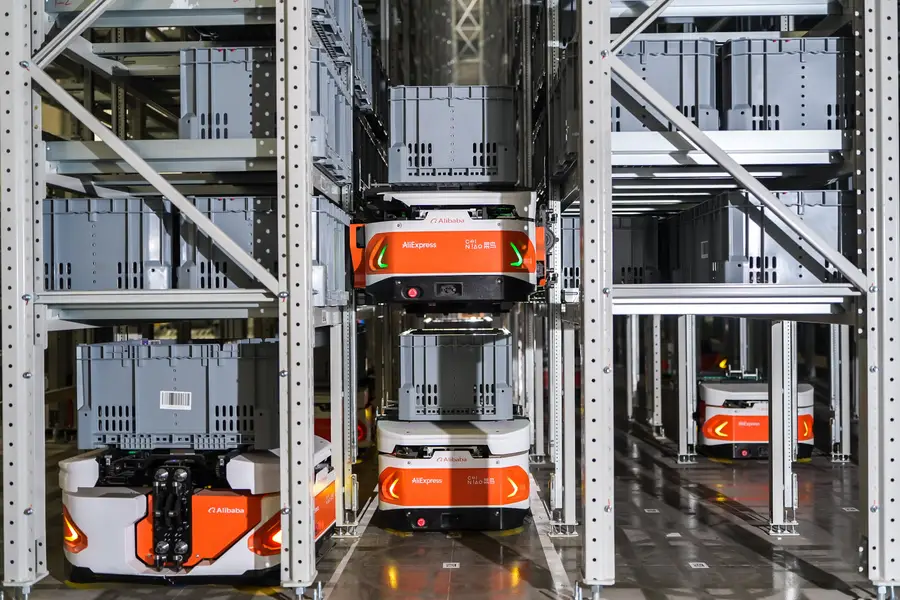
The latest model in Cainiao’s growing robot army is ZeeBot, which it recently began deploying in China, with plans to expand to the rest of its global network. Its standout feature is its climbing ability, which allows it to move not only on the ground but also vertically within the warehouse to store and retrieve goods, breaking away from the traditional split between ground transportation and vertical storage operations in automated warehouses.
The large, pallet-style robot can wander throughout Cainiao’s warehouses, capable of moving large containers to where they’re needed. Bi Jianghua, Cainiao vice president and general manager of its logistics technology division, talked with Bamboo Works about ZeeBot’s new place in the company’s work environments. He also spoke about broader automation trends in logistics, and a future of “dark warehouses” where everything is automated.
Q: Tell us a bit more about ZeeBot, and what operational problems it’s designed to solve
A: ZeeBot is Cainiao’s climbing warehouse robot, designed to solve a core pain point in warehouse automation, namely, the lack of flexibility and too many handoffs between devices. In traditional automated warehouses, work is usually split across several machines, such as ground robots, lifts and stackers. Each transfer between systems creates waiting time, coordination overhead and potential failure points. In other words, the more handoffs there are, the less efficient and less flexible the whole system becomes.
ZeeBot is designed to follow the movement pattern of a real warehouse worker more closely, combining ground movement, vertical climbing, bin transport and retrieval into one robot. That means it can complete the workflow on its own, without relying on repeated transfers between different devices.
As a key product that connects multiple operating stages, ZeeBot will help drive warehouses from single-point automation toward a new stage of full-chain intelligent collaboration among multiple robots powered by AI scheduling.
Q: What advantages do ZeeBots have over earlier technology?
ZeeBot builds on earlier generations of bin-handling automation, solving several of their limitations. The evolution of warehouse bin-handling robots can be divided into four stages: First-generation bin shuttle systems consisting of shuttle robots deployed on each shelf level, with lifts used for transfers. This is efficient, but the cost is very high. Second-generation AGV (automated guided vehicles) tote-to-person systems eliminate some transfer complexity, but are still limited by space utilization.
Then there are third-generation systems, which use a “large robot + small robot handoff” model. Large robots retrieve bins in the aisle, while small robots transport them on the ground. But efficiency is constrained by the slower speed of the large robots, and scheduling between two robot types adds complexity. Fourth-generation mini-stacker solutions are fast and low-cost, but often rely on a “one robot per aisle” model. If one robot fails, the entire aisle can stop working, which reduces flexibility.
Compared with these earlier solutions, ZeeBot offers several advantages. It can move faster, up to 4 meters per second on flat ground. It can climb faster vertically, able to reach a five-story-high rack in around 10 seconds. It allows for higher storage density, with up to 40% improvement in space utilization. Its modular design and improved deployment efficiency give warehouses greater scalability and flexibility. In short, ZeeBot combines speed, flexibility and density in a way earlier systems could not.
Q: How is Cainiao deploying these robots, both in China and abroad?
A: At our Dongguan Machong cross-border warehouse, which supports cross-border operations covering more than 40 European countries and handles millions of outbound parcels daily, more than 120 ZeeBots have doubled labor productivity compared with traditional manual warehouses. Efficiency has also improved by 20% to 30% versus conventional automation solutions such as CTU systems.
In the first half of this fiscal year, Cainiao will launch climbing-robot projects in the Netherlands and Spain, both on a larger scale than the Dongguan warehouse. Three more projects are underway in Guangzhou, one in Hong Kong is in the delivery stage, and opportunities in the United States, Canada and the Middle East are also being discussed. A project in Japan is expected to be confirmed soon.
Q: What does the business case look like for deploying ZeeBot at scale?
A: The payback period for climbing robots varies depending on warehouse size, operating intensity, and deployment conditions. However, their true value lies in how they transform the overall structure of warehouse operations.
First, ZeeBot helps automate the most repetitive, labor-intensive, and physically demanding tasks in the warehouse. Second, ZeeBot simplifies the entire workflow. Automation helps make processes more standardized, more predictable and less error-prone.
The business case for ZeeBot is about improving warehouse economics in a more comprehensive way — through higher productivity, lower operational complexity, better consistency and a more scalable operating model. The return comes not only from direct cost savings, but also from stronger execution, lower error rates and a warehouse structure that can support long-term growth.
Q: What kinds of next-generation robots is Cainiao looking at beyond ZeeBot?
Cainiao sees climbing robots as a combination of hardware and AI software. The hardware provides flexible movement and transport across the warehouse, while AI enables the robot to understand different scenarios and make decisions in a real operational environment. Beyond ZeeBot, Cainiao is focusing on robots that can do more than just move goods and store bins. The next generation will need to handle picking, exception recovery and more autonomous warehouse operations.
One of the key directions is picking robots. For example, after ZeeBot brings a tote or bin to a workstation, the next robot in the process completes the picking task. Ultimately, robots should be able to identify items, understand picking conditions and complete the picking process independently. That means robots must be able to understand product shapes, spatial positions and environmental changes, while autonomously scanning, making decisions, self-correcting and restoring operations. The key enabler behind that vision is the continued maturity of AI in physical-world logistics scenarios.
The Bamboo Works offers a wide-ranging mix of coverage on U.S.- and Hong Kong-listed Chinese companies, including some sponsored content. For additional queries, including questions on individual articles, please contact us by clicking here
To subscribe to Bamboo Works free weekly newsletter, click here
Related Articles