InnoLight shines on AI infrastructure spending binge
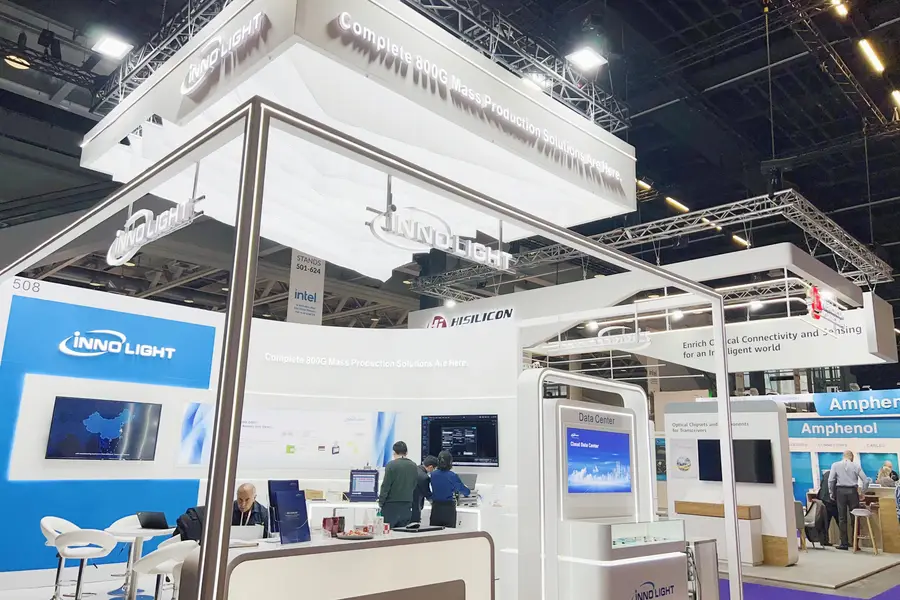
The optical transceiver maker’s revenue rose 182% in the first half of this year, sharply accelerating from 70% growth for all of 2025
Key Takeaways:
- Innolight’s revenue nearly tripled in the first half of the year, while its profit rose by an even stronger 243%
- The maker of optical transceivers said capital spending by China’s internet giants was notably lower than their global peers in the first quarter of this year
By Doug Young
The maiden financial report from Zhongji InnoLight Co. Ltd. (3308.HK; 300308.SZ), released on Friday, is notable for several things, most notably its strong triple-digit growth on the company’s top and bottom lines. That growth isn’t a huge surprise, since InnoLight makes optical transceivers that are a key component in the infrastructure used for AI computing.
More notable is the dichotomy between AI spending in China and the rest of the world detailed in the company’s report. While the report shows frenzied spending in the West by companies like Google and Microsoft, spending is far more muted in China, despite reports about huge spending by local names like Alibaba and ByteDance. That dichotomy is working to InnoLight’s advantage, since the company gets the vast majority of its sales from outside China.
Finally, the report is also notable for the mushrooming size of InnoLight’s indebtedness as it rushes to expand to meet booming demand, which could be a red flag for investors if the current AI spending frenzy slows.
Investors didn’t seem to like the report, with InnoLight’s Hong Kong-listed shares falling more than 10% on Monday morning, the first trading day after the announcement. The company raised a sizable HK$53 billion ($6.76 billion) in its IPO in July – cash that it will need as it rapidly scales up to meet booming demand. The company’s optical transceivers are a key component for data transmission, serving as the hardware that converts electrical signals to light signals that can then be sent over fiber optic.
The Hong Kong stock has notched some modest gains since the IPO, though nothing like some other AI and robotics plays that we’ve seen this year. After the early decline on Monday morning, the shares were trading at HK$1,016, about 3.7% above their IPO price of HK$980. Even at that level they still command a relatively premium forward price-to-earnings (P/E) ratio of 39, ahead of a 28 for U.S. rival Coherent Corp. (COHR.US) and a 22 for Chinese peer Eoptolink Technology (300502.SZ), its two largest competitors.
InnoLight is the leader for optical interconnect solutions with 21.2% of the global market, according to third-party data in its IPO prospectus. In its inaugural earnings report, it describes 2022 as a pivotal year that kicked off a new phase of development for the cloud computing sector, thanks to exploding demand for large-scale computing clusters to support AI training and inference workloads.
That demand has accelerated sharply in the last two years, as reflected by InnoLight’s own explosive growth. The company’s revenue nearly tripled in the first half of the year, rising 182% to 41.8 billion yuan ($6.22 billion) from 14.8 billion yuan a year earlier, according to the latest report. That marked a sharp acceleration from 2025, when the company’s revenue rose 60% to 38.2 billion yuan, a figure that looked impressive at the time but pales compared with the latest growth rate. On a quarterly basis, the company’s year-on-year growth rate slowed to 175% in the second quarter from 192% in the first.
Uneven demand
That takes us to the next topic we raised earlier, namely, the lopsided situation between the Chinese and international markets. Much is written about AI spending in general, and China is typically characterized as spending just as heavily as the West on the technology. But the trio of Alibaba, Tencent and Baidu logged a combined 64.7 billion yuan in capital expenditure in the first quarter of this year, up just 18% year-on-year, according to InnoLight, citing previously published financial results. By comparison, Microsoft, Amazon, Meta and Google reported combined first-quarter capex of $164.9 billion, up about 86% year-on-year.
That big difference was also present in InnoLight’s own numbers. The company’s international revenue rose 210% in the first half of the year to 39.6 billion yuan. But its China revenue rose by a far smaller 7.7% during the period to 2.16 billion yuan. That difference boosted international revenue to 95% of the company’s total from 86% a year earlier.
In its IPO prospectus, InnoLight said the global market for optical interconnect products is expected to grow at an average rate of 31.6% annually between 2025 and 2030 to reach $111 billion by the end of that period. InnoLight’s growth rate is well above that, suggesting the first-half revenue growth rate may be an anomaly rather than a new norm. And if companies rein in their AI spending, which could easily happen, InnoLight could quickly find itself with too much capacity from its own recent buildup.
That leads us to the topic of InnoLight’s growing indebtedness as it aggressively ramps up its capacity. The company’s net cash from operating activities dropped to 1.79 billion yuan in the first half of this year from 3.22 billion yuan a year earlier, as it blamed increasing payments for raw materials. Its net cash used in investment activities also rose sharply to 6.8 billion yuan from 696 million yuan over that time. As a result, its net cash decreased by 4.2 billion yuan over the six months to June 30, though that doesn’t include the HK$53 billion that it raised from the IPO in July. As it spent heavily on expansion, the company’s gearing ratio also more than doubled to 17.1% at the end of June from 8.26% at the end of last year.
The company is clearly expanding very quickly, and should be able to use the money from the July IPO to fund that expansion. But if the global AI buildout loses momentum, InnoLight could easily find itself stuck with huge amounts of idle capacity.
For now, at least, things look relatively strong for the company. Its expenses rose roughly in line with its strong revenue growth. And its growing economies of scale allowed InnoLight to boost its gross margin by more than 7 percentage points to 45.8% in the latest period from 38.7% a year earlier. That helped lift the company’s first-half profit by 243% to 13.7 billion yuan from 4 billion yuan a year earlier, outpacing its revenue growth rate by a large margin.
On the whole, the report looks quite positive. The slower AI spending in China comes as a slight surprise, though InnoLight is insulated from that by its heavy reliance on the international market. The lone red flag is the company’s rapid expansion, which could come back to haunt it if global AI infrastructure spending begins to slow.
To subscribe to Bamboo Works weekly free newsletter, click here
Related Articles
RELATED ARTICLES
-
IPO fundraising leader Zhongji Innolight stumbles in trading debut
 3308.HK300308.SHE
 -
Han’s CNC etches out triple-digit growth on AI infrastructure boom
3200.HK301200.SHE
-
Optical communications leader Eoptolink plans Hong Kong listing
300502.SHE
- FS.com rides high-speed AI networks to higher profits
-
AsiaInfo calls on AI, space communications to revive its flagging business
1675.HK
- INTERVIEW: Shanghai Able Digital turns structured knowledge into AI-ready infrastructure
-
GDS commits up to 50 billion yuan to capture booming AI data center demand
GDS.US