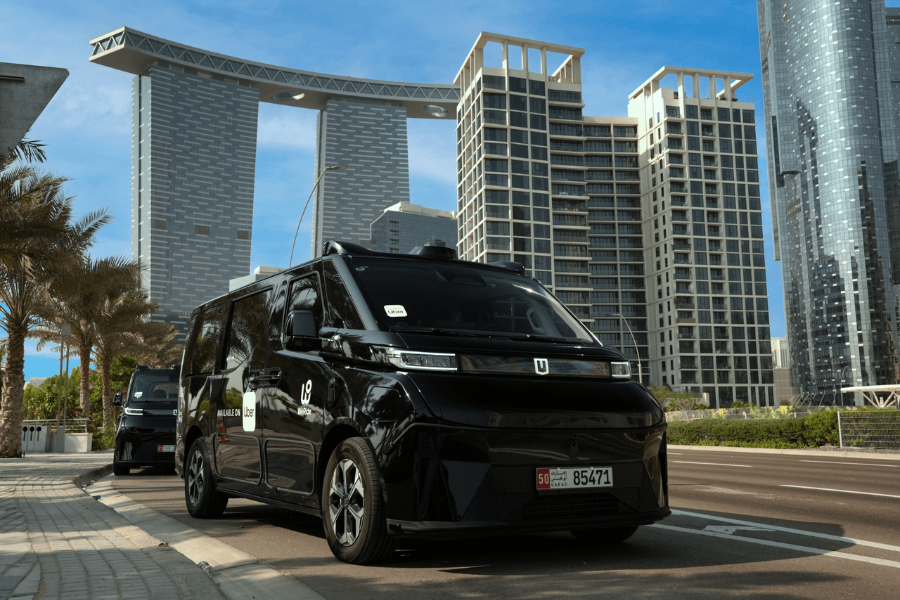
The company’s shares have outperformed domestic rival Pony AI this year, as investors applaud its rapid global expansion and higher margins
Key Takeaways:
- WeRide’s revenue rose 88% in the third quarter, fueled by a 172% jump for its international division, which is on track to surpass its domestic business
- The company’s gross margin is more than double the figure for domestic rival Pony AI, drawing on an asset-light business model and diversified revenue mix
By Doug Young
After finishing slower out of the gate, WeRide Inc. (WRD.US; 0800.HK) appears to be overtaking its two leading Chinese rivals in the race to win over investors with their robotaxi operations. That’s our big takeaway based on the latest results from WeRide, released last Friday, combined with recent investor sentiment towards chief rivals Pony AI (PONY.US; 2026.HK) and Baidu (BIDU.US; 9988.HK), which operates the Apollo Go robotaxi service.
One number nicely summarizes why investors are showing a growing preference for WeRide over Pony AI, namely, gross margin. WeRide’s latest report shows its gross margin stood at 43.0% in the third quarter, up 10.1 percentage points from 32.9% a year earlier. By comparison, Pony AI’s third-quarter gross margin stood at 17.8%, less than half of WeRide’s figure, and was actually down from 18.4% a year earlier. Baidu only releases limited data for Apollo Go, and doesn’t include gross margins.
WeRide’s high gross margin is the result of several factors that have increasingly won over investors to its business model.
A leading factor is the company’s diversification, with robotaxis accounting for about a third of its business. Its second major business is AI infrastructure, which serves customers not only in autonomous driving, but also in robotics, embodied AI and foundation models. Its third business pillar involves providing levels 2 and 3 (L2 and L3) autonomous driving technology to other carmakers. Such diversification is a foundation of a well-run business, especially in an area like autonomous driving where regulation is constantly changing as new challenges arise.
One such challenge emerged in China in March this year, when Baidu’s fleet of more than 100 robotaxis suddenly shut down one day in the city of Wuhan due to a system problem. That led China to sharply slow the industry’s development while it conducted a review lasting several months. More recently, U.S.-based Waymo was ordered to suspend all services on highways following at least two safety-related incidents.
Another factor working in WeRide’s favor is its relatively advanced international operation. That’s important because international operations are often far more profitable than operations in China, where competition is usually quite intense. Lastly, investors also seem to like WeRide’s broadly asset-light model, especially outside China, which helps to limit its cash burn in this capital intensive industry.
The shifting investor sentiment is apparent in WeRide’s stock. The shares aren’t exactly doing great, down about 65% this year and about 80% below the price from their October 2024 U.S. IPO. But everything is relative, and that performance outshines Pony AI in several ways. Whereas WeRide shares have spent most of their post-IPO life underwater, Pony AI’s U.S. shares were above their November 2024 IPO price as recently as February this year, as the company seemed to be winning over investors with better progress for its robotaxi business. But Pony’s stock has gone into sharp reverse this year, and is now 77% year-to-date, trading 74% below its IPO price.
As Pony AI’s shares tanked, WeRide moved ahead in terms of price-to-book (P/B) ratios with a figure of 1.94 – roughly double the 0.97 for Pony AI.
Riches overseas
Next, we’ll take a closer look at the several previously mentioned factors that are turning investor sentiment in WeRide’s favor. The company currently operates about 4,100 robo-vehicles worldwide, which also includes robobuses and robosweepers in addition to robotaxis. Robotaxis make up the majority of that fleet at more than 2,300 by the end of September, up about 26% quarter-on-quarter.
The big majority of its robotaxis are in China, with an especially big concentration in the southern city of Guangzhou where the company is based. WeRide said its Guangzhou fleet achieved “positive unit economics” during the quarter, and its domestic fleet averaged 21 orders per vehicle each day.
But the company’s bigger story lies outside China, especially in the Middle East. It said its fleet in the region totaled about 600 robotaxis at the end of September, up 50% from 400 just three months earlier, mostly in Dubai and Abu Dhabi. Notably, the company uses an asset-light model outside China where it works with local partners that provide local fleet investment and perform daily operations.
One of its biggest partners is Uber (UBER.US), and WeRide notes that it’s the ride-sharing giant’s largest partner outside the U.S. Here, we should note that Baidu and Pony AI also have partnerships with Uber, with Pony AI also using a similar asset light model.
WeRide’s overall revenue rose 88% in the third quarter to 321.5 million yuan ($48.2 million) from 171 million yuan a year earlier. Much of that lift came from its overseas operation, consisting mostly of robo-vehicles, which rose 172% over the period to 147 million yuan, fast approaching half of its revenue total. That rapid growth was a major factor behind the big gross margin gain.
Elsewhere overseas, WeRide noted it secured Spain’s first national operating permit for level 4 (L4) autonomous passenger vehicles, and also made advances for its operations in Switzerland, Belgium and France, and began road testing in Slovakia.
WeRide doesn’t provide as much information about its other two businesses in AI infrastructure and supplying autonomous driving technology for other car brands, which collectively account for nearly two-thirds of its revenue. It said AI infrastructure revenue, derived from its Jingshuo Technology unit, nearly doubled during the quarter, though it didn’t provide an actual figure. Meanwhile, its business providing L2 and L3 autonomous driving technology to other brands, such as Aion and GAC, reached more than 100,000 unit deliveries cumulatively for its WRD 3.0 system by the end of the quarter.
On the bottom line, the company reported a net loss of 310 million yuan, roughly the same as its 307 million yuan loss a year earlier. Its cash dropped sharply to 3.85 billion yuan at the end of September from about 7 billion yuan at the end of last year. But CFO Jennifer Li assured investors that the company has “more than four years of cash runway, sufficient to fully fund our path to self-sustaining cash flow.”
The analyst community is still broadly positive on both WeRide and Pony AI, with nearly everyone who follows the pair rating them a “buy” or “strong buy.” And given the way that sentiment between the two has shifted so much in the past year, it’s always quite possible that things could change yet again as these two companies fiercely compete with one another both at home and increasingly on the global stage.
To subscribe to Bamboo Works weekly free newsletter, click here
Related Articles
RELATED ARTICLES
-
Its revenue surging, can co-built fleets help Pony AI drive to profits?
 2026.HKPONY.US
- Losses, losses and more losses. How far down the road is WeRide’s profitability?
- Trunk Technology drives ahead in search of profits
-
Dida eyes road back to revenue growth under Tongcheng umbrella
2559.HK0780.HK
- Zhejiang Energy Marine steams ahead on green shipping boom
-
Adaspace edges up in Hong Kong trading debut
6935.HK
- E-paper giant DKE edges up in Hong Kong trading debut