Zhuanzhuan’s IPO ambitions to put earnings power to the test
The secondhand trading platform is reported to be seeking a $500 million listing, giving investors the chance to appraise its inspections-led business model
Key Takeaways:
- Zhuanzhuan has said it makes more than $3 billion in annual revenue from trade in used goods ranging from phones to designer clothes and accessories
- The company earns money from consignment fees and the margin on goods bought for resale, making efficiency in quality inspections, after-sales service and inventory turnover key to profitability
By Lee Shih Ta
Has a used phone had its parts replaced? Is a designer handbag genuine? Questions like these, which can be hard to resolve, have helped secondhand trading platform Zhuanzhuan build a business that turns over more than $3 billion a year.
Incubated by Chinese online classifieds platform 58.com, the company has gradually incorporated inspections, valuations and after-sales services into its transactions. Now, it is preparing to let the capital markets put a price on that business.
The platform operator Beijing Zhuanzhuan Spirit Technology Co. Ltd. has confidentially filed for a Hong Kong IPO that could raise up to $500 million and take place in 2027, Bloomberg has reported, citing people familiar with the plans.
Zhuanzhuan founder Huang Wei, a graduate of Tsinghua University, previously headed Baidu News and assembled the team behind Baidu Maps. He joined 58.com in 2013 and led the team that founded Zhuanzhuan two years later. At the time, China’s secondhand trading platforms were competing for users. The company’s main rival was Xianyu, an Alibaba Group (9988.HK; BABA.US) platform that grew through Taobao’s ecosystem. To catch up, Zhuanzhuan spent heavily on advertising, sponsored variety shows and offered low-cost services.
According to media reports, Zhuanzhuan charged just 1 yuan for its phone inspection service in 2019 and absorbed the cost of home visits even when transactions were canceled. The sustained spending pushed the company to a point where it only had enough cash to cover about six months of wages, prompting an accelerated move into verification services as an enhanced business model.
The premium service Zhuanzhuan Youpin was launched in 2016, starting with inspections of pre-owned phones. The quality checks and transaction protections developed into today’s “Official Verification” service, which covers multiple product lines. Depending on the category, the service checks functionality, condition or authenticity, and provides inspection reports along with return policies and warranties.
As the priorities shifted, the company announced in September 2025 that it would phase out its open marketplace, where trading was not subject to inspections, to focus entirely on its verification business. By then, the open market accounted for less than 3% of the platform’s gross merchandise value.
The business of quality checks
With a more direct role in transactions, Zhuanzhuan makes money in two main ways. Huang has said that roughly 60% to 70% of goods are handled as consignment sales, with the platform charging a service fee. Zhuanzhuan purchases the remaining products for resale, earning the spread between buying and selling prices while bearing financing and inventory risks.
That also explains the emphasis on turnover. Computers, communications devices and consumer electronics sell within 20 days on average, while pre-owned luxury goods take about 30 days, the company says. If an item is slow to sell, a price cut for newer equivalent products could compress the resale margin. Consigned goods also take up inspection, storage and display resources. Faster turnover allows the same service network to handle more transactions.
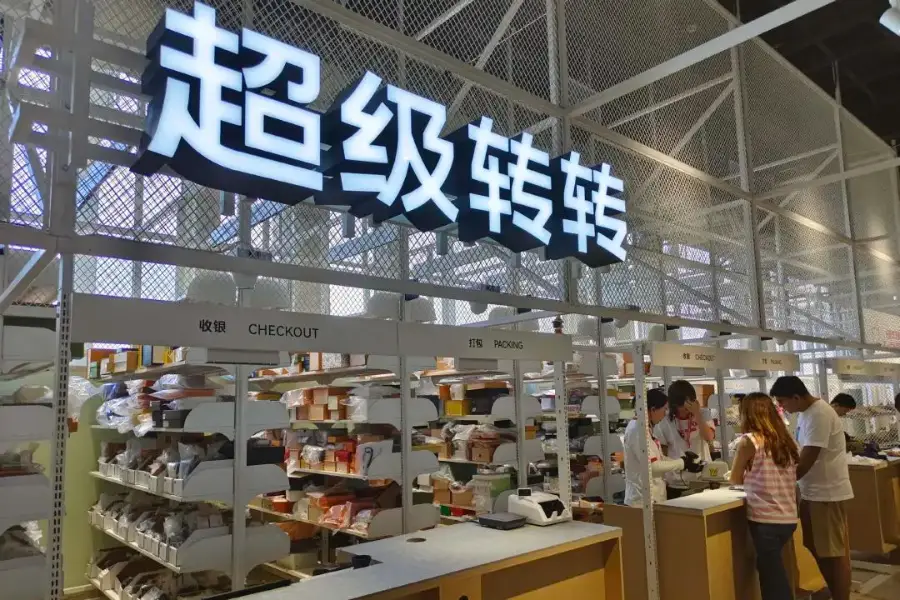
As the model took shape, Zhuanzhuan expanded through a merger with used-phone e-commerce platform Zhaoliangji and extended its services to categories including designer bags, watches and apparel through the acquisition of secondhand fashion and luxury goods platform Hongbulin, also known as Plum. It also opened large-format “Super Zhuanzhuan” stores.
The model has proven to be lucrative. Huang disclosed in an interview that Zhuanzhuan’s revenue grew about 30% in 2025 to exceed 20 billion yuan ($3 billion), saying the firm has been profitable since 2022. According to its annual consumer report, the number of users trading across product categories jumped by more than 116% in 2025, indicating that consumers were moving beyond phones into other goods.
However, the platform’s role in valuation, inspection and sales can also lead users to question its impartiality. In 2023, a blogger said the same phone got different inspection results when purchased through Zhuanzhuan and then offered for resale, sparking a controversy over report discrepancies. The company subsequently acknowledged operational errors and inconsistent assessments in parts of its inspection process and pledged to strengthen training.
Such inconsistences mean sellers may suspect the platform of using reported defects to drive down purchase prices, while buyers may question product quality. Zhuanzhuan invested more than 200 million yuan in expanding its quality department in 2024, with Huang later saying that inspection staff accounted for more than half of the total workforce.
Is the company overvalued?
The impact of service costs on profits can be assessed by looking at industry peers. ATRenew Inc. (RERE.US), the parent of AHS Recycle, which trades in used electronics, reported revenue of 21.05 billion yuan and net profit of 336 million yuan in 2025, giving it a profit margin of just 1.6%. These figures show that even at scale, the business requires tight control over merchandise, fulfillment and operating costs.
ATRenew had a market capitalization of about $900 million as of Nov. 13. According to a Beijing Business Today report in April this year, Zhuanzhuan was valued at more than $3 billion in its last funding round, more than three times its peer’s market value. Private and public markets differ in their pricing approach, and the revenue streams of the two companies are not alike, but Zhuanzhuan will need to demonstrate the earnings value of its consignment business and its expansion across product categories if it hopes to retain its previously reported value. Otherwise, it could face pressure to accept a lower appraisal when it lists.
To subscribe to Bamboo Works weekly free newsletter, click here
Related Articles
RELATED ARTICLES
-
Moore Threads returns to IPO funding trough to finance its GPU ambitions
 688795.SHG
-
Creality’s 3D-printing dream faces first post-IPO test
3388.HK
- Hansoh’s overseas ambitions tested as EU stalls cancer drug sales
- Beijing light aircraft crash slows China’s eVTOL ambitions
- Where China’s AI models make their money
-
Ganfeng rediscovers profitability as volatile lithium prices test its mettle
002460.SHE
-
SinoHytec shifts to hydrogen power storage. But is it too little too late?
688339.SHG