Anker swims beyond its signature chargers with ‘shallow sea’ approach
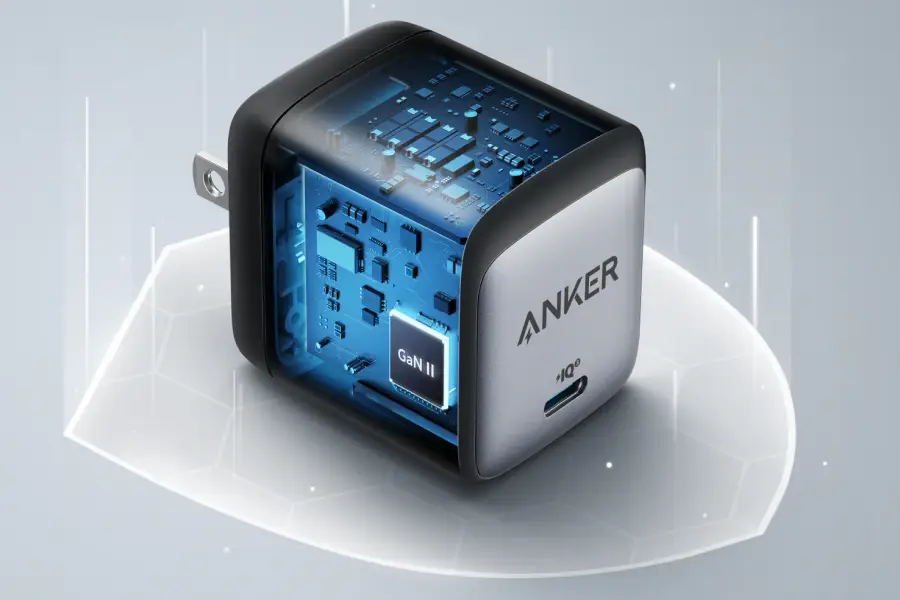
Known globally for its power banks, the company wants to be valued as a multi-category hardware maker as it files for a Hong Kong IPO
Key Takeaways:
- Anker Innovations has filed for a Hong Kong listing, seeking to add an offshore fundraising channel to its existing listing on Shenzhen’s ChiNext board
- The power bank maker’s revenue and profit are growing, but weakening cash flow, Amazon dependence and big bets on energy storage and AI audio complicate its story
By Hu Minghe
Anker Innovations Technology Co. Ltd. (300866.SZ) used to be an easy company to explain. It sold chargers, power banks and cables trusted by overseas consumers, winning it strong ratings on Amazon, the world’s biggest e-commerce operator.
That’s still the brand many global shoppers know. But as Anker pursues a Hong Kong listing, with heavyweights CICC, Goldman Sachs and JPMorgan as sponsors, the company is asking investors to look beyond the charger shelf. It wants them to believe it can turn its Chinese cross-border brand into a global shopping cart for a much wider range of consumer hardware, spanning home energy storage, smart security, headphones, projectors, creative printers and more AI-driven devices.
That puts Anker at the edge of an emerging trend for the next stage of China’s export economy. The first stage was contract manufacturing, where anonymous Chinese factories churned out products that ultimately got branded with big Western names. The second was Amazon-native direct-to-consumer sales of Chinese branded products. Anker is trying to ride a third wave by becoming a Chinese company with strong product development capabilities and a premium image that could help it break free from reliance on low prices that are often a key selling point for many Chinese brands.
The numbers give Anker a credible starting point. Its revenue rose 23.5% last year to 30.5 billion yuan ($4.2 billion), while its net profit increased 18.4% to 2.62 billion yuan, according to its Hong Kong listing document filed last week. Its gross margin has also been improving steadily, rising from 42.7% in 2023 to 43.9% last year, suggesting Anker has brand power that many Chinese hardware exporters lack.
But its net margin slipped to 8.6% from 9.7% in 2023, and operating cash flow tumbled 82.5% over that period to 481 million yuan, largely due to growing R&D costs from big spending as the company tries to diversify its product portfolio. That raises the question of whether the cost of becoming more complex is beginning to drag on the company.
‘Shallow sea’ strategy
Despite sitting on a brand that’s synonymous with power banks, Anker is already more diversified than its reputation suggests. Charging and power storage accounted for 50.5% of 2025 revenue, while its Eufy smart-home and creative products contributed 27.1% and Soundcore audio products and Nebula projectors made up 22.4%.
Founder Yang Meng, previously a senior software engineer at Google, calls his strategy “shallow sea.” That means avoiding giant categories such as smartphones, PCs and TVs, and instead entering many mid-sized electronics segments that are less competitive and where things like product design and online reviews can still sway consumers. Anker avoids going head-to-head with giants like Apple, Samsung, Huawei and Xiaomi in their strongest arenas like smartphones and PCs. Instead, it looks for niches big enough to offer strong business opportunities but still too small to attract the global giants.
The problem is that shallow seas don’t necessarily mean weak competitors, especially when it comes to emerging Chinese brands battling for recognition. In chargers, Ugreen (301606.SZ) and Baseus-like brands are pushing equally hard. In robot vacuums and smart cleaning, there are rivals like Roborock (688169.SH), Ecovacs (603486.SH) and Dreame. In portable and home energy storage, there’s EcoFlow, Bluetti and Hello Tech Energy’s (301327.SZ) Jackery brand. And in projectors, there’s Xgimi (688696.SH).
That competitive landscape explains why Anker is trying to move up the technology curve to differentiate its products from the crowd and charge more premium prices. Its Anker Solix storage products are probably its most meaningful new leg, because they extend the company’s charging and battery expertise into bigger-ticket household energy products. Its Soundcore audio business is also becoming a technology test bed: Anker has worked with Zhicun Technology on a compute-in-memory AI audio chip designed to run noise-cancelling models in low-power headphones. The company is also pushing EufyMake creative printers and AI-enabled home security products.
These efforts make Anker more interesting than the usual one-trick pony brand, but also riskier. A charger can win with good design, safety, certification and distribution. But a home energy system may need installation, after-sales service and stricter safety control. A security camera brings privacy and data-protection risk. AI headphones require chips, algorithms and longer R&D cycles. Robots require still more capital, patience and talent. And all these new products take Anker into areas where it has little experience, while also charging up its R&D spending.
Déjà vu?
Investors have seen this movie before with Anker. Around 2022, after expanding into too many product lines, the company cut a number of categories where it couldn’t build enough competitive advantage. Since then Yang has said new categories now need longer upfront investment, often three years or more. That shift helps explain why R&D spending rose 37.2% last year to 2.89 billion yuan – well ahead of revenue growth.
Channel risk is another issue. Amazon still accounts for more than half of revenue, despite Anker’s efforts to expand its own website and sell through Walmart, Best Buy, Target, Costco and other retailers. That dependence is a strength when Amazon traffic is cheap and rankings are favorable. But it can become a weakness if platform rules or fees change, or if new competition arrives and gets strong reviews.
Anker’s manufacturing is also mostly outsourced. That keeps the company asset-light, but also puts pressure on it to control quality among its suppliers. Recent recalls involving the company’s power banks in multiple markets are a reminder that consumer trust can be expensive to maintain when you have less control over your suppliers. And that issue only becomes more difficult when products move beyond small accessories into more complex household energy and security.
Valuation therefore matters. Anker’s Shenzhen shares currently trade at roughly 24 times trailing earnings, giving Hong Kong investors a visible reference point for its future Hong Kong listing. That multiple is not excessive for a branded hardware exporter whose revenue is growing by more than 20%. But it’s not cheap if cash flow is weakening and new product development keeps absorbing capital.
Anker has already proved that a Chinese company can build a trusted global charger brand. Its Hong Kong IPO asks investors to believe something more: that the same system can keep producing winners as the products become more complex, more regulated and more expensive to develop. For now, Anker is still growing. The big question is whether its many “shallow seas” can come together to create a new ocean around its growing stable of brands, or whether the foray could take it into deeper waters where it has trouble staying afloat.
To subscribe to Bamboo Works weekly free newsletter, click here
Related Articles
Can Longcheer buy its way to the top of the AI rack?
Two auto giants hitch wagons to combat harsh industry winter
RELATED ARTICLES
-
Rethinking bigger Is better: China’s long march toward higher-capacity energy storage cells
- After years on the sidelines, VNET seizes on China’s AI moment with new CATL tie-up
- Booming electricity demand feeds KeLiang’s niche in power grid simulation
- Qingtao Energy reaches solid-state battery milestone, but model remains unproven