Printing the future: How China’s consumer 3D printing boom is reshaping global markets
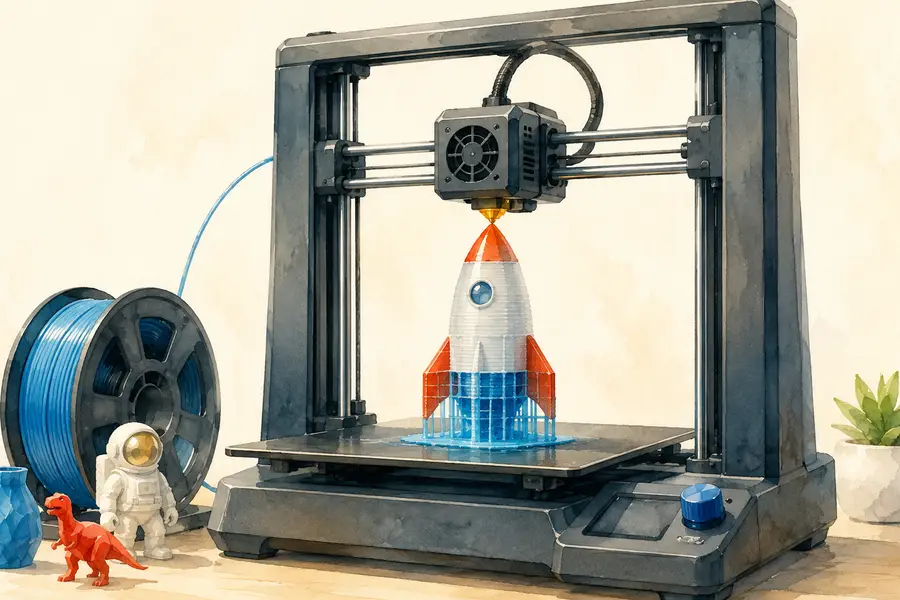
The advanced technology is spreading from consumer desktops to high-end manufacturing, driven by exports, lower prices and AI adoption
By CLS Marketwatch
As the key driver behind additive manufacturing, 3D printing technology has become a transformative force by disrupting traditional production paradigms. Today, however, this industrial-grade technology is rapidly making its way into households. From toys and flowerpots to footwear, users can now produce items on command using simple materials and ready-made models. At the same time, building on a robust manufacturing foundation and supply chain strengths, the 3D printing industry is working its way into China’s high-end manufacturing systems at an unprecedented pace.
3D printing’s wild ride
3D printing is one of the fastest-growing segments of China’s manufacturing sector. In the first half of 2026, the country’s 3D printing equipment output jumped by 48.5% year- on-year, ranking first in terms of growth among all major industrial products.
Meanwhile, China is also filling the global demand gap for 3D printing. The country exported a cumulative 3.62 million 3D printers in the first half of 2026, with export value reaching 9.61 billion yuan ($1.43 billion), up 90.2% and 109.3% year-on-year, respectively, according to official data. Based on the current growth rate, full-year exports are expected to climb to 8 million units this year. In the long term, global revenue from 3D printer sales is expected to hit $115 billion by 2034, growing by an average 18% annually over the next 10 years. Notably, the consumer market is expected to be the key growth driver.
Growth in China’s consumer 3D printer market currently follows two main tracks. Efforts by industry leaders Bambu Lab and Creality (3388.HK) to extend their sales networks, ramp up public outreach, and provide hands-on product demonstrations have greatly raised public awareness and demand for 3D printers. At the same time, “3D printing farms” engaged in mass production are also emerging across China, further expanding application scenarios and demand for consumer-grade products. According to incomplete statistics, China is currently home to several thousand 3D printing farms of varying scale, with a cumulative 300,000 units of equipment installed and growing.
What’s powering the consumer boom?
Three key factors are contributing to the booming demand for consumer-grade 3D printers in China: rapidly falling equipment prices, simplified operation, and a more mature model ecosystem. Among those, falling prices are the most direct driver of the consumer-market boom. Mainstream 3D printing products currently sell for thousands of yuan, or typically less than $1,000, making them cheaper than many smartphones.
As prices have dropped, lower usage barriers have further stimulated the market. In the past, users generally found 3D printing complex and intimidating. Today, deep integration of AI has solved problems involving difficulty of use. Advanced features such as auto- leveling, real-time monitoring, and automated troubleshooting have transformed devices from professional tools requiring manual calibration into plug-and-play smart terminals, effectively removing operational obstacles for ordinary users.
An increasingly rich resource ecosystem has also played a pivotal role in retaining users. The MakerWorld online model community, operated by Bambu Lab, is a case in point. Using heavy subsidies to incentivize creators, the platform has accumulated nearly 3 million model resources and a large base of active creators, with model resources growing at a rate of nearly 100,000 per month. Meanwhile, Creality, is working to incorporate AI-assisted modeling tools that empower users to create their own designs.
Industrial 3D: The patient giant
Compared with the consumer side’s explosive growth, industrial-grade expansion has been more muted. Global shipments of industrial-grade 3D printing equipment rose by 18% year-over-year in the first quarter of 2026, while the Chinese market increased by 29% – both figures far below the consumer-grade equipment sector. But from an application value perspective, the industrial-grade market still commands a larger base and has already started large-scale deployment in certain high-value scenarios.
Indeed, 3D printing offers numerous unique and irreplaceable advantages in modern industrial manufacturing. These include the ability to vastly shorten R&D and delivery cycles; support small-batch customized production without the need for mold tooling; and offer an exceptionally high degree of design freedom, enabling the fabrication of complex structures difficult or impossible to achieve through traditional manufacturing.
As a result, this emerging manufacturing technology is rapidly proliferating across various industries. In the high-tech aerospace sector, critical components such as rocket engine thrust chambers and nozzles are now being mass-produced using 3D printing. Moreover, companies like Farsoon Technologies (688433.SH) are leveraging the unique advantages of 3D printing to helping aerospace firms overcome technical challenges in manufacturing lightweight, complex, and irregularly shaped structural components. Similarly, precision structural parts, including hinges for foldable smartphones, titanium alloy frames for smartwatches, and drone components, as well as liquid-cooling heat dissipation parts in the low-altitude economy sector, are all accelerating their adoption of 3D printing processes.
China’s 3D printing industry has generally established a competitive advantage in the consumer-grade segment, underpinned by supply chain cost efficiencies, intelligent integration, and a thriving content ecosystem. Nevertheless, those scale advantages on the consumer side won’t automatically translate to the same dominant position on the industrial side. While industrial-grade 3D printing has achieved breakthroughs in high-value scenarios such as aerospace, healthcare, and precision manufacturing, further in-depth R&D and refinement are still required in certain areas to achieve a transition to next-generation manufacturing powered by 3D printing.
CLS Marketwatch provides insights and analysis on China’s industries. You can contact the author at liujingyi@cls.cn
To subscribe to Bamboo Works weekly free newsletter, click here
Related Articles

RELATED ARTICLES
-
Creality’s 3D-printing dream faces first post-IPO test
 3388.HK
 - How AI’s growth left consumer electronics facing an uncertain future
- How AI agents are reshaping China’s office ecosystem
- The embodied intelligence puzzle: A deep dive into China’s humanoid robot industry
-
Shareholders greet shape-shifting Impro Precision’s fundraising with skepticism
1286.HK