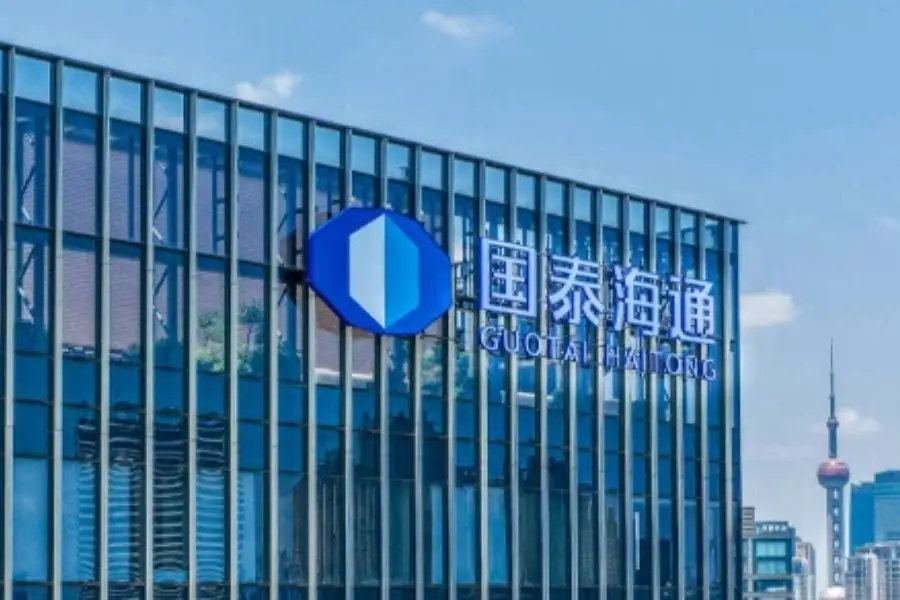
The titan formed through the merger of two large brokerages said its profit surged in the first half of 2026 as it leveraged its massive scale to cultivate high-margin services
Key Takeaways:
- Guotai Haitong said it expects to report its recurring net profit soared as much as 171% in the first half of this year
- The company’s breakout performance shows that mega brokerages formed through a government-led sector consolidation stand to benefit nicely from their super-size
By Warren Yang
State-directed corporate matchmaking often breeds bloated corporate giants that lose out to leaner, more agile rivals, especially when the newly merged entities were already big state-owned companies. Yet under the right conditions, scale alone can be a powerful asset.
That’s certainly the case for Guotai Haitong Securities Co. Ltd. (2611.HK), a mega brokerage born from the merger of Shanghai state-backed peers Guotai Junan and Haitong Securities last year. Last Friday, the company said its net profit likely jumped 27% to 30% year-over-year in the first half of 2026 to as much as 20.5 billion yuan ($2.82 billion).
As remarkable as those numbers look, the company’s underlying business looks even more striking when stripping out a one-off accounting profit boost it booked last year. Excluding such non-recurring gains, primarily massive negative goodwill logged during the integration process last year, Guotai Haitong estimates that its recurring first-half net profit skyrocketed 164% to 171% year-over-year to 19.75 billion yuan. For the second quarter alone, the company expects to post a staggering net profit surge of nearly 300%.
To be sure, favorable market conditions are providing nice tailwinds for the brokerage sector in general. Capital markets in China have rebounded sharply, as domestic equity valuations stabilize and Beijing significantly reopens the onshore IPO pipeline.
But Guotai Haitong also unlocked post-merger synergies to drive revenue generation across high-margin segments like wealth management and investment banking – areas often dominated by larger institutions that can offer better and more diverse services than their boutique counterparts. To maximize those benefits, the company is banking on an integrated approach that bundles investment, underwriting and research services.
For the China Securities Regulatory Commission (CSRC), which is helping to steer the consolidation, Guotai Haitong’s numbers are a timely validation of the broader master plan. Since President Xi Jinping explicitly urged regulators to push for structural industry consolidation, the CSRC has set an ambitious target: cultivating two to three globally competitive, tier-one investment banks by 2035, supported by a tighter, highly professional tier of specialized domestic leaders.
Plagued by fragmentation
Before this campaign began, China’s brokerage sector was chronically fragmented. More than 140 firms, many controlled by local governments or state-owned enterprises (SOEs), routinely undercut each other on basic retail trading commissions, offering nearly identical, commoditized financial services.
The merger that formed Guotai Haitong has opened the floodgates for what has become a full-scale consolidation wave across the sector. In November 2025, elite investment bank China International Capital Corp. (CICC)(3908.HK; 601995.SH) stunned the market by announcing a three-way combination to absorb Dongxing Securities (601198.SH) and Cinda Securities (601059.SH) to create a powerhouse with more than 1 trillion yuan in assets. The massive share-swap transaction was formally accepted for vetting by the Shanghai Stock Exchange in June, and is currently pending final clearance by the CSRC.
The momentum spilled directly into 2026. In March, Soochow Securities (601555.SH) announced a plan to acquire a controlling stake in regional neighbor Donghai Securities to dominate wealthy Jiangsu province. Weeks later, in April, Orient Securities (3958.HK) unveiled a cash-and-stock deal to acquire Shanghai Securities to create another top-10 titan with an estimated 583 billion yuan in total assets.
In most of these cases, the companies being combined are owned by a single entity, which makes the merger easier. Analysts think that when the dust settles, the current sea of 140-plus legacy brokerages will probably be reduced to fewer than 50 highly capitalized institutions. And differentiated, risk-based regulatory paths will separate a small group of elite global players from smaller locally oriented firms.
Quality over quantity
For investors, what matters most at the end of the day is what this structural transformation means for profitability among the remaining brokerages. Historically, Chinese brokerages relied heavily on transaction fees from speculative retail trading, a model that is highly volatile due to variations in activity between bull and bear markets. The model is also inherently un-strategic because everyone basically offers the same product and very similar prices.
To break this dependence, the mega brokerages like Guotai Haitong are shifting toward higher-margin services like wealth management and fund advisory, targeting the vast pool of capital held by China’s aging population.
Simultaneously, they are retooling their investment banking units away from the real estate and traditional manufacturing sector, building end-to-end ecosystems designed specifically to serve Beijing’s priority sectors like advanced semiconductors, AI and clean energy technology.
These newly empowered state champions, armed with fortified balance sheets, are also looking to expand their global presence. Most are using their Hong Kong subsidiaries as primary launchpads to establish wealth management hubs and corporate finance outposts across Southeast Asia, which is home to a large ethnic Chinese population.
Guotai Haitong is set to turbocharge this regional expansion model. Just last month, its board approved a plan to inject 9 billion yuan into its Hong Kong-based primary offshore vehicle, Guotai Junan International. The international unit will use the funds to transform its existing hubs in Hong Kong, Singapore and Vietnam into comprehensive corporate finance and wealth management gateways.
Yet elevating its status to a global investment bank won’t be so easy, as it requires an entirely different corporate DNA than Guotai Haitong currently has. Chinese state-backed brokerages like Guotai Haitong remain tied to institutional structures that prioritize regulatory compliance and national strategic alignment over aggressive financial risk-taking. Reconciling the strict mandates of state-supervised capitalism with the freewheeling, highly competitive realities of global investment banking is an operational challenge that can’t be solved simply by deploying a large amount of capital.
Guotai Haitong shares rallied as much as nearly 7% the day after the positive profit alert, but ended with just a 1% gain. They trade at a lofty price-to-earnings (P/E) ratio of 14, higher than 11 for Citic Securities (6030.HK; 600030.SH), which Guotai Haitong unseated as China’s largest brokerage by assets after its formation through the merger.
Guotai Haitong’s blowout first-half shows that growing big can pay off nicely, especially in a highly insular market where a newly emerging group of titans enjoys strong government support. Investors appear to appreciate that, as its valuation shows.
To subscribe to Bamboo Works weekly free newsletter, click here
Related Articles
RELATED ARTICLES
-
For Futu and UP Fintech, regulatory bombshell may finally clear global path forward
- Brewing consolidation and drilling for growth: China’s coffee and dental sectors face new realities
- Webull charges into high-velocity trading as U.S. removes longstanding restriction
- Rethinking bigger Is better: China’s long march toward higher-capacity energy storage cells
-
Why regulating capital and serving burgers are both getting tougher in China
WEN.US