Londian Wason finds gold, but also financial challenges, in copper foil
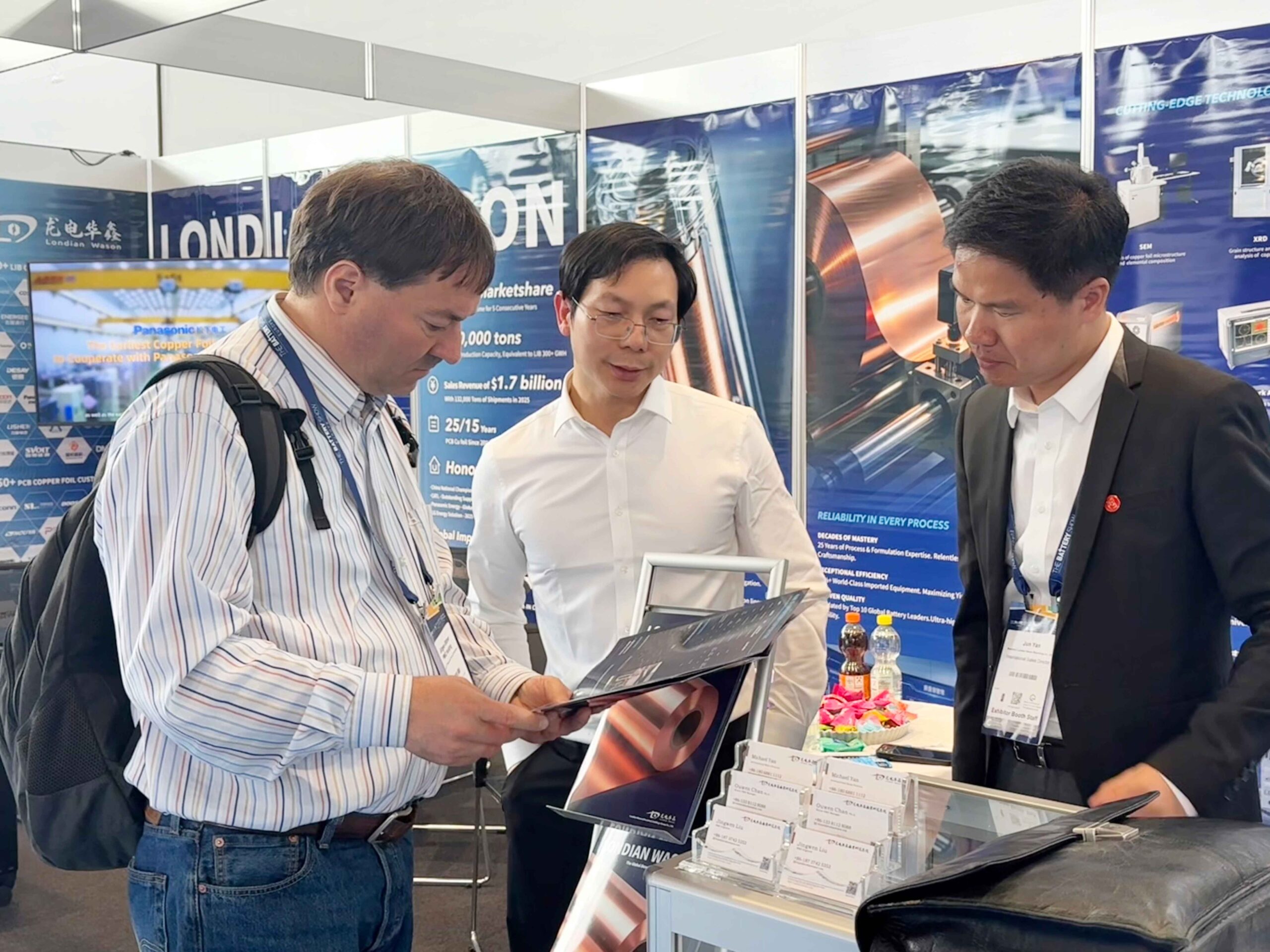
The maker of a key component for new energy batteries has filed for what could become the biggest New York IPO by a Chinese company in more than a year
Key Takeaways:
- Londian Wason could become only the third Chinese company to list on Wall Street this year, following its application for an IPO that could raise around $350 million
- The copper foil maker’s business has gotten off to a strong start this year, after losing money in 2024, as the highly cyclical new energy battery industry rebounds
By Doug Young
When Wang Guanran entered the prestigious George Washington University in Washington, D.C., as a 19-year-old international relations and economics major in 2019, he probably never dreamed he would lead a company preparing for a massive Wall Street IPO just six years later. But then again, maybe he did, given his status as son of a former Chinese securities regulator who later built a business empire making a key material for new energy batteries.
That’s the personal story behind Londian Wason New Energy Tech Inc., a copper foil maker that’s attempting to become only the third Chinese company to list on Wall Street this year, with its application last week for a New York Stock Exchange IPO. Such listings were once common, numbering in the dozens each year. But that’s slowed to a crawl this year, as companies come under pressure from regulators on both sides of the Pacific.
In this case Londian Wason’s Wang family ties are almost certainly a factor behind what’s likely to be a successful New York listing in a difficult environment. Londian Wason is part of an empire built by Wang Guanran’s father, Wang Weidong, who worked at the China Securities Regulatory Commission (CSRC) in the 1990s, before striking out on his own to cobble together a series of companies, some of which lie at the core of Londian Wason.
The Chinese securities regulator must approve all Chinese IPOs in offshore markets, including the U.S. The CSRC has become quite strict about approving U.S. listings lately, partly due to U.S.-China tensions and also in a bid to choke off many of the smaller, low-quality companies that were listing in New York in recent years.
Since Dec. 12 last year, the CSRC has only approved two new Wall Street listings: Londian Wason and used car trading specialist DSC Holdings, which made its Nasdaq trading debut last month after raising about $50 million.
Unlike many of the earlier Chinese listings that typically raised less than $20 million and were underwritten by small, boutique investment banks, first DSC’s and now Londian’s IPO have big names attached. Londian’s counts Cantor Fitzgerald, CMB International and Huatai Securities among its underwriters, all fairly respectable names in the U.S. and China. The company also boasts an A-list of investors from the electric vehicle (EV) battery space, including South Korea’s SK Inc. and Mirae Asset, as well as Chinese auto giant GAC.
Londian Wason’s customer list is also a who’s-who of battery makers, including LG Energy Solution, Panasonic Industrial Materials, SK On, Samsung SDI, CATL and BYD.
Londian Wason didn’t disclose a fundraising target in its prospectus. But Renaissance Capital estimated the listing could raise about $350 million, which would be the biggest IPO since milk tea chain Chagee raised $411 million in its April 2025 Nasdaq listing.
Cyclical business
While Wang Guanjun looks slightly young for such a big job, we should point out this kind of elevation of the next-generation to leadership in a family company is quite common in China. In such cases, a more experienced person usually provides important guidance while the young leader is still learning, and that appears to be the case here. In addition to his chairman’s title, Wang Guanjun, now 26, is also co-CEO, alongside co-CEO Zhou Guangling, 41, who has a financial background and previously served as assistant to the president at Hong Kong-listed Lingbao Gold, another company in the family’s business empire.
Londian Wason looks attractive from a strategic standpoint, since the copper foil it makes is a key component in not only EV batteries, but also batteries used in the booming industry for energy storage systems. What’s more, Londian Wason also gets a smaller but still significant part of its revenue from copper foil used in printed circuit boards (PCBs) that have become a hot area recently due to their use in AI computing products like servers.
The reality is a little more nuanced, however. Londian Wason gets most of its business from a small number of major customers that place big orders, but also have power to demand low prices. The company’s business is also very capital intensive, requiring huge investment to make its copper foil. Lastly, there’s a huge element of cyclicity to the battery industry, which is only now beginning to emerge from a major downturn caused by a rapid buildup of new capacity that led to big oversupply.
The lump sum of all those factors is that Londian Wason got off to a weak start in 2025, before things picked up during the year as both prices and demand improved. The company’s revenue rose by 24% in 2025 to 10.9 billion yuan, and then the figure more than doubled in the first quarter of 2026 to 4.07 billion yuan from 1.91 billion yuan in the year-ago period.
As things improved, its gross margin rose to 10.4% in the first quarter of 2026 from just 3.0% a year earlier. And on its bottom line, the company returned to the black with a 134 million yuan profit in the first quarter of this year, reversing a 68.4 million yuan loss a year earlier.
In addition to industry cyclicity, the company is also weighed down by heavy debt as it constantly spends to maintain its facilities. It had a massive 5.54 billion yuan in short-term debt at the end of last year, and another 4 billion yuan in long-term borrowings. Its heavy spending made the company cash-flow negative on an operating basis in both 2024 and 2025, which is draining its cash reserves. The company even detailed how it recently “suffered from net working capital deficiency that (raised) substantial doubt about our ability to continue as a going concern,” and only recovered after obtaining financial report from a major shareholder.
The bottom line is that this is a well-connected company that is also quite well placed as a leading supplier to the EV and energy storage sectors. But industry cyclicity and price pressure from its customers means it may barely manage to scrape out profits in the best of times, and could come under great strain during industry downcycles.
To subscribe to Bamboo Works weekly free newsletter, click here
Related Articles

RELATED ARTICLES
-
Qingtao Energy reaches solid-state battery milestone, but model remains unproven
-
CATL poised to boost lead over rivals in global battery race
3750.HK300750.SHE
- What listings? Small Chinese firms withdraw their Wall Street IPO applications
- Lithium battery tide powers Tinci Materials toward Hong Kong IPO
- After years on the sidelines, VNET seizes on China’s AI moment with new CATL tie-up